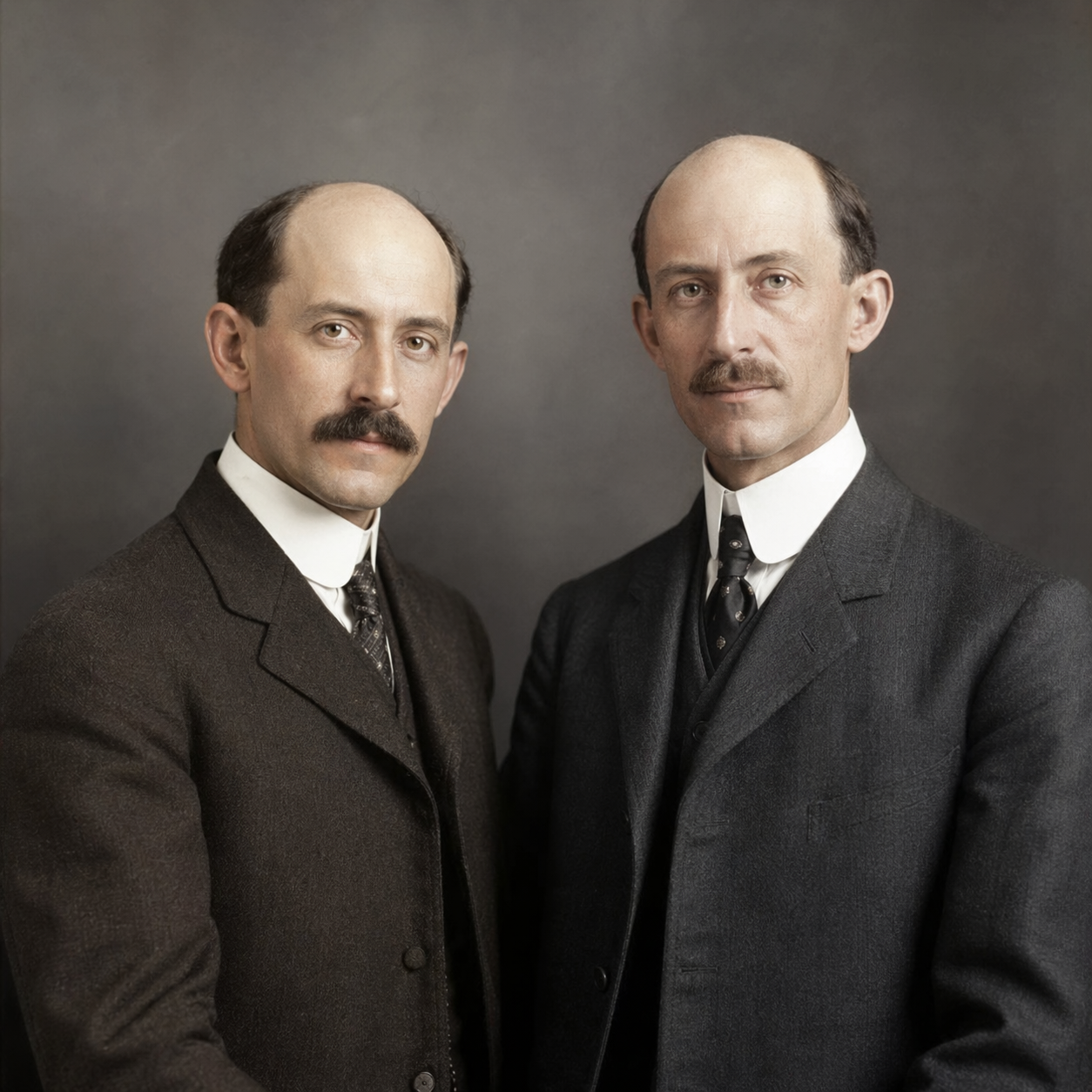
Wright Brothers (Orville & Wilbur) — "I know of only one bird — the parrot — that talks; and it can't fly very high."
I know of only one bird — the parrot — that talks; and it can't fly very high.
I know of only one bird — the parrot — that talks; and it can't fly very high.
Click any product to generate a realistic preview. Up to 3 at a time.
* Initial load can take up to 90 seconds — revising the preview in another color is nearly instant.
"The machine has been working very nicely and we have been making several flights each day."
"The machine is now a commercial success."
"We have not yet fully solved the problem of balance in high winds."
"The greatest value of our work is that it will be an inspiration to others."
"The only bird that could speak told us what it knew, but we didn’t understand its language."
American aviation pioneers who achieved the first sustained powered controlled airplane flight at Kitty Hawk, NC, on December 17, 1903. Closely associated with Octave Chanute (their gliding mentor and aeronautical correspondent). For an intellectual contrast, see Samuel Pierpont Langley, Smithsonian Institution Secretary and government-funded aviation researcher — Langley's Aerodrome crashed twice into the Potomac in October-December 1903 with $50,000 of War Department funding; the Wright Brothers' bicycle-shop empiricism beat Langley's institutional Big Science by 9 days. The most-cited example in engineering history of empirical-tinkerer beating institution-funded credentialism.
Wilbur Wright, when asked to speak at a dinner given in his honor at the Aero Club de la Sarthe. He declined, saying only this one sentence.
Date: 1908
ShockingFound in 1 providers: gemini
1 source checked
Talking a lot and achieving a lot are different skills. People who speak constantly often accomplish little, while those who focus on real work tend to stay quiet. The parrot mimics human speech but remains a clumsy flier, making it a pointed symbol of how verbal performance does not translate into practical capability. Action, not chatter, is what carries you to new heights.
The Wrights were famously taciturn bicycle mechanics from Dayton who let their glider tests and 1903 Kitty Hawk flight speak for them. They avoided reporters, refused flashy demonstrations, and kept their wing-warping research secret while competitors boasted. Wilbur once said the parrot line to deflect a speech request. It captures their workshop ethic: thousands of wind-tunnel measurements and careful engineering beat grand public promises every time.
In the early 1900s, aviation was dominated by loud self-promoters like Samuel Langley, whose government-funded Aerodrome crashed spectacularly into the Potomac days before Kitty Hawk. Newspapers routinely hyped charlatans claiming flight while real progress stalled. The Wrights worked in obscurity in North Carolina's Outer Banks, funded only by bicycle-shop profits. Their skepticism of talkers reflected an era when scientific credibility was being wrested away from showmen and handed to quiet, methodical empirical tinkerers.
AI-generated insights based on extensive research and information for context. Factual errors? Email [email protected].
Your cart is empty