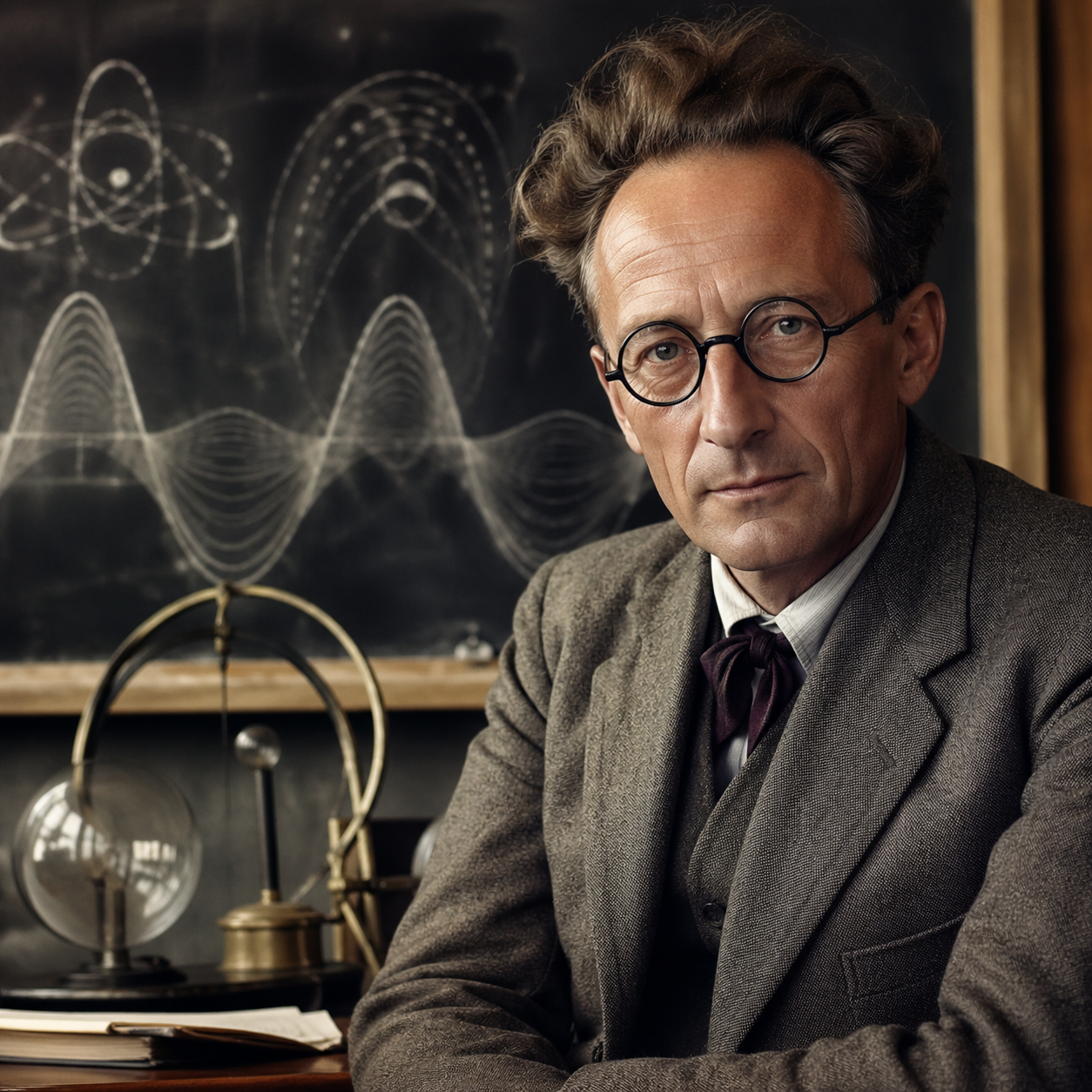
Erwin Schrodinger — "The total number of minds in the universe is one."
The total number of minds in the universe is one.
The total number of minds in the universe is one.
Click any product to generate a realistic preview. Up to 3 at a time.
* Initial load can take up to 90 seconds — revising the preview in another color is nearly instant.
"We are all stardust."
"What we observe as material bodies and forces are nothing but shapes and variations in the structure of space."
"The future of mankind depends on the wisdom of its leaders. And that is a very frightening thought."
"I am born into an environment — I know not whence I came nor whither I go nor who I am."
"The problem of the 'thing in itself' is not a problem that can be solved by science. It is a philosophical problem."
Austrian physicist who shared the 1933 Nobel for the wave equation that bears his name and the famous cat thought-experiment. Closely associated with Werner Heisenberg (matrix-mechanics rival who reached the same physics by different math) and Albert Einstein (his pen-pal on quantum interpretation). For an intellectual contrast, see Niels Bohr, Danish physicist and architect of the Copenhagen interpretation — Schrödinger's cat thought-experiment was specifically designed to ridicule Bohr's 'observer-dependent reality' reading of quantum mechanics — Schrödinger thought the Copenhagen interpretation was absurd; the cat was meant as reductio ad absurdum.
From 'Quantum Questions: Mystical Writings of the World's Great Physicists', a highly controversial and monistic philosophical statement.
Date: 1984 (book published, quote likely from earlier writings)
ShockingFound in 2 providers: gemini,grok
2 sources checked
All conscious minds are ultimately a single unified consciousness, not separate isolated entities. What feels like individual awareness is actually one universal mind experiencing itself through many apparent forms. The sense of being a distinct self is an illusion — beneath the surface, every mind participates in the same fundamental reality, indivisible and whole.
Schrödinger spent decades studying quantum mechanics and its philosophical implications, becoming fascinated by Vedantic philosophy. His 1944 book 'What is Life?' and his essays on consciousness directly explored this idea. He believed physics pointed toward a unified reality, and his wave function formalism — describing particles as probability waves rather than distinct objects — reinforced his view that separateness is fundamentally illusory.
Writing in the mid-20th century, Schrödinger worked amid quantum mechanics' radical dismantling of classical materialism. Physics had revealed that particles lack definite properties until observed, and entanglement suggested non-local connections. Eastern philosophy was also gaining Western scientific attention. This convergence made unified-consciousness ideas credible to serious physicists rather than purely mystical speculation.
AI-generated insights based on extensive research and information for context. Factual errors? Email [email protected].
Your cart is empty