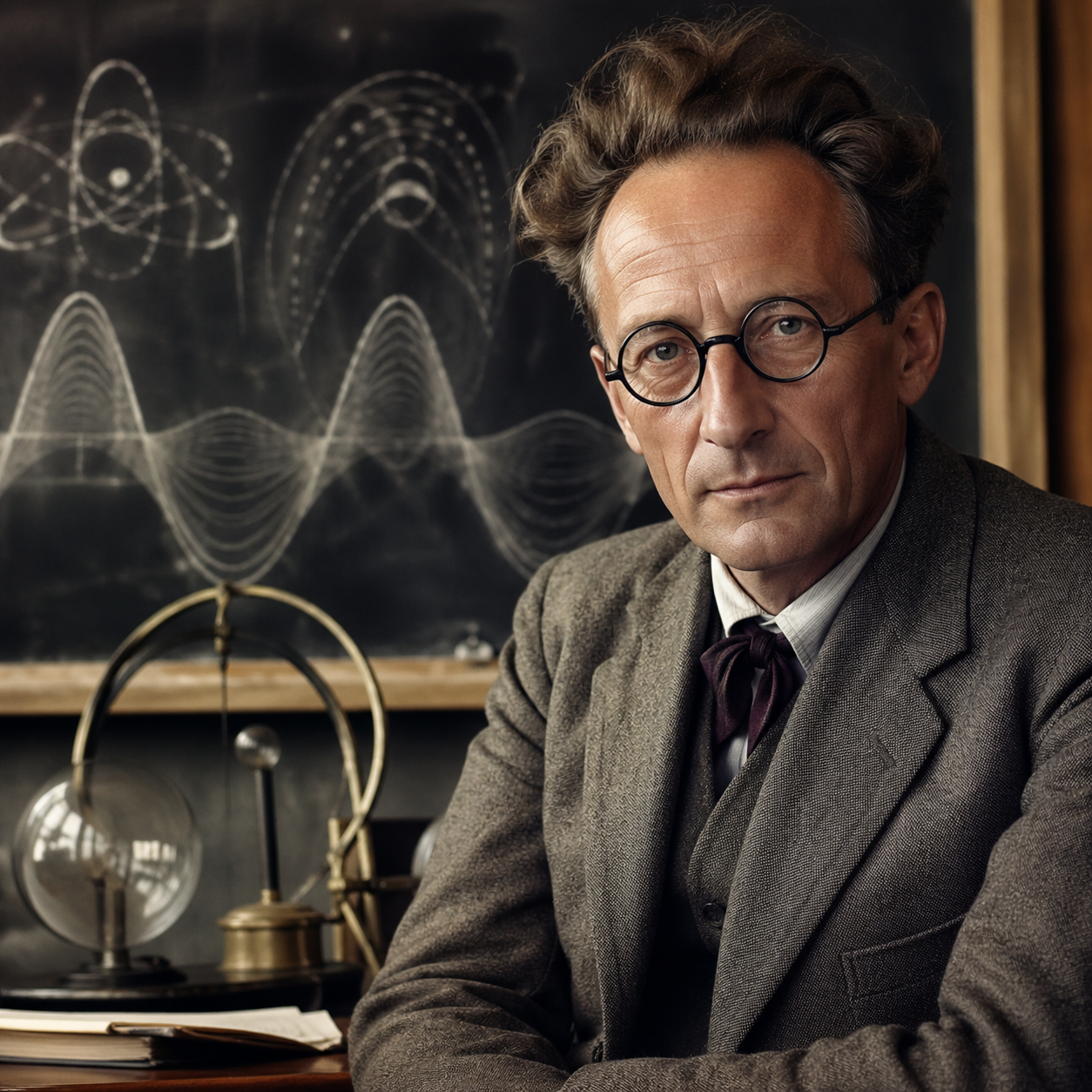
Erwin Schrodinger — "The only way to do great work is to love what you do."
The only way to do great work is to love what you do.
The only way to do great work is to love what you do.
Click any product to generate a realistic preview. Up to 3 at a time.
* Initial load can take up to 90 seconds — revising the preview in another color is nearly instant.
"God's existence or non-existence, and the validity of moral laws, are not matters for scientific inquiry."
"Quantum mechanics is a wonderful theory. But it is not the last word."
"We do not belong to this material world that science constructs for us. We are not in it; we are outside. We are only spectators. The reason why we believe that we are in it, that we belong to the pic…"
"The problem of the 'thing in itself' is not a problem that can be solved by science. It is a philosophical problem."
"The only constant in life is change."
Austrian physicist who shared the 1933 Nobel for the wave equation that bears his name and the famous cat thought-experiment. Closely associated with Werner Heisenberg (matrix-mechanics rival who reached the same physics by different math) and Albert Einstein (his pen-pal on quantum interpretation). For an intellectual contrast, see Niels Bohr, Danish physicist and architect of the Copenhagen interpretation — Schrödinger's cat thought-experiment was specifically designed to ridicule Bohr's 'observer-dependent reality' reading of quantum mechanics — Schrödinger thought the Copenhagen interpretation was absurd; the cat was meant as reductio ad absurdum.
Attributed, a common inspirational quote, not definitively linked to Schrodinger.
Date: Unknown
GeneralFound in 1 providers: grok
1 source checked
Greatness requires more than skill or effort — it demands genuine love for what you're doing. When passion drives your work, you push through obstacles, seek deeper understanding, and invest your full attention. Without that love, work becomes mechanical and mediocre. This cuts through advice about technique or strategy: the real prerequisite for exceptional output is caring deeply, even obsessively, about your craft itself rather than its rewards.
Schrödinger embodied this throughout his career. His 1926 wave equation emerged from months of obsessive, passionate investigation driven by intellectual curiosity, not prestige. He crossed disciplinary boundaries willingly, writing What is Life? to explore biology through physics. Forced into exile by the Nazis, he continued working wherever he landed — Dublin, Oxford, Graz — sustained purely by love of the problems themselves rather than institutional stability or recognition.
The 1920s–1930s marked quantum mechanics' explosive birth, when a small passionate community of European physicists dismantled centuries of classical certainty at gatherings like the Solvay Conferences. Scientists collaborated across borders driven by intellectual love rather than commercial incentive. Simultaneously, political upheaval — fascism's rise, mass displacement, world war — tested whether creative work could survive duress. Those who kept producing, like Schrödinger, validated that intrinsic passion outlasts even catastrophic external circumstances.
AI-generated insights based on extensive research and information for context. Factual errors? Email [email protected].
Your cart is empty