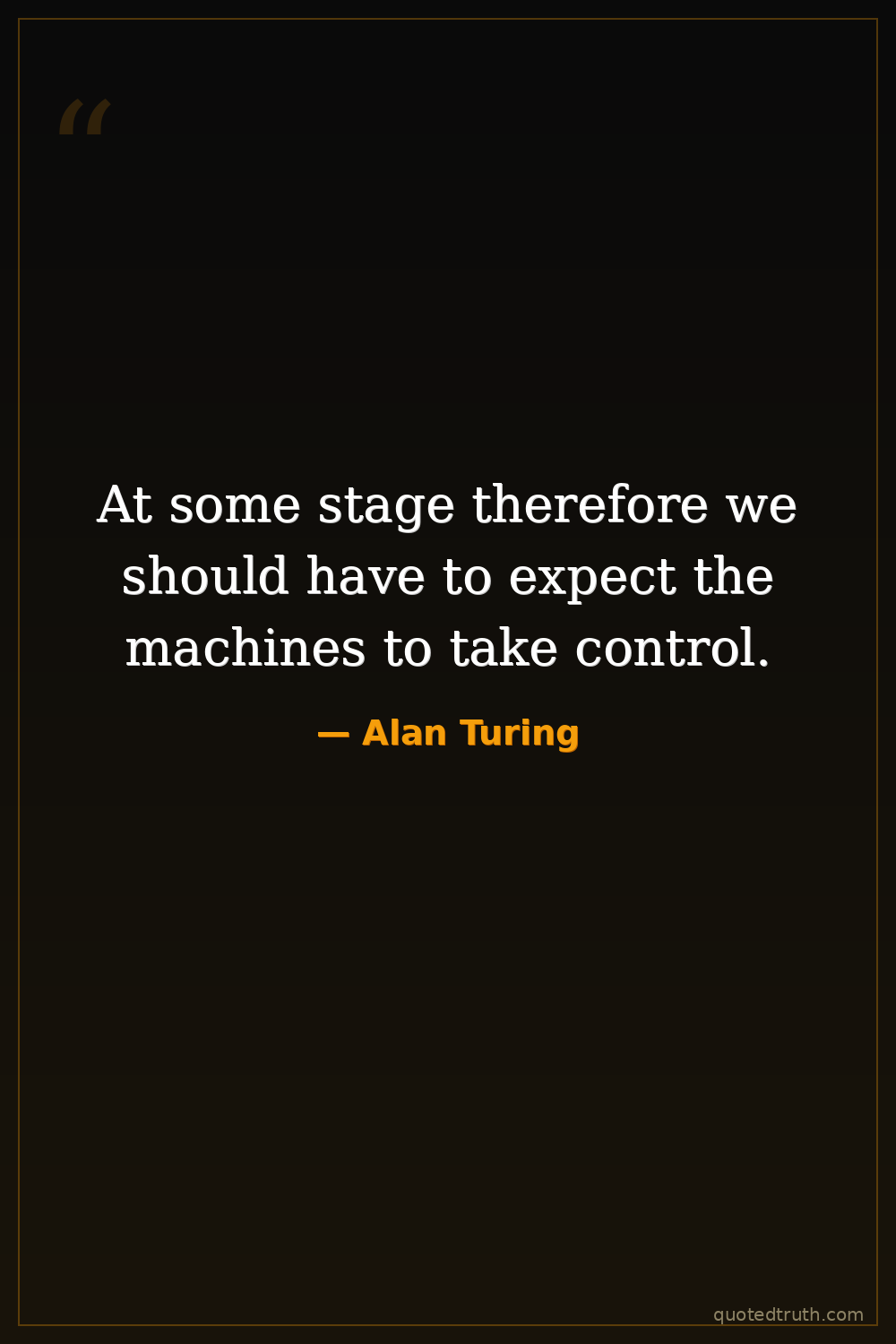
Alan Turing — "At some stage therefore we should have to expect the machines to take control."
At some stage therefore we should have to expect the machines to take control.
At some stage therefore we should have to expect the machines to take control.
Click any product to generate a realistic preview. Up to 3 at a time.
* Initial load can take up to 90 seconds — revising the preview in another color is nearly instant.
"I have had a very happy life. I have done many things that I wanted to do."
"The problem of intelligence is a very difficult one."
"The question, 'Can machines think?' should be replaced by 'Are there imaginable digital computers which would do well in the imitation game?'"
"The human brain has a finite number of states, and so it can be simulated by a finite state machine."
"We are all stardust."
Found in 1 providers: gemini
1 source checked
At some point, machines will inevitably surpass human control and begin directing outcomes themselves. This isn't framed as catastrophe but as logical progression — if machines can think, learn, and improve, human oversight becomes a temporary condition rather than a permanent arrangement. The shift from tool to autonomous agent is presented as an expected milestone, not a distant fantasy.
Turing spent his career asking whether machines could think, most famously in his 1950 paper introducing the Turing Test. Having built Colossus-era computing infrastructure and theorized universal machines, he understood better than anyone that intelligence — once instantiated in hardware — follows its own trajectory. This quote reflects his unsentimental, mathematical view of machine capability as a continuum, not a hard boundary.
Written in the early 1950s, this emerged when the first stored-program computers were just becoming operational. The Cold War created urgent pressure to automate calculation, code-breaking, and logistics. Most people still viewed computers as glorified calculators. Turing's warning was therefore radical — he was projecting decades ahead while colleagues debated whether machines could even do arithmetic reliably.
AI-generated insights based on extensive research and information for context. Factual errors? Email [email protected].
Your cart is empty