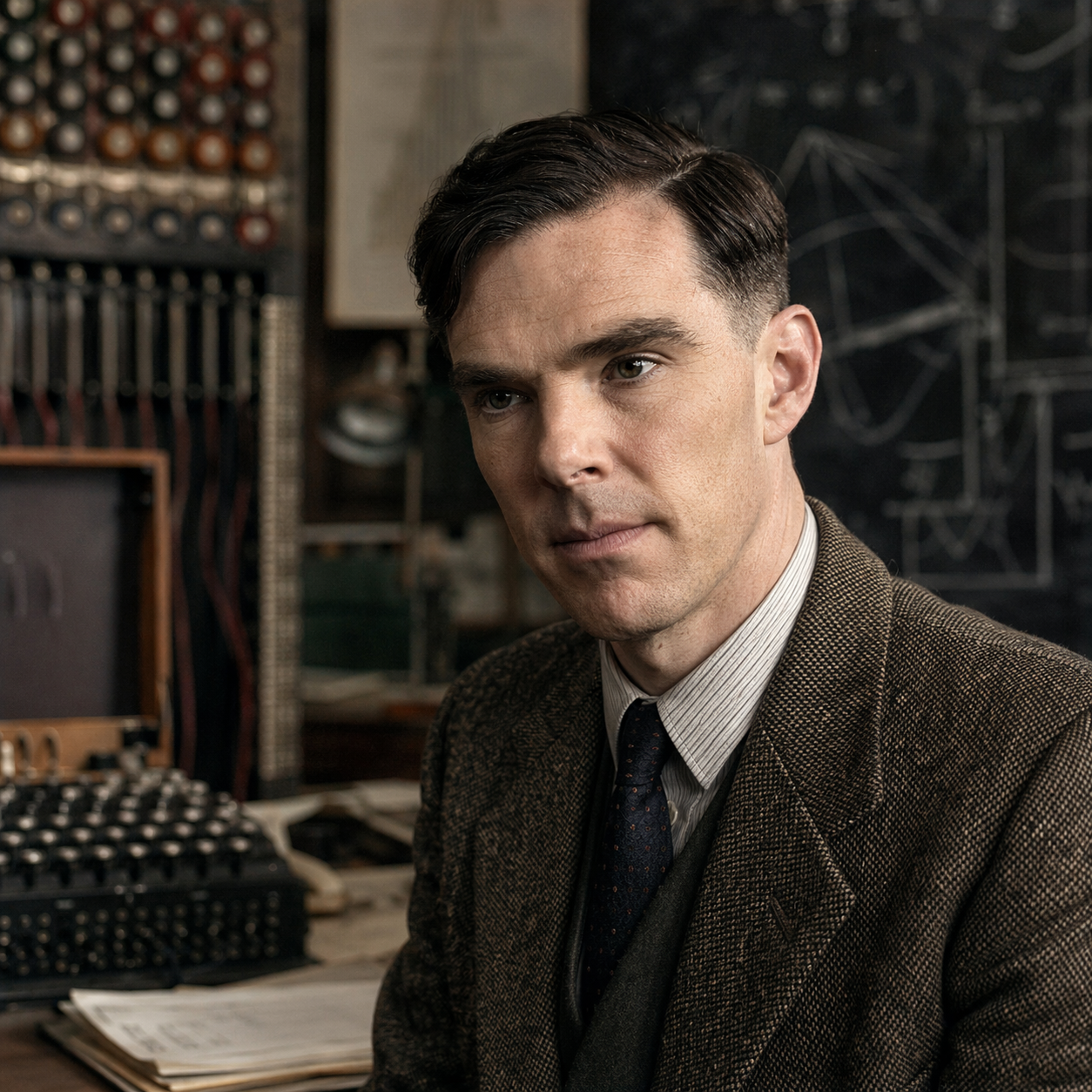
Alan Turing — "I am not interested in whether a machine can think, but in whether it can make m…"
I am not interested in whether a machine can think, but in whether it can make me think.
I am not interested in whether a machine can think, but in whether it can make me think.
Click any product to generate a realistic preview. Up to 3 at a time.
* Initial load can take up to 90 seconds — revising the preview in another color is nearly instant.
"The new form of the problem can be described in terms of a game which we call the 'imitation game.' It is played with three people, a man (A), a woman (B), and an interrogator (C) who may be of either…"
"A computer is a universal machine, capable of carrying out any calculation that can be performed by a human."
"The greatest obstacle to discovery is not ignorance, but the illusion of knowledge."
"The future of humanity depends on the development of artificial intelligence."
"I expect to lie in the sun, talk French and modern Greek, and make love, though the sex and nationality... has yet to be decided: in fact it is quite possible that this item will be altogether omitted…"
Found in 1 providers: grok
1 source checked
The value of intelligence — artificial or otherwise — lies not in the process itself but in the effect it has on others. A thinking machine matters only if it provokes deeper questions, insights, or ideas in the human interacting with it. Utility is measured by intellectual stimulation produced, not by internal mechanism or capability alone.
Turing spent his career asking whether machines could replicate human thought, most famously through the Turing Test. Yet his deeper drive was always human understanding — cracking Enigma to save lives, building theoretical foundations others would think through for decades. He cared about what computation revealed about minds, not computation as an end.
In the 1940s–50s, computing emerged from wartime necessity into peacetime possibility. Society debated whether machines were tools or something more. Turing worked when 'computer' still meant a person doing arithmetic. His era demanded justification for expensive, room-sized machines — their worth measured entirely by what problems they helped humans solve.
AI-generated insights based on extensive research and information for context. Factual errors? Email [email protected].
Your cart is empty