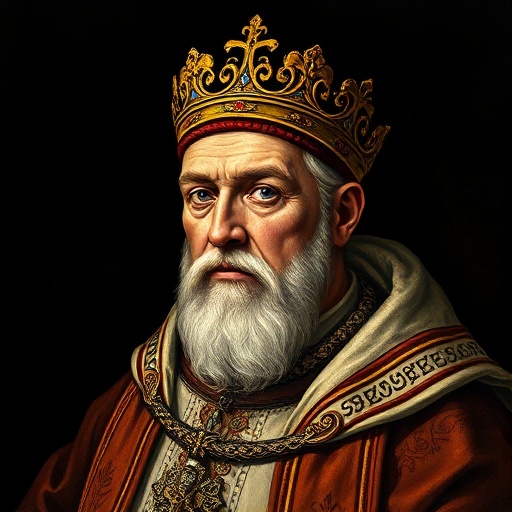
Pope Urban II — "Let those who have been accustomed to make private war against the faithful carr…"
Let those who have been accustomed to make private war against the faithful carry on an approved war against the infidels.
Let those who have been accustomed to make private war against the faithful carry on an approved war against the infidels.
Click any product to generate a realistic preview. Up to 3 at a time.
* Initial load can take up to 90 seconds — revising the preview in another color is nearly instant.
"Gird yourselves, everyone of you, I say, and be valiant sons; for it is better for you to die in battle than to behold, the sorrows of your race and of your holy places. Let neither property nor the a…"
"We absolve all who undertake this journey from all penance for their sins."
"Let no one, on account of his possessions, hesitate to set out."
"When you have decided to go, you must publicly make your vow and dedicate yourselves to God."
"But if you are hindered by love of children, parents and wives, remember what the Lord says in the Gospel, 'He that loveth father or mother more than me, is not worthy of me.'"
Pope (1088-1099) whose Council of Clermont speech (November 1095) launched the First Crusade — the founding event of nine centuries of Christian-Muslim military conflict. Closely associated with Pope Gregory VII (his predecessor on papal-imperial reform). For an intellectual contrast, see Saladin, Kurdish-Muslim Sultan of Egypt and Syria (1138-1193) — Saladin recaptured Jerusalem in 1187, undoing the First Crusade Urban II launched 92 years earlier. Saladin's chivalrous treatment of Christian prisoners became the canonical Muslim counter-image to Crusader brutality. The cleanest before/after pairing of the Crusades' moral arc.
Found in 1 providers: grok
1 source checked
Redirecting violence toward a sanctioned target. European knights constantly waged private feudal wars against fellow Christians — neighbors, lords, peasants. This quote says stop fighting your own people and instead direct that aggression outward against Muslims holding Jerusalem. It transforms destructive internal conflict into a Church-approved holy mission. The logic is coldly pragmatic: warriors exist and love fighting, so give them an approved enemy rather than letting them tear Christendom apart from within.
Urban II was a French nobleman turned Cluniac monk who championed the Peace of God movement — Church efforts to limit feudal violence against civilians. He understood the warrior class from birth. At Clermont in 1095, he addressed battle-hardened knights who understood war as identity. His rhetorical genius was working with that violence rather than against it, redirecting martial instincts toward recovering Jerusalem while cementing papal authority as the supreme power over Christendom.
In 1095 Europe, feudal lords waged constant wars against neighbors, seizing lands and terrorizing peasants. Church-led Peace of God and Truce of God initiatives had largely failed. Simultaneously, Seljuk Turks had captured Jerusalem and were threatening Constantinople — Emperor Alexios I begged Rome for military help. Urban recognized an opening: unify Europe's fractious warriors under papal leadership, relieve Byzantium from Turkish pressure, and reclaim the holy city in one divinely sanctioned campaign.
AI-generated insights based on extensive research and information for context. Factual errors? Email [email protected].
Your cart is empty