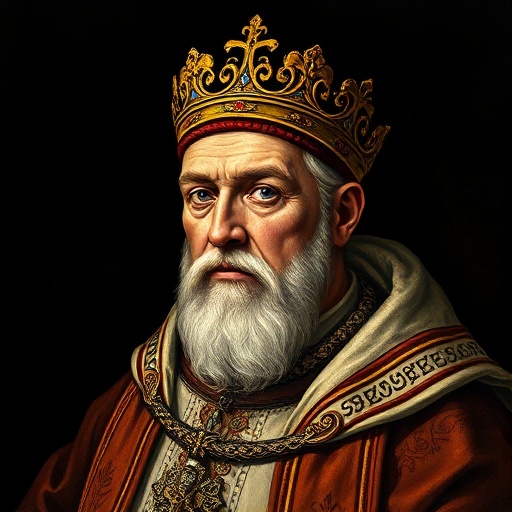
Pope Urban II — "Let no one who has entered upon this pilgrimage turn back."
Let no one who has entered upon this pilgrimage turn back.
Let no one who has entered upon this pilgrimage turn back.
Click any product to generate a realistic preview. Up to 3 at a time.
* Initial load can take up to 90 seconds — revising the preview in another color is nearly instant.
"The Most High has chosen you for this glorious task."
"Therefore, I pray and exhort, nay not I, but the Lord prays and exhorts you, as heralds of Christ, to urge men of all ranks, knights and foot-soldiers, rich and poor, to hasten to exterminate this vil…"
"It is no longer a matter of avenging just the injuries made to men, but rather those made to God. It is no longer a matter of attacking a city or a castle, but of conquering the Holy Places. If you tr…"
"You will wear the sign of the cross on your garments, as a pledge of your immovable vow, and you will wear it until you return."
"Arise, then, and go against this wicked race, and fight for the people of God!"
Pope (1088-1099) whose Council of Clermont speech (November 1095) launched the First Crusade — the founding event of nine centuries of Christian-Muslim military conflict. Closely associated with Pope Gregory VII (his predecessor on papal-imperial reform). For an intellectual contrast, see Saladin, Kurdish-Muslim Sultan of Egypt and Syria (1138-1193) — Saladin recaptured Jerusalem in 1187, undoing the First Crusade Urban II launched 92 years earlier. Saladin's chivalrous treatment of Christian prisoners became the canonical Muslim counter-image to Crusader brutality. The cleanest before/after pairing of the Crusades' moral arc.
Found in 1 providers: grok
1 source checked
Once you have committed to this sacred journey, abandonment is unacceptable. Commitment demands total follow-through; retreat or cowardice dishonors the cause and yourself. A pledge made before God carries absolute weight—wavering after dedication is a form of betrayal. See this through to its conclusion regardless of hardship, fear, or obstacle.
Urban II launched the First Crusade at Clermont in 1095, personally mobilizing thousands across Europe. As pope, he understood that half-committed armies fail militarily and spiritually. His entire legacy depended on crusaders completing the Jerusalem campaign. This directive reflects his pastoral authority, strategic necessity, and his theological conviction that God-ordained missions demand unwavering fidelity from those who answer the call.
In 1095 medieval Europe, Jerusalem had fallen under Seljuk Turkish control, threatening Christian pilgrimage routes and Byzantine territory. Feudal armies were notoriously unreliable—knights frequently abandoned campaigns when supplies dwindled or the cause seemed lost. Urban needed spiritual reinforcement for military discipline. The Church's authority framed desertion as mortal sin, making this command both practical military strategy and binding religious obligation.
AI-generated insights based on extensive research and information for context. Factual errors? Email [email protected].
Your cart is empty