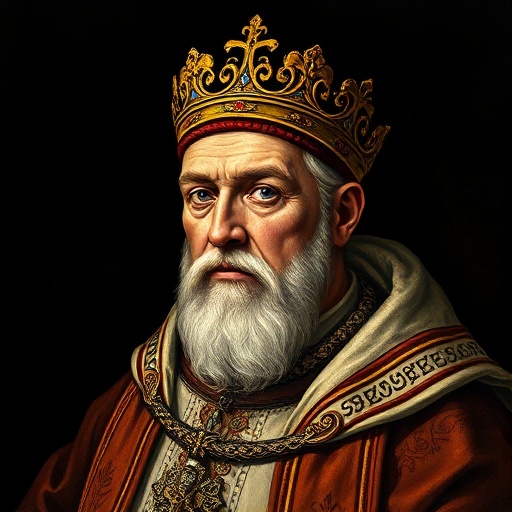
Pope Urban II — "The royal city, situated at the center of the world, is now held captive by His …"
The royal city, situated at the center of the world, is now held captive by His enemies, and is enslaved by peoples who do not know God.
The royal city, situated at the center of the world, is now held captive by His enemies, and is enslaved by peoples who do not know God.
Click any product to generate a realistic preview. Up to 3 at a time.
* Initial load can take up to 90 seconds — revising the preview in another color is nearly instant.
"Let our lives be stronger than death to fight against the enemies of the Christian people."
"Whoever shall set out on this journey out of devotion alone, and not for gain or honor, shall be absolved from all sin."
"You are called shepherds; see that you do not act as hirelings. But be true shepherds, with your crooks always in your hands. Do not go to sleep, but guard on all sides the flock committed to you. For…"
"The kingdom of the Greeks is now dismembered by them and deprived of territory so vast in extent that it can not be traversed in a march of two months. On whom therefore is the labor of avenging these…"
"The land which you inhabit is too narrow for your large population; it scarcely furnishes food enough for its cultivators. Hence it is that you murder and devour one another."
Pope (1088-1099) whose Council of Clermont speech (November 1095) launched the First Crusade — the founding event of nine centuries of Christian-Muslim military conflict. Closely associated with Pope Gregory VII (his predecessor on papal-imperial reform). For an intellectual contrast, see Saladin, Kurdish-Muslim Sultan of Egypt and Syria (1138-1193) — Saladin recaptured Jerusalem in 1187, undoing the First Crusade Urban II launched 92 years earlier. Saladin's chivalrous treatment of Christian prisoners became the canonical Muslim counter-image to Crusader brutality. The cleanest before/after pairing of the Crusades' moral arc.
Found in 1 providers: grok
1 source checked
Jerusalem — the 'royal city' — is occupied by non-Christian rulers who, from Urban's perspective, are enemies of God. The quote frames control of the holy city not as a political dispute but a cosmic injustice: the sacred center of the Christian world enslaved by the faithless. Urban is saying our holiest place is in the hands of people who reject our God, and that situation is spiritually intolerable and demands action.
Urban II spent his papacy centralizing Church authority and defending Christendom from internal schism and external threat. A Benedictine monk turned pope, he believed Rome bore responsibility for all Christian civilization. This quote mirrors his life's work: Jerusalem's fall was not merely military but a spiritual failure demanding spiritual leadership. His Council of Clermont speech in 1095, from which this comes, was the defining act of his pontificate — mobilizing feudal Europe as one unified Christian army.
In 1095, Seljuk Turks controlled Jerusalem and had crushed Byzantine forces at Manzikert in 1071. Emperor Alexios I had appealed to Rome for aid. Medieval Christian cartography literally placed Jerusalem at the earth's geographic center. Augustine's just war theology provided doctrinal cover for holy violence. Europe's feudal knights, restricted by the Peace of God movement from fighting each other, desperately needed an outlet. Urban's framing of Jerusalem's 'captivity' fused theology, geopolitics, and martial culture into the crusading movement.
AI-generated insights based on extensive research and information for context. Factual errors? Email [email protected].
Your cart is empty