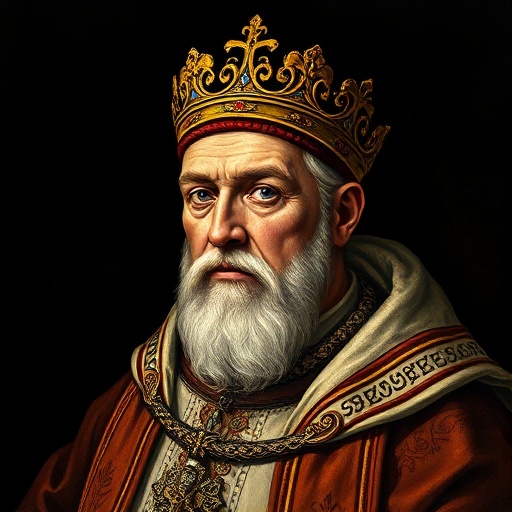
Pope Urban II — "We desire that you should know that the Lord is with you."
We desire that you should know that the Lord is with you.
We desire that you should know that the Lord is with you.
Click any product to generate a realistic preview. Up to 3 at a time.
* Initial load can take up to 90 seconds — revising the preview in another color is nearly instant.
"We desire that you, with all the faithful, should hasten to the aid of the Christians, and strive to deliver them from the hands of the pagans."
"Christian blood, redeemed by the blood of Christ, has been shed, and Christian flesh, akin to the flesh of Christ, has been subjected to unspeakable degradation and servitude."
"We, by the authority of Almighty God and of the blessed apostles Peter and Paul, grant to all who undertake this expedition remission of sins."
"Whoever shall set out on this journey out of devotion alone, and not for gain or honor, shall be absolved from all sin."
"For if He, shall find worms, that is, sins, In them, because you have been negligent in your duty, He will command them as worthless to be thrown into the abyss of unclean things."
Pope (1088-1099) whose Council of Clermont speech (November 1095) launched the First Crusade — the founding event of nine centuries of Christian-Muslim military conflict. Closely associated with Pope Gregory VII (his predecessor on papal-imperial reform). For an intellectual contrast, see Saladin, Kurdish-Muslim Sultan of Egypt and Syria (1138-1193) — Saladin recaptured Jerusalem in 1187, undoing the First Crusade Urban II launched 92 years earlier. Saladin's chivalrous treatment of Christian prisoners became the canonical Muslim counter-image to Crusader brutality. The cleanest before/after pairing of the Crusades' moral arc.
Found in 1 providers: grok
1 source checked
A direct assertion of divine presence and favor directed at an audience. The speaker claims God actively accompanies and supports the people being addressed, offering reassurance and moral validation for their actions or purpose. It functions as both comfort and authorization — implying that whatever they undertake carries sacred endorsement and that they need not fear because celestial power stands beside them.
Urban II delivered this type of declaration at Clermont in 1095 when launching the First Crusade. As pope, his authority rested on being Christ's earthly representative, so asserting divine presence was his core pastoral function. His entire crusade project depended on convincing warriors that God willed their campaign — this phrase encapsulates the theological legitimacy he needed to mobilize Christian Europe toward Jerusalem.
In 1095 medieval Europe, the papacy was consolidating authority after the Investiture Controversy. Jerusalem had fallen to Seljuk Turks, and Byzantine Emperor Alexios I requested Western aid. Crusading theology framed holy war as penitential pilgrimage. Clergy wielded enormous influence over collective action, and papal proclamations carried the weight of divine command for populations whose worldview was entirely shaped by Christian cosmology.
AI-generated insights based on extensive research and information for context. Factual errors? Email [email protected].
Your cart is empty