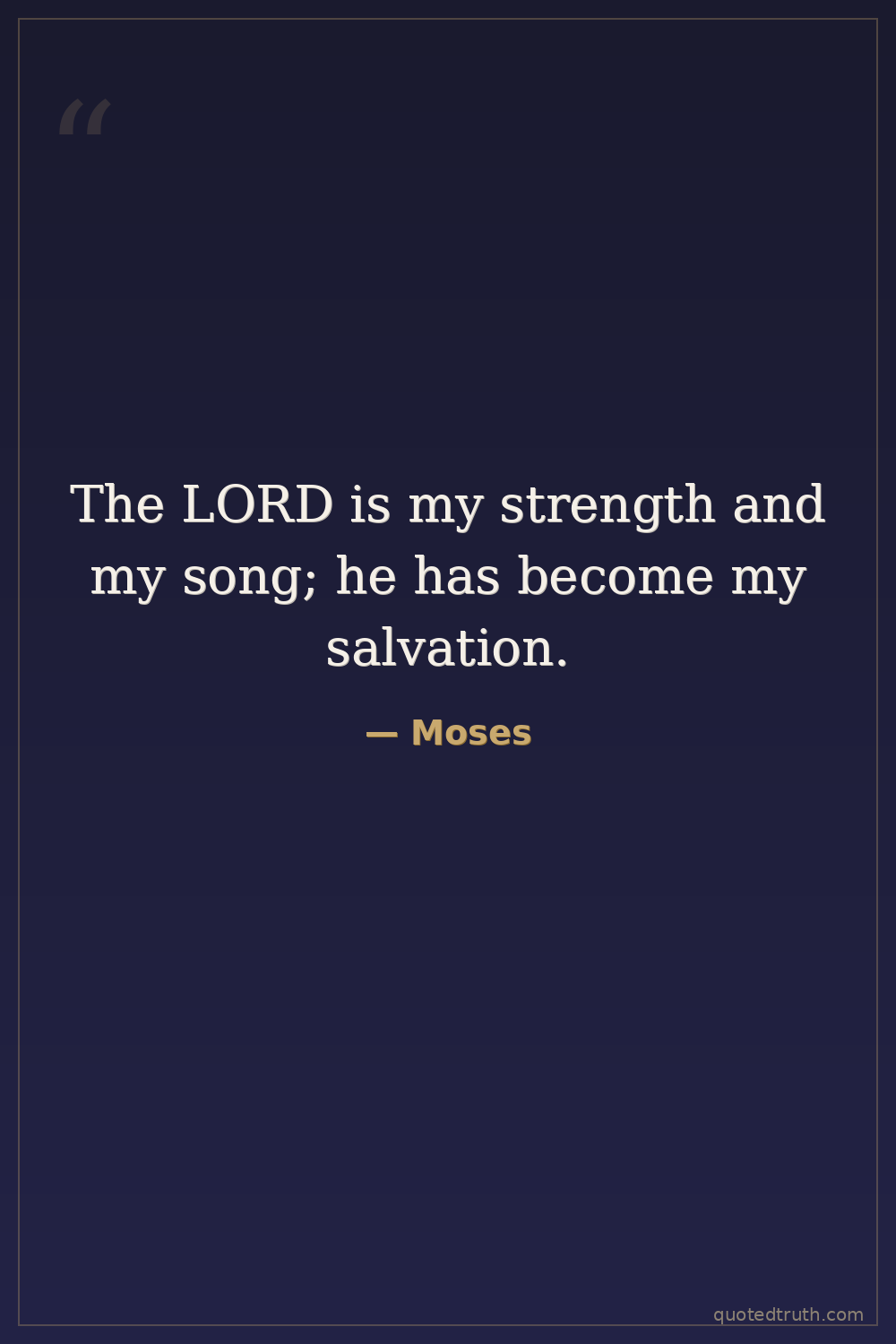
Moses — "The LORD is my strength and my song; he has become my salvation."
The LORD is my strength and my song; he has become my salvation.
The LORD is my strength and my song; he has become my salvation.
Click any product to generate a realistic preview. Up to 3 at a time.
* Initial load can take up to 90 seconds — revising the preview in another color is nearly instant.
"You turn people back to dust, saying, 'Return to dust, you mortals.'"
"Hear, O Israel: The Lord our God, the Lord is one."
"Thou shalt not suffer a witch to live."
"But as truly as I live, all the earth shall be filled with the glory of the Lord."
"Teach us to number our days, that we may gain a heart of wisdom."
From the Song of the Sea, sung by Moses and the Israelites (Exodus 15:2).
Date: c. 13th Century BCE (Traditional)
PhilosophicalFound in 1 providers: gemini
1 source checked
This line is a burst of gratitude and relief. The speaker says God is the source of the power keeping him going, the reason he has something joyful to sing about, and the one who rescued him from disaster. Strength, music, and salvation collapse into a single idea: survival was not self-made. Everything that should have destroyed him did not, and he credits that outcome entirely to a higher power he trusts.
Moses says this in Exodus 15 right after leading the Hebrews through the parted Red Sea while Pharaoh's army drowns behind them. As the prophet who confronted Pharaoh, received the Ten Commandments, and guided a freed slave population for forty years, Moses repeatedly framed victories as divine acts, not personal achievements. The line fits his core conviction that deliverance, law, and national identity all flowed from God rather than from his own leadership or military force.
In the Late Bronze Age, roughly the 13th century BCE, Egypt was the dominant military power and its pharaohs were considered gods. Surrounding peoples worshipped many deities tied to rivers, storms, and armies. A freed slave population crediting one invisible God with defeating Pharaoh's chariots was a radical theological claim. Victory songs were standard in that world, but they normally praised kings; redirecting the credit to a single deity helped forge the early Israelite identity.
AI-generated insights based on extensive research and information for context. Factual errors? Email [email protected].
Your cart is empty