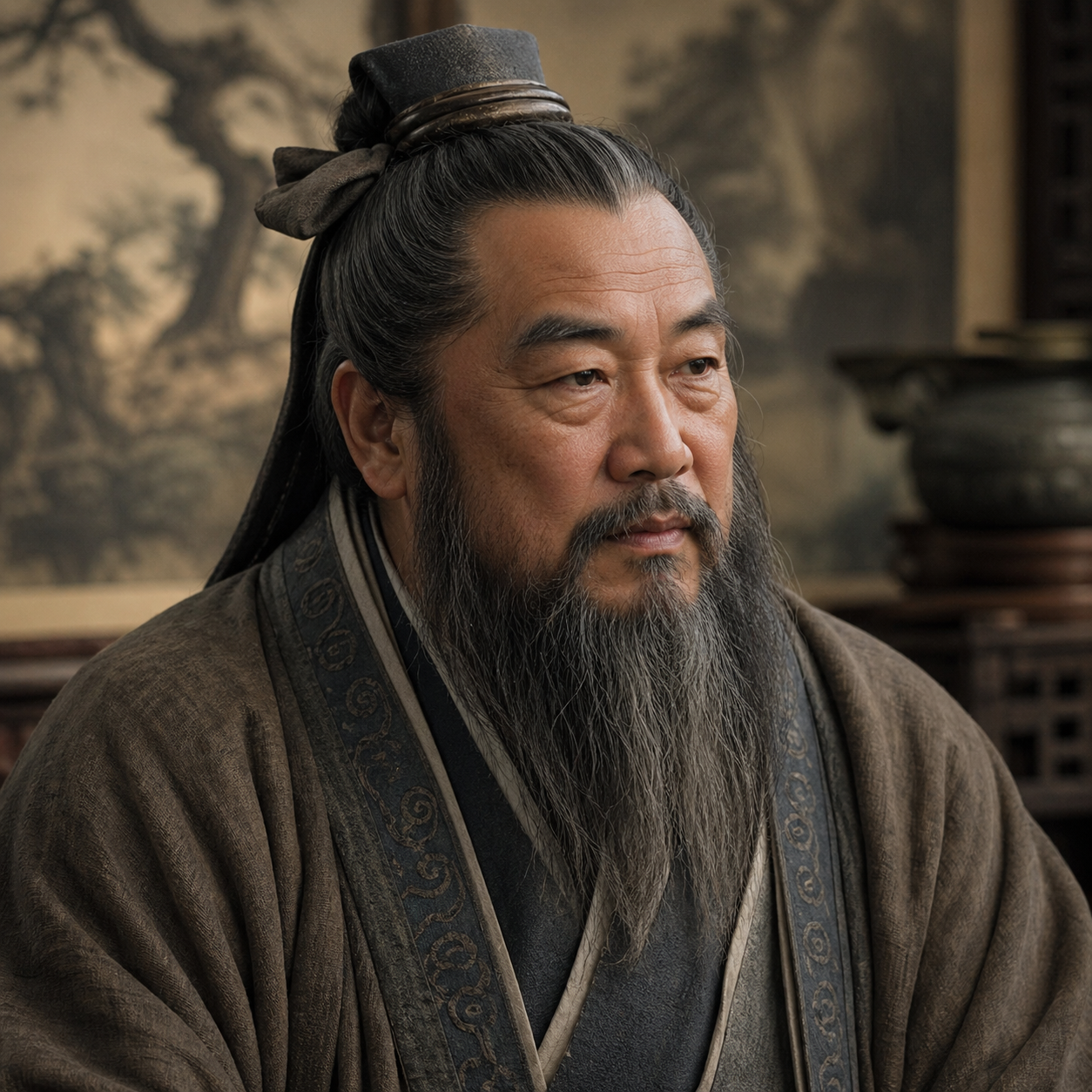
Confucius — "Life is really simple, but we insist on making it complicated."
Life is really simple, but we insist on making it complicated.
Life is really simple, but we insist on making it complicated.
Click any product to generate a realistic preview. Up to 3 at a time.
* Initial load can take up to 90 seconds — revising the preview in another color is nearly instant.
"I have never seen anyone who loved virtue as much as they loved sex."
"The gentleman seeks to be slow in speech and earnest in action."
"The Master said, 'A man may be able to recite the three hundred odes, but if, when entrusted with a governmental charge, he knows not how to act, or if, when sent to any quarter on a mission, he canno…"
"When you know a thing, to hold that you know it; and when you do not know a thing, to allow that you do not know it—this is knowledge."
"The Master said, 'When I walk along with two others, they may serve me as my teachers. I will select their good qualities and follow them, their bad qualities and avoid them.'"
Chinese philosopher and teacher whose teachings (compiled by his students in the Analects) became the foundational ethical framework of East Asian civilization for 2,500 years. Closely associated with Mencius (his most-influential follower a century later). For an intellectual contrast, see Laozi, near-contemporary Chinese sage and Tao Te Ching author — Confucius systematized social order through ritual and family hierarchy; Laozi's Taoist effortless-action philosophy argued such systems were the disease, not the cure. The two founding poles of Chinese moral philosophy — every East Asian moral tradition since has positioned itself between them.
The standard scholarly entry points to Confucius's work: Philip J. Ivanhoe (Georgetown, Chinese philosophy) — Confucian Moral Self Cultivation (2000); Edward Slingerland (UBC, Asian Studies) — Effortless Action: Wu-wei as Conceptual Metaphor (2003); Tu Weiming (Harvard, Confucian scholar) — Confucian Thought: Selfhood as Creative Transformation (1985). These are the works graduate seminars cite when teaching Confucius.
Found in 1 providers: gemini
1 source checked
Existence itself offers straightforward paths: eat when hungry, rest when tired, treat others well, do honest work. Yet people pile on worry, overthink decisions, chase status, hold grudges, and construct elaborate problems where none need exist. The saying points out that complication is usually self-inflicted, a product of our restless minds rather than reality itself. Strip away the noise and life becomes manageable again.
Confucius spent his life teaching that virtue comes from mastering basic human relationships and daily conduct, not esoteric knowledge. He emphasized ren (humaneness), filial piety, and sincerity, insisting moral clarity was accessible to anyone willing to practice it. Frustrated by courtiers who dressed up self-interest in ritual and rhetoric, he returned repeatedly to plain duties, making this observation about needless complication fully consistent with his teaching style.
Confucius lived during the Spring and Autumn period (551-479 BCE), when the Zhou dynasty was fragmenting into warring states and old ritual order was collapsing. Rulers schemed, alliances shifted, and scholars devised increasingly elaborate political doctrines to justify power. Ordinary people suffered under taxation, conscription, and factional violence. Against this backdrop of manufactured complexity and moral drift, Confucius urged a return to simple, reliable virtues as the foundation for restoring social harmony.
AI-generated insights based on extensive research and information for context. Factual errors? Email [email protected].
Your cart is empty