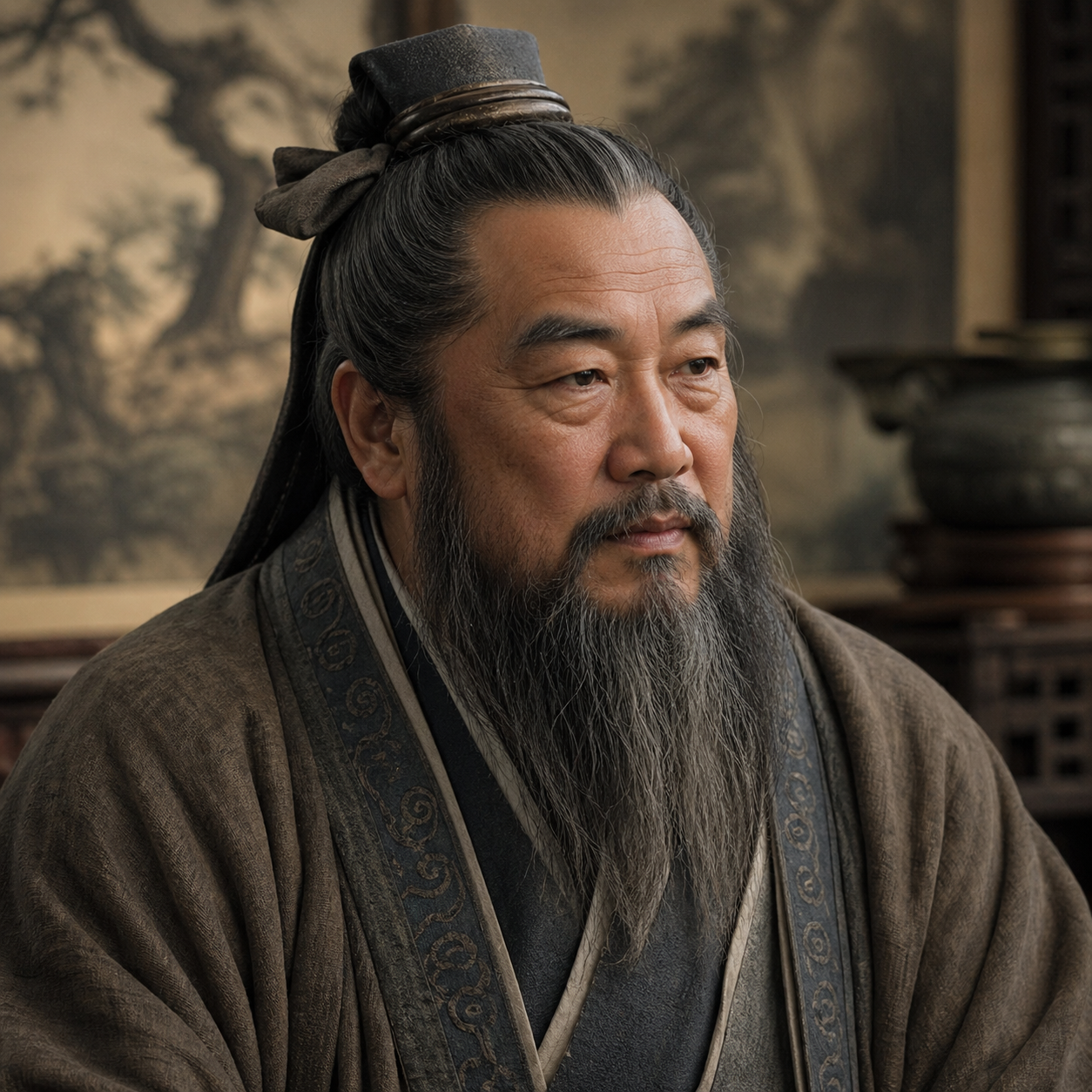
Confucius — "The superior man has a proper pride, but is not proud."
The superior man has a proper pride, but is not proud.
The superior man has a proper pride, but is not proud.
Click any product to generate a realistic preview. Up to 3 at a time.
* Initial load can take up to 90 seconds — revising the preview in another color is nearly instant.
"A journey of a thousand miles begins with a single step."
"The superior man, in the world, does not set his mind either for anything, or against anything; what is right he will follow."
"The superior man is universally benevolent, but not clannish."
"When the wind blows, the grass bends."
"Humanity is more important for people than water or fire. I have seen people walk through water and fire and die. I have never seen someone tread the path of humanity and perish."
Chinese philosopher and teacher whose teachings (compiled by his students in the Analects) became the foundational ethical framework of East Asian civilization for 2,500 years. Closely associated with Mencius (his most-influential follower a century later). For an intellectual contrast, see Laozi, near-contemporary Chinese sage and Tao Te Ching author — Confucius systematized social order through ritual and family hierarchy; Laozi's Taoist effortless-action philosophy argued such systems were the disease, not the cure. The two founding poles of Chinese moral philosophy — every East Asian moral tradition since has positioned itself between them.
The standard scholarly entry points to Confucius's work: Philip J. Ivanhoe (Georgetown, Chinese philosophy) — Confucian Moral Self Cultivation (2000); Edward Slingerland (UBC, Asian Studies) — Effortless Action: Wu-wei as Conceptual Metaphor (2003); Tu Weiming (Harvard, Confucian scholar) — Confucian Thought: Selfhood as Creative Transformation (1985). These are the works graduate seminars cite when teaching Confucius.
Found in 1 providers: grok
1 source checked
A person of genuine worth carries quiet self-respect rooted in their character and integrity, but never puffs themselves up, boasts, or looks down on others. There is a clear line between healthy dignity, which is steady and inward, and arrogance, which demands recognition and belittles people. True confidence does not need to announce itself, while pride that seeks applause reveals insecurity rather than strength.
Confucius spent his life trying to shape the junzi, or superior person, defined by ren (humaneness) and li (ritual propriety). Passed over for high office and often rebuffed by rulers, he modeled composed self-worth without bitterness. He taught that virtue is cultivated inwardly, not displayed, and repeatedly warned students against flattery, self-promotion, and hollow status-seeking. This saying captures the dignified humility he embodied while wandering between states seeking a ruler who would listen.
Confucius lived during the late Spring and Autumn period (551–479 BCE), when the Zhou dynasty's authority had collapsed and rival states warred for supremacy. Aristocrats jockeyed for rank, ministers schemed, and ostentatious displays of wealth and power were common as old ritual order crumbled. Against this backdrop of status anxiety and moral decay, Confucius urged a return to inner cultivation and proper conduct, contrasting the dignified junzi with the petty, boastful men who dominated courts.
AI-generated insights based on extensive research and information for context. Factual errors? Email [email protected].
Your cart is empty