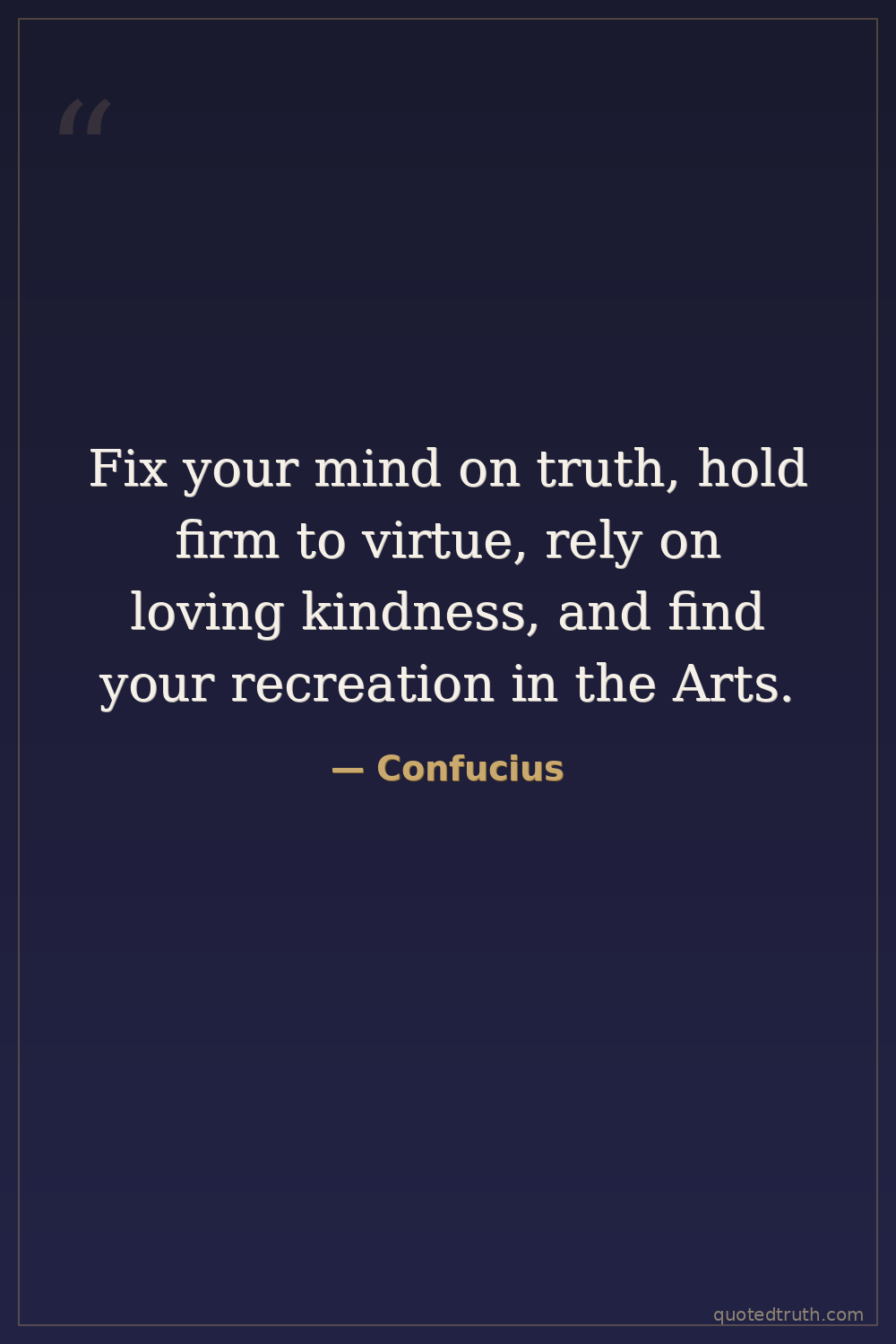
Confucius — "Fix your mind on truth, hold firm to virtue, rely on loving kindness, and find y…"
Fix your mind on truth, hold firm to virtue, rely on loving kindness, and find your recreation in the Arts.
Fix your mind on truth, hold firm to virtue, rely on loving kindness, and find your recreation in the Arts.
Click any product to generate a realistic preview. Up to 3 at a time.
* Initial load can take up to 90 seconds — revising the preview in another color is nearly instant.
"The superior man is modest in his speech, but exceeds in his actions."
"The Master said, 'What is the highest wisdom? To know men.'"
"When the wind blows, the grass bends."
"The Master said, 'A man can enlarge the Way, but the Way cannot enlarge a man.'"
"The Master said, 'The student of virtue has no anxieties; the man of wisdom has no perplexities; the man of courage has no fears.'"
Chinese philosopher and teacher whose teachings (compiled by his students in the Analects) became the foundational ethical framework of East Asian civilization for 2,500 years. Closely associated with Mencius (his most-influential follower a century later). For an intellectual contrast, see Laozi, near-contemporary Chinese sage and Tao Te Ching author — Confucius systematized social order through ritual and family hierarchy; Laozi's Taoist effortless-action philosophy argued such systems were the disease, not the cure. The two founding poles of Chinese moral philosophy — every East Asian moral tradition since has positioned itself between them.
The standard scholarly entry points to Confucius's work: Philip J. Ivanhoe (Georgetown, Chinese philosophy) — Confucian Moral Self Cultivation (2000); Edward Slingerland (UBC, Asian Studies) — Effortless Action: Wu-wei as Conceptual Metaphor (2003); Tu Weiming (Harvard, Confucian scholar) — Confucian Thought: Selfhood as Creative Transformation (1985). These are the works graduate seminars cite when teaching Confucius.
Found in 1 providers: gemini
1 source checked
This saying lays out four priorities for a well-ordered life. Aim your thinking at what is actually true, stay committed to doing the right thing even when it costs you, let genuine care for others guide how you treat people, and spend your free time on cultivated pursuits like music, reading, or art rather than idle distraction. Together they form a daily template for becoming a better person.
Confucius spent his life teaching that character is built through disciplined practice, not birth or wealth. He personally studied ritual, poetry, music, archery, and calligraphy, the classical Six Arts he references here. Ren, translated as loving kindness, was the central virtue of his whole system, and his insistence that leisure itself should refine a person matches his reputation as a tireless student who said he forgot to eat when absorbed in learning.
Confucius lived during the Spring and Autumn period, when the Zhou dynasty was fracturing and rival states fought constantly. Traditional rituals were collapsing, corrupt officials bought office, and ordinary people suffered under warlord violence. Against that backdrop, he argued that social order had to be rebuilt from individual moral cultivation upward. Framing even recreation as character work was a direct rebuke to a ruling class that treated power as entertainment and neglected the self-discipline he believed held civilization together.
AI-generated insights based on extensive research and information for context. Factual errors? Email [email protected].
Your cart is empty