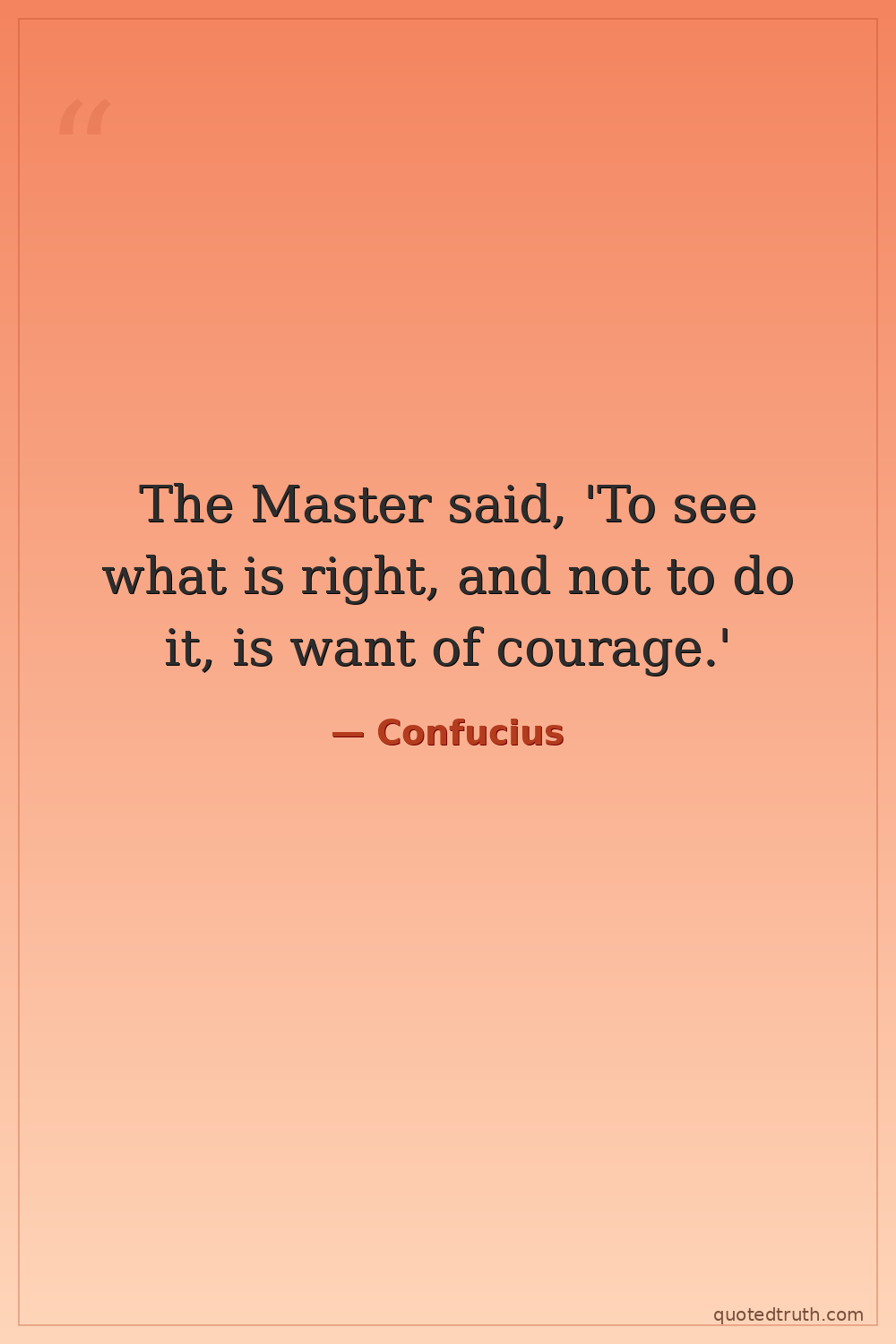
Confucius — "The Master said, 'To see what is right, and not to do it, is want of courage.'"
The Master said, 'To see what is right, and not to do it, is want of courage.'
The Master said, 'To see what is right, and not to do it, is want of courage.'
Click any product to generate a realistic preview. Up to 3 at a time.
* Initial load can take up to 90 seconds — revising the preview in another color is nearly instant.
"He who speaks without modesty will find it difficult to make his words good."
"If the mechanic wishes to do his work well, he must first sharpen his tools."
"The Master said, 'He who acts with a constant view to his own advantage will be much murmured against.'"
"Fix your mind on truth, hold firm to virtue, rely on loving kindness, and find your recreation in the Arts."
"The Master said, 'The superior man is universally benevolent, and not partisan. The mean man is partisan, and not universally benevolent.'"
Chinese philosopher and teacher whose teachings (compiled by his students in the Analects) became the foundational ethical framework of East Asian civilization for 2,500 years. Closely associated with Mencius (his most-influential follower a century later). For an intellectual contrast, see Laozi, near-contemporary Chinese sage and Tao Te Ching author — Confucius systematized social order through ritual and family hierarchy; Laozi's Taoist effortless-action philosophy argued such systems were the disease, not the cure. The two founding poles of Chinese moral philosophy — every East Asian moral tradition since has positioned itself between them.
The standard scholarly entry points to Confucius's work: Philip J. Ivanhoe (Georgetown, Chinese philosophy) — Confucian Moral Self Cultivation (2000); Edward Slingerland (UBC, Asian Studies) — Effortless Action: Wu-wei as Conceptual Metaphor (2003); Tu Weiming (Harvard, Confucian scholar) — Confucian Thought: Selfhood as Creative Transformation (1985). These are the works graduate seminars cite when teaching Confucius.
Found in 3 providers: deepseek,grok,gemini
3 sources checked
Knowing the right thing to do but failing to act on it isn't prudence or humility—it's cowardice. Recognizing a moral obligation creates responsibility to fulfill it, and staying silent or passive when you see injustice, wrongdoing, or a clear duty reveals weakness of character. Courage isn't just facing physical danger; it's the willingness to act on your conscience even when action is inconvenient, unpopular, or risky to your standing.
Confucius built his entire ethical system around the cultivation of the junzi, the morally upright person who embodies ren (humaneness) and yi (righteousness). He spent years wandering between states trying to advise rulers, often at personal risk, rather than stay comfortably silent. This saying captures his conviction that moral knowledge without moral action was hollow—a failure of character he diagnosed in many officials of his day.
Confucius lived during the Spring and Autumn period (551–479 BCE), an era of collapsing Zhou authority, warring states, and widespread corruption among nobles and officials. Many educated men avoided confronting injustice to preserve their positions under unstable rulers. Confucius pushed back against this careerist silence, insisting that scholars and ministers had a duty to remonstrate with power. His teaching tied social order directly to the personal courage of individuals willing to act rightly.
AI-generated insights based on extensive research and information for context. Factual errors? Email [email protected].
Your cart is empty