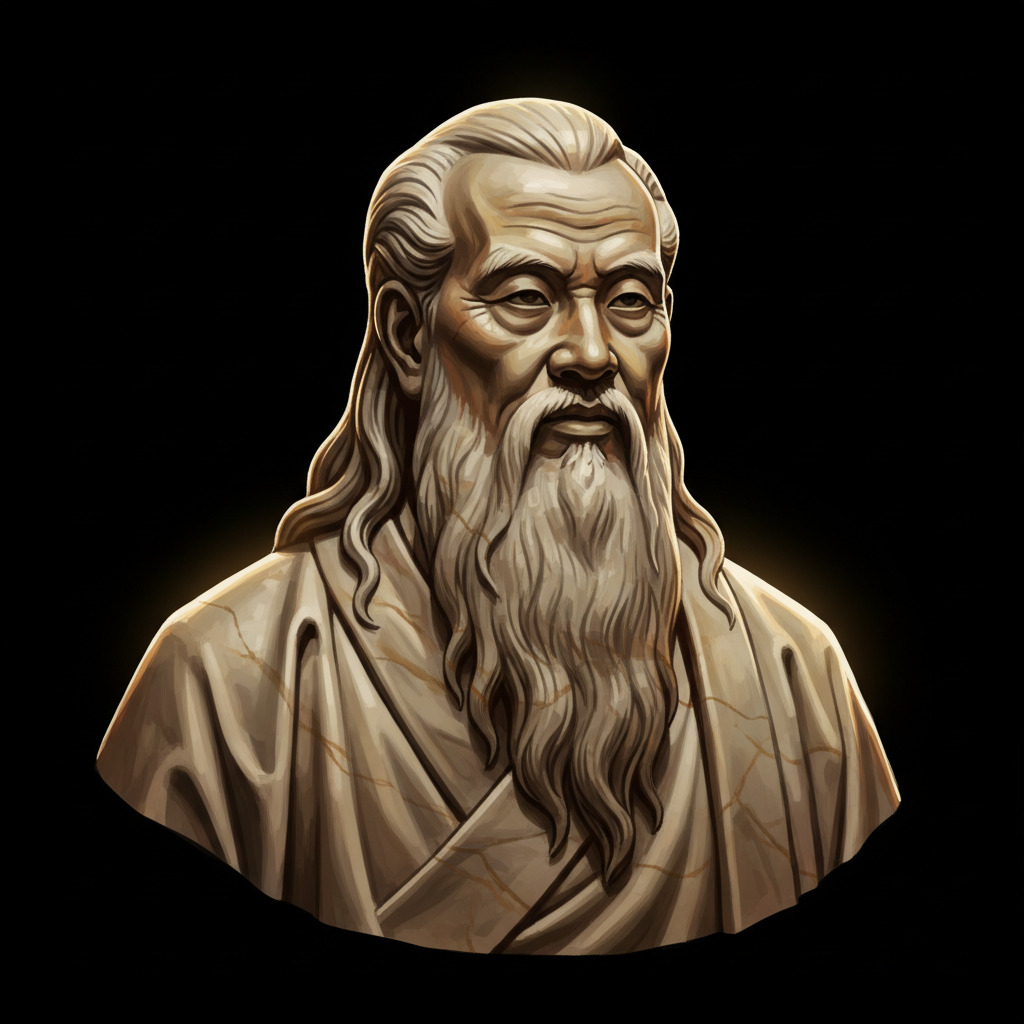
Laozi — "Because of the great love, one is courageous."
Because of the great love, one is courageous.
Because of the great love, one is courageous.
Click any product to generate a realistic preview. Up to 3 at a time.
* Initial load can take up to 90 seconds — revising the preview in another color is nearly instant.
"The value of teaching without words and accomplishing without action is understood by few in the world."
"A man with outward courage dares to die; a man with inward courage dares to live."
"When the great Tao is lost, there is 'benevolence' and 'righteousness'."
"The more prohibitions there are, the poorer the people will be. The more sharp weapons the people have, the more trouble there will be in the country. The more clever and skillful man is, the more str…"
"Without going out of the door, one can know the whole world. Without peeping through the window, one can see the Way of Heaven. The further one goes, the less one knows."
Reputed founder of Taoism and author of the Tao Te Ching, whose wu wei (effortless action) shaped East Asian philosophy. Closely associated with Zhuangzi (later Taoist who extended Laozi's framework). For an intellectual contrast, see Confucius, near-contemporary Chinese sage of social ritual and duty — Confucius systematized social order through ritual and hierarchy; Laozi argued that all such systems were the disease, not the cure — the two founding poles of Chinese moral philosophy.
Found in 1 providers: gemini
1 source checked
Deep love for someone or something gives you the strength to act bravely, even when you are afraid. When you truly care about a person, a cause, or a principle, fear loses its grip because protecting or pursuing what you love matters more than your own safety or comfort. Courage is not the absence of fear but a natural byproduct of caring deeply enough that hesitation becomes impossible.
Laozi taught that the softest force in nature, water, wears down stone, and that yielding often outlasts rigidity. As the reputed author of the Tao Te Ching and a keeper of royal archives, he observed rulers and saw that true strength came from compassion rather than force. For him, love was one of three treasures, the root from which genuine bravery grows, not aggression or ambition.
Laozi lived during the late Zhou dynasty, an era of collapsing feudal order and constant warfare between rival states that later fueled the Warring States period. Rulers prized military might, harsh law, and cunning strategy above all. Against this backdrop of violence and ambition, Laozi's claim that love produces real courage was a quiet rebuke, offering a countercultural path of humility, compassion, and restraint when everyone else chased power through force.
AI-generated insights based on extensive research and information for context. Factual errors? Email [email protected].
Your cart is empty