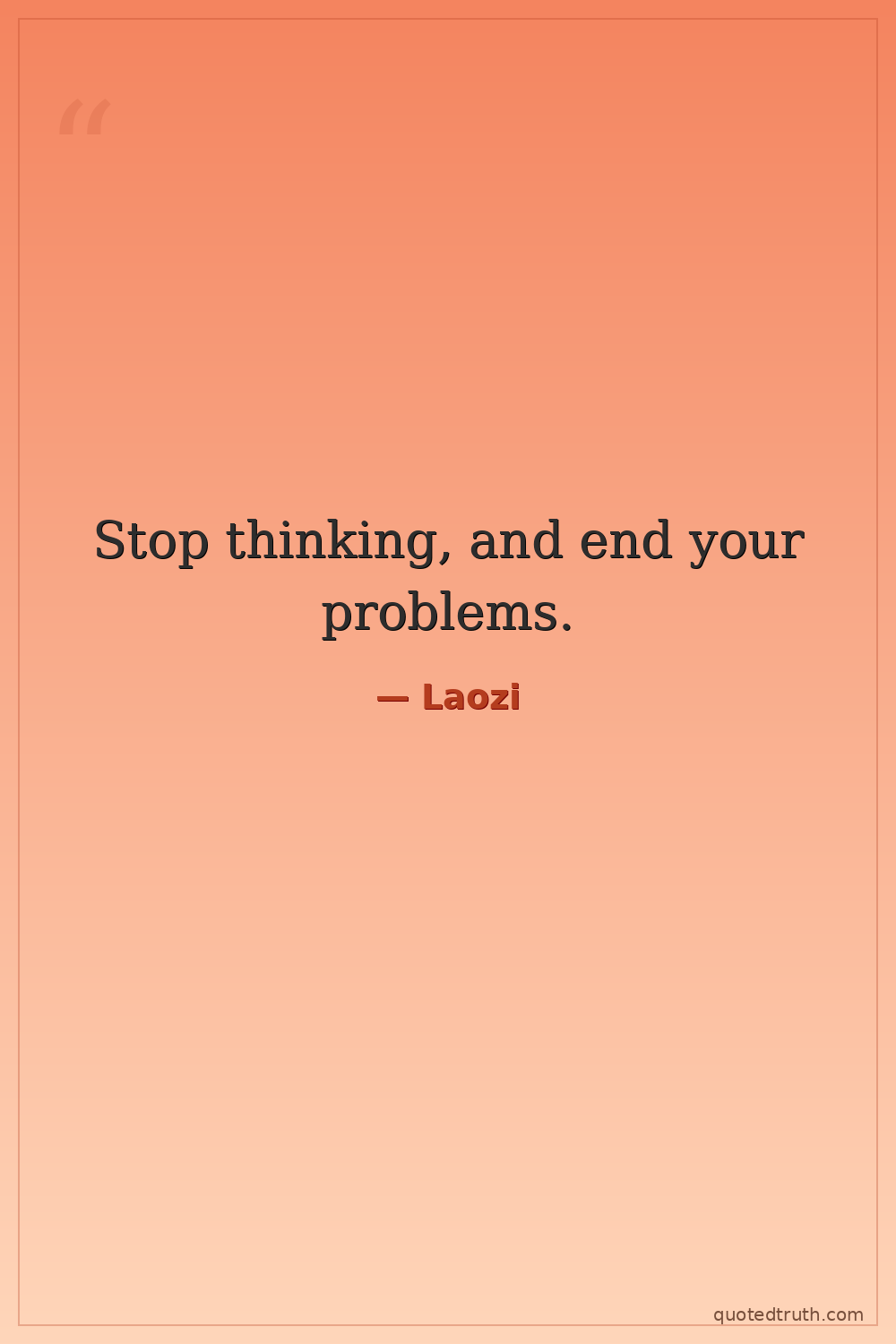
Laozi — "Stop thinking, and end your problems."
Stop thinking, and end your problems.
Stop thinking, and end your problems.
Click any product to generate a realistic preview. Up to 3 at a time.
* Initial load can take up to 90 seconds — revising the preview in another color is nearly instant.
"The heaviest thing in the world is a human heart."
"The highest good is like water. It nourishes all things without trying to."
"Make the small big and the few many; Do good to him who has done you an injury."
"The great square has no corners. The great vessel is never full. The great sound is inaudible. The great image has no form."
"He who controls others may be powerful, but he who has mastered himself is mightier still."
Reputed founder of Taoism and author of the Tao Te Ching, whose wu wei (effortless action) shaped East Asian philosophy. Closely associated with Zhuangzi (later Taoist who extended Laozi's framework). For an intellectual contrast, see Confucius, near-contemporary Chinese sage of social ritual and duty — Confucius systematized social order through ritual and hierarchy; Laozi argued that all such systems were the disease, not the cure — the two founding poles of Chinese moral philosophy.
Found in 1 providers: gemini
1 source checked
Much of what torments us is manufactured by our own minds—endless analysis, worry, comparison, and mental chatter. The problems multiply through thinking about them rather than through the situations themselves. If you set aside the restless inner commentary and stop forcing conclusions, the tangle often dissolves. Clarity and peace arrive not by solving every question intellectually but by quieting the machinery that generates the questions in the first place.
Laozi taught wu wei, effortless action, and warned that cleverness and striving create the very disorders they claim to fix. As a reputed archivist who grew disillusioned with court intellectualism and rode west into retreat, he embodied withdrawal from mental noise. His Tao Te Ching repeatedly praises the uncarved block, the empty vessel, and the sage who knows without calculating—making this line a compact distillation of his lifelong critique of overthinking.
Laozi lived during the Zhou dynasty's decline, likely the 6th–4th century BCE, as competing states waged constant war and rival schools—Confucians, Legalists, Mohists—churned out elaborate doctrines on ritual, governance, and moral reasoning. Scholars debated endlessly while society fractured. Against this climate of hyper-intellectual statecraft and anxious strategizing, Taoism offered a radical counterweight: return to simplicity, nature, and stillness. Telling people to stop thinking was a direct rebuke of the era's philosophical arms race.
AI-generated insights based on extensive research and information for context. Factual errors? Email [email protected].
Your cart is empty