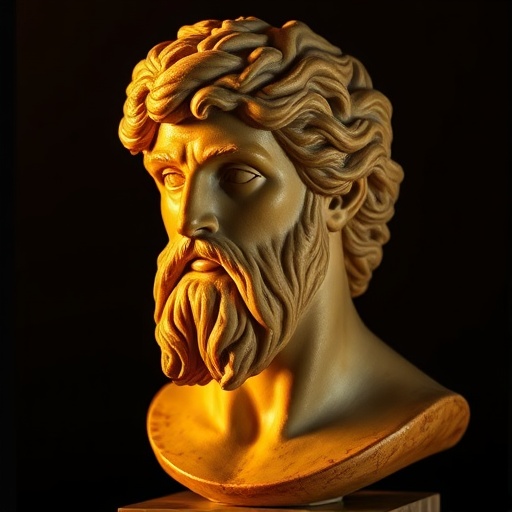
Pythagoras — "Above the cloud with its shadow is the star with its light."
Above the cloud with its shadow is the star with its light.
Above the cloud with its shadow is the star with its light.
Click any product to generate a realistic preview. Up to 3 at a time.
* Initial load can take up to 90 seconds — revising the preview in another color is nearly instant.
"Beans look like the gates of Hades."
"Do not speak a little on many subjects, but much on a few."
"In no way neglect the health of your body; But give it drink and food in due measure, and also the exercise of which it has need."
"Above the cloud with its shadow is the star with its light. Above all things reverence thyself."
"It is difficult to walk at one and the same time many paths of life."
Greek philosopher and mathematician whose school in Croton combined geometry (the Pythagorean theorem), number-mysticism, and a religious-vegetarian way of life. Closely associated with Thales of Miletus (earlier pre-Socratic and the first philosopher). For an intellectual contrast, see Heraclitus, pre-Socratic Greek philosopher of flux — Heraclitus called Pythagoras 'the chief of swindlers' — among the founding insults of the philosophical-rivalry tradition. Their 'all is flux' vs 'all is number' poles still organize the philosophy of mathematics today (Platonist vs anti-realist).
A poetic metaphor suggesting looking beyond immediate difficulties to higher truths or ideals.
Date: c. 5th Century BCE
PhilosophicalFound in 1 providers: gemini
1 source checked
Beyond every obstacle that darkens your view lies something brighter and enduring. Clouds represent temporary troubles, confusion, or setbacks that seem overwhelming in the moment, while stars represent lasting truths, hope, and guiding principles that remain constant. The saying urges you to remember that difficulties are passing shadows, and steady light exists above them even when you cannot see it from below.
Pythagoras believed the cosmos was ordered by numerical harmony and that souls could ascend from material confusion toward eternal truth. As founder of a mystical-mathematical brotherhood, he taught that disciplined contemplation lifted the mind past sensory illusion to divine geometry. The image of stars above clouds mirrors his conviction that unchanging mathematical reality sits beyond fleeting physical appearances, rewarding those who study the heavens and purify their thinking.
In the 6th century BCE, Greek thinkers were shifting from myth toward rational inquiry, and astronomy was tangled with religion. Pythagoras lived in Croton, southern Italy, where his school studied celestial motion as sacred order. Most people feared eclipses and storms as divine anger, but Pythagoreans saw predictable patterns. Claiming the stars shone beyond clouds affirmed a radical new worldview: nature obeyed permanent laws humans could discover through reason and numerical study.
AI-generated insights based on extensive research and information for context. Factual errors? Email [email protected].
Your cart is empty