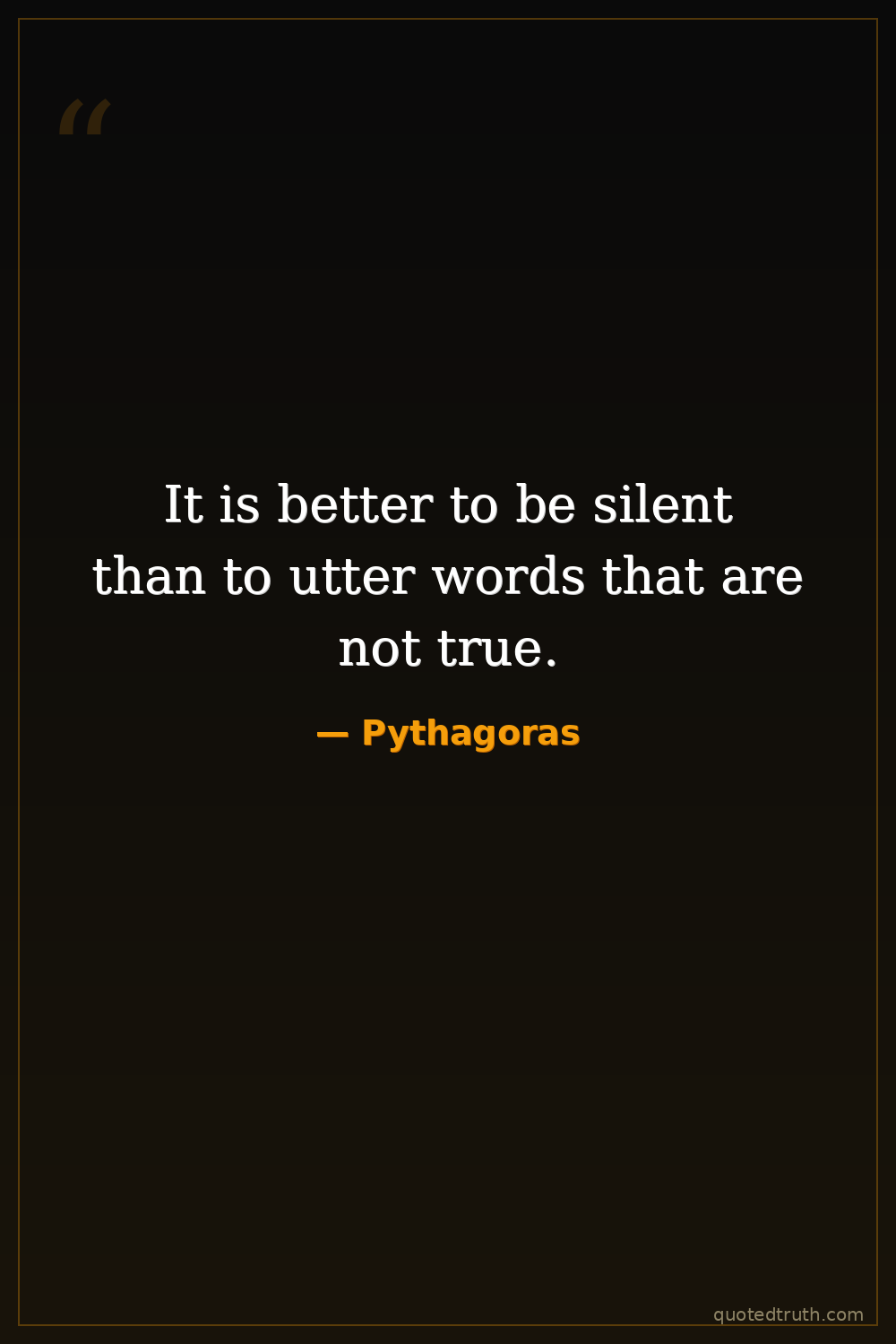
Pythagoras — "It is better to be silent than to utter words that are not true."
It is better to be silent than to utter words that are not true.
It is better to be silent than to utter words that are not true.
Click any product to generate a realistic preview. Up to 3 at a time.
* Initial load can take up to 90 seconds — revising the preview in another color is nearly instant.
"Friendship is one soul in two bodies."
"Number is the within of all things."
"Above all things, reverence yourself."
"Do not receive a weasel into your house."
"The highest goal of music is to connect one's soul to their Divine Nature, not entertainment."
Greek philosopher and mathematician whose school in Croton combined geometry (the Pythagorean theorem), number-mysticism, and a religious-vegetarian way of life. Closely associated with Thales of Miletus (earlier pre-Socratic and the first philosopher). For an intellectual contrast, see Heraclitus, pre-Socratic Greek philosopher of flux — Heraclitus called Pythagoras 'the chief of swindlers' — among the founding insults of the philosophical-rivalry tradition. Their 'all is flux' vs 'all is number' poles still organize the philosophy of mathematics today (Platonist vs anti-realist).
Found in 1 providers: grok
1 source checked
Keeping quiet is preferable to saying something false. If you cannot speak the truth, do not speak at all. Words carry weight and consequence, so releasing inaccurate statements damages others, corrupts understanding, and stains your own credibility. Silence costs nothing, but falsehood always costs something. Choose restraint over the urge to fill a conversation with claims you cannot stand behind honestly.
Pythagoras ran a disciplined brotherhood where initiates observed a multi-year vow of silence before being allowed to speak in discussions. Truthfulness was a core ethical requirement alongside mathematics, music, and purification rites. As a teacher obsessed with harmony, proof, and precise ratios, he treated sloppy or dishonest speech as a violation of cosmic order, mirroring the rigor he demanded in geometry and number theory.
In 6th-century BCE Greece, rhetoric and persuasion dominated public life, and traveling sophists were paid to argue any side convincingly. Oral culture meant reputations, lawsuits, and political fates hinged on spoken claims. Pythagoras founded his school in Croton amid this climate, pushing back against clever but hollow speech. Emphasizing truthful silence was a radical ethical stance when eloquence without honesty was becoming a professional skill across the Greek world.
AI-generated insights based on extensive research and information for context. Factual errors? Email [email protected].
Your cart is empty