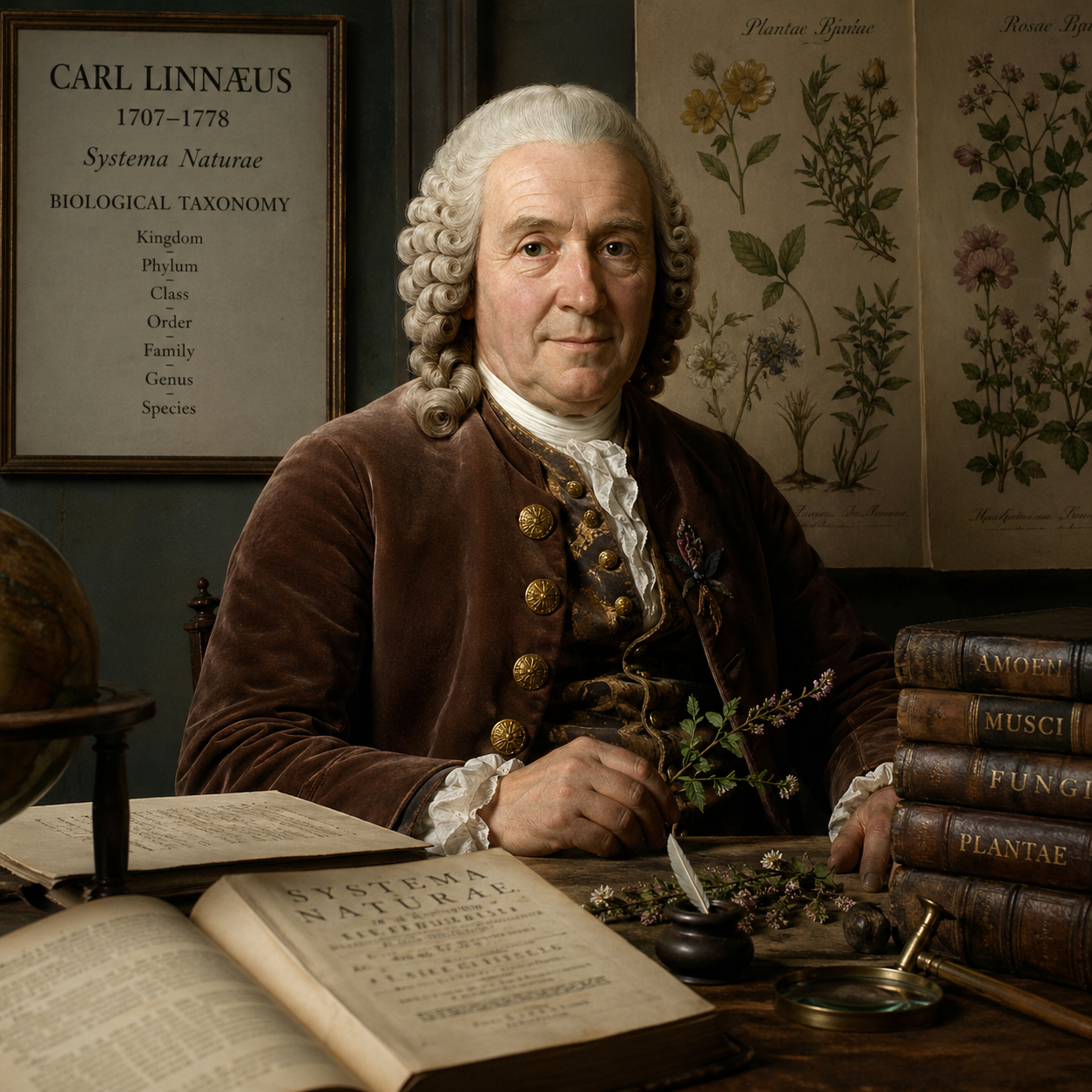
Carl Linnaeus — "If a tree dies, plant another in its place."
If a tree dies, plant another in its place.
If a tree dies, plant another in its place.
Click any product to generate a realistic preview. Up to 3 at a time.
* Initial load can take up to 90 seconds — revising the preview in another color is nearly instant.
"Women are more lascivious than men, as is evident from their greater lubricity and their monthly purgations."
"The African is lazy, crafty, negligent, and governed by caprice."
"¿Qué tiene de extraño que yo no vea a Dios si no puedo ver siquiera al Yo que vive en mí?"
"I am not ashamed to confess that I am a man who loves flowers."
"The classification of plants is the most difficult of all tasks."
Swedish botanist and the father of modern taxonomy whose Systema Naturae (1735) introduced binomial nomenclature for naming all species. Closely associated with Joseph Banks (British naturalist who carried Linnaean classification on Cook's voyages). For an intellectual contrast, see Comte de Buffon, French naturalist and Histoire Naturelle author (1749-1788) — Buffon explicitly attacked Linnaean fixed-categories taxonomy as artificial and rejected the binomial system; his gradualist, environment-shaped natural history was the explicit alternative. Anticipates the fixed-species-vs-evolution debate Darwin would later resolve.
A practical and philosophical statement on renewal and environmental stewardship.
Date: 18th Century
PhilosophicalFound in 1 providers: gemini
1 source checked
When something is lost or ends, respond by creating anew rather than mourning the absence. Loss is not a reason to stop; it is a prompt to begin again. Replace what is gone with something living. This is an ethic of practical resilience — forward action over grief, restoration over lament, continuation over cessation.
Linnaeus spent his life cataloguing and naming the natural world's organisms, developing the binomial nomenclature system still used today. His reverence for living things was foundational. As a botanist who literally organized life itself into systems, replanting reflected his belief that nature's abundance must be actively stewarded and perpetuated, not passively observed.
The 18th-century Enlightenment saw Europeans aggressively clearing forests for agriculture and timber, driving early ecological concern. Linnaeus worked amid Sweden's deforestation pressures and witnessed natural systems under strain. His era also saw the birth of natural philosophy as empirical science, making stewardship of living systems both a moral and intellectual priority for the educated class.
AI-generated insights based on extensive research and information for context. Factual errors? Email [email protected].
Your cart is empty