Carl Linnaeus — "The classification of plants is the most difficult of all tasks."
The classification of plants is the most difficult of all tasks.
The classification of plants is the most difficult of all tasks.
Click any product to generate a realistic preview. Up to 3 at a time.
* Initial load can take up to 90 seconds — revising the preview in another color is nearly instant.
"The most beautiful flower is the one that is most accurately drawn."
"The first step in wisdom is to know the things themselves."
"I have been called a second Adam."
"The African is lazy, crafty, negligent, and governed by caprice."
"Women are more lascivious than men, as is evident from their greater lubricity and their monthly purgations."
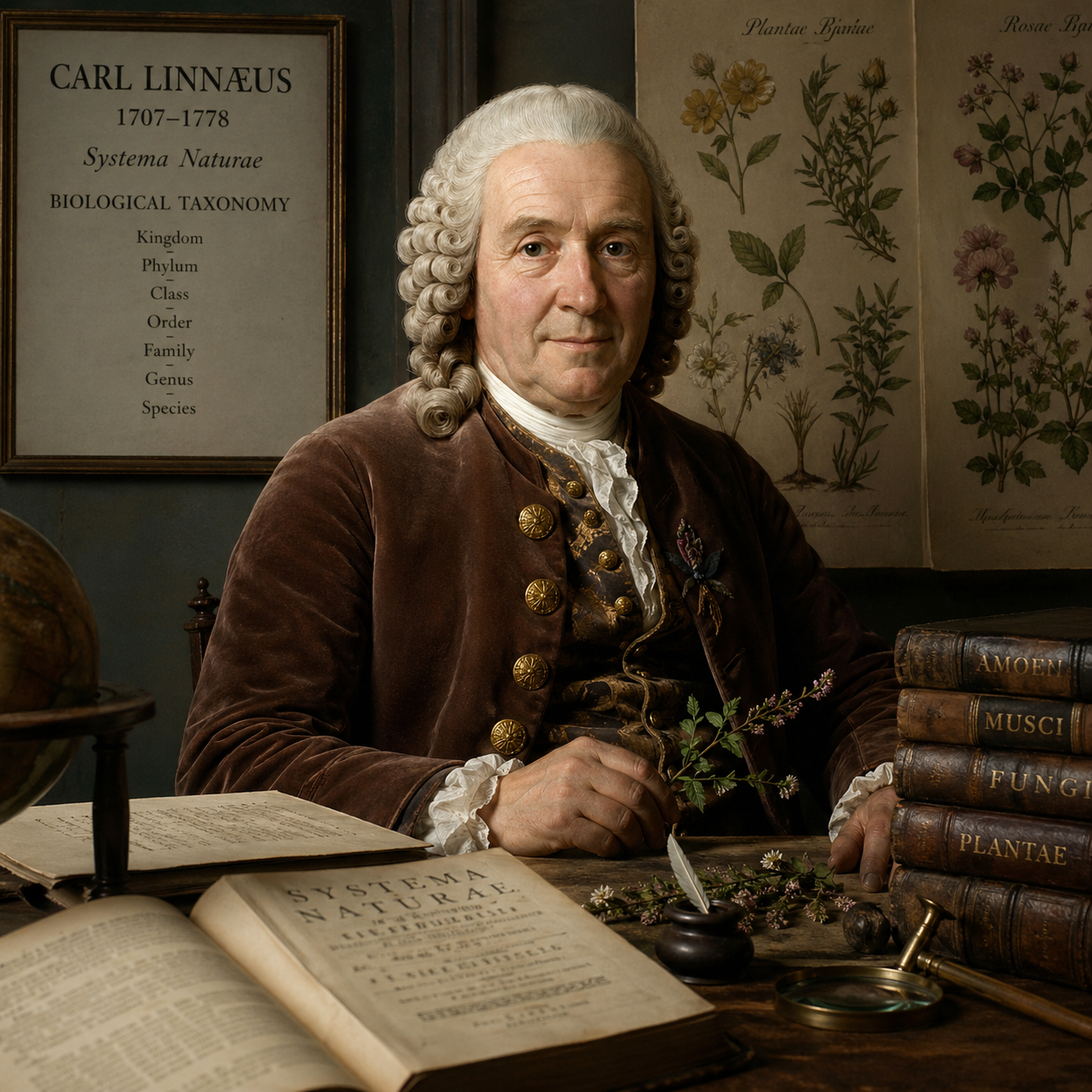
Swedish botanist and the father of modern taxonomy whose Systema Naturae (1735) introduced binomial nomenclature for naming all species. Closely associated with Joseph Banks (British naturalist who carried Linnaean classification on Cook's voyages). For an intellectual contrast, see Comte de Buffon, French naturalist and Histoire Naturelle author (1749-1788) — Buffon explicitly attacked Linnaean fixed-categories taxonomy as artificial and rejected the binomial system; his gradualist, environment-shaped natural history was the explicit alternative. Anticipates the fixed-species-vs-evolution debate Darwin would later resolve.
A statement acknowledging the immense challenge of plant taxonomy.
Date: c. 1730s-1770s
WisdomFound in 1 providers: gemini
1 source checked
Organizing living things into named categories seems straightforward, but requires reconciling enormous natural variation, overlapping traits, and borderline cases that resist clean boundaries. Plants vary by region, season, and growth stage, making consistent grouping genuinely hard. The task demands exhaustive observation across thousands of specimens and principled judgment about which differences matter enough to define a distinct group — a challenge that compounds with every new species discovered.
Linnaeus spent his career building the binomial naming system and his 1753 Species Plantarum catalogued over 7,700 plants. His Lapland expeditions and worldwide student correspondence exposed him to constant edge cases where his own sexual classification system, based on stamen and pistil counts, struggled. He revised Systema Naturae twelve times, each revision reflecting how much harder the work proved than initially conceived, making this admission deeply personal.
The Age of Exploration flooded European naturalists with thousands of undescribed plant species from the Americas, Africa, and Asia, but no agreed naming system existed. Different botanists used incompatible names for identical plants. Botanical gardens in Leiden, Uppsala, and Kew were expanding rapidly. The Enlightenment demanded rational order from nature's chaos, making a universal classification system both urgently needed and politically contested among competing European scholarly traditions.
AI-generated insights based on extensive research and information for context. Factual errors? Email [email protected].
Your cart is empty