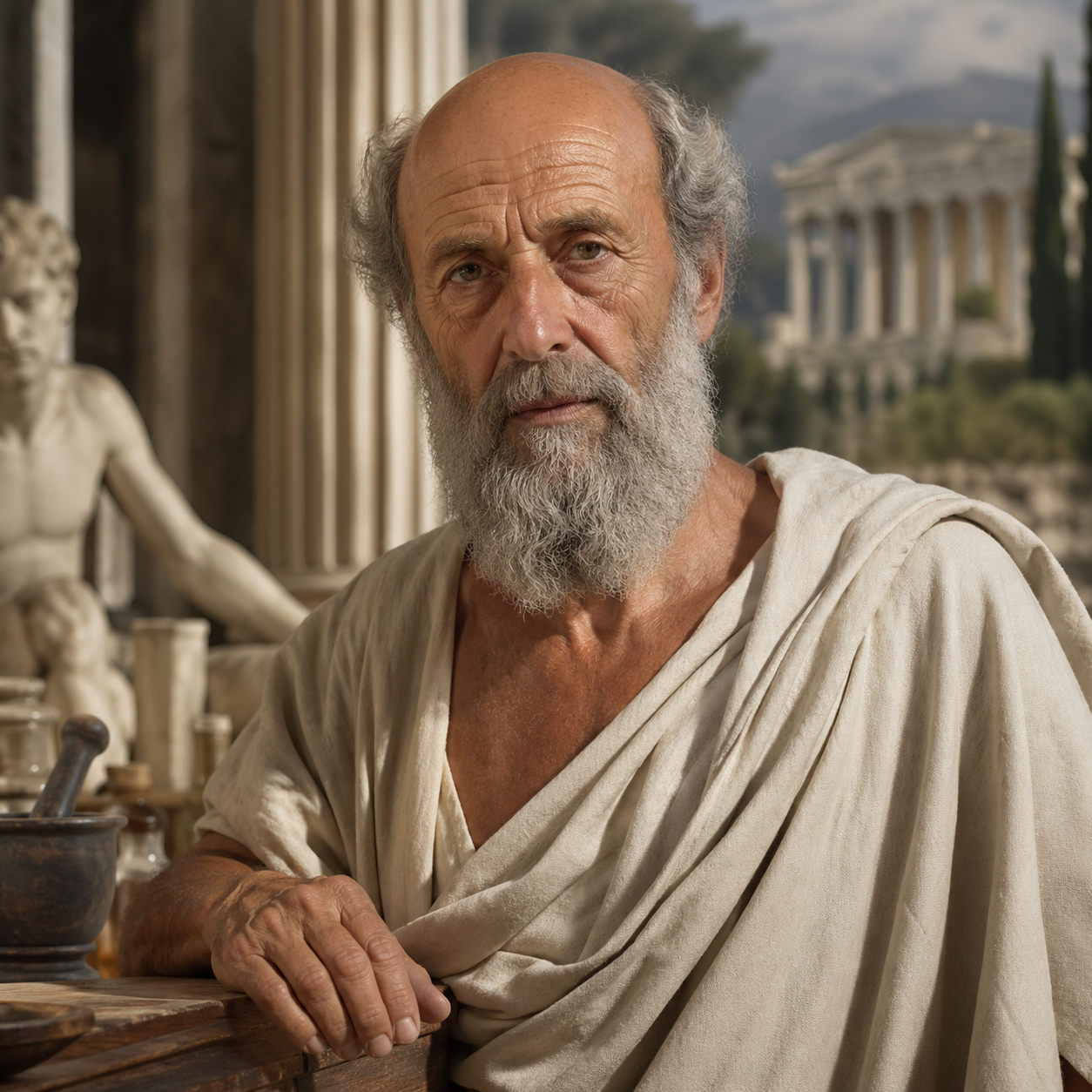
Hippocrates — "Before you heal someone, ask him if he's willing to give up the things that make…"
Before you heal someone, ask him if he's willing to give up the things that make him sick.
Before you heal someone, ask him if he's willing to give up the things that make him sick.
Click any product to generate a realistic preview. Up to 3 at a time.
* Initial load can take up to 90 seconds — revising the preview in another color is nearly instant.
"There are in fact two things, science and opinion; the former begets knowledge, the latter ignorance."
"The powers of the elements are shown in the seasons."
"That which is used - develops. That which is not used wastes away."
"The most important thing in life is health."
"When a fever is present, the bowels should be loose; when absent, they should be costive."
Highlights patient responsibility and the role of lifestyle in healing.
Date: c. 5th Century BCE
PhilosophicalFound in 1 providers: gemini
1 source checked
Healing requires more than a physician's skill—it demands patient willingness to change. If someone's habits, diet, or behaviors are causing their illness, any intervention is temporary without behavioral change. Recovery is a two-way contract: the healer offers knowledge and treatment, the patient must surrender what harms them. No cure holds if the root cause remains. Personal commitment to change is as essential as any medicine.
Hippocrates built medicine on naturalistic causes—diet, climate, and lifestyle—rather than divine intervention. His Hippocratic Corpus is filled with dietary regimens and lifestyle prescriptions, showing he believed habit was central to health. Practicing in ancient Greece, he saw patients whose recoveries failed because they wouldn't change their eating or daily routines. For Hippocrates, the physician's role was to guide; the patient's choices ultimately determined the outcome.
In 5th–4th century BCE Greece, disease was commonly blamed on divine punishment or spiritual imbalance—prayers and sacrifices were standard treatment. Hippocrates challenged this, arguing illness had physical causes rooted in environment, diet, and habit. Without antibiotics, surgery, or pharmaceuticals, lifestyle change was often the most powerful intervention available. Convincing patients to abandon harmful behaviors was therefore not philosophical advice but practical medicine—the physician's primary lever for achieving lasting recovery.
AI-generated insights based on extensive research and information for context. Factual errors? Email [email protected].
Your cart is empty