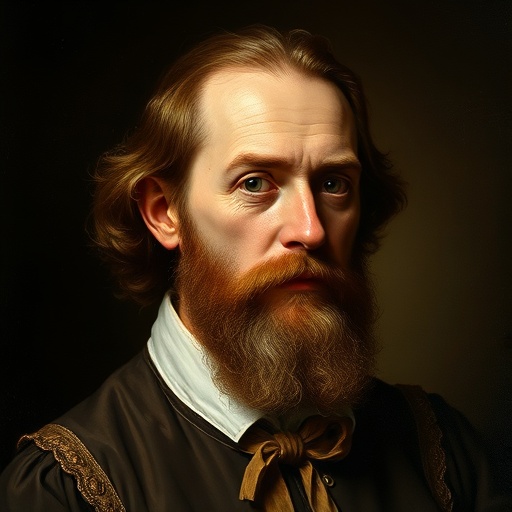
William Harvey — "I avow myself the partisan of truth alone."
I avow myself the partisan of truth alone.
I avow myself the partisan of truth alone.
Click any product to generate a realistic preview. Up to 3 at a time.
* Initial load can take up to 90 seconds — revising the preview in another color is nearly instant.
"The circulation of the blood is a new doctrine, and I doubt not but it will meet with its opponents."
"I began to think whether there might not be a motion as it were in a circle."
"The body is a machine, but it is a divine machine."
"Nature is a free and open book, to be read and understood by all who have the patience and the power to do so."
"The examination of the bodies of animals has always been my delight."
English physician whose On the Motion of the Heart and Blood in Animals (1628) demonstrated blood circulation, overturning 1,400 years of Galenic medicine. Closely associated with Francis Bacon (his contemporary in the new English empiricism). For an intellectual contrast, see Galenic medicine, the 2nd-century Greek medical tradition (humors, blood-as-consumed-fuel) — Harvey calculated that the heart pumps more blood per hour than the body could possibly produce as fuel — a single quantitative observation that demolished the entire Galenic-Aristotelian medical worldview. The cleanest example in medical history of arithmetic disproving 14 centuries of authority.
A declaration of intellectual honesty and dedication to scientific truth, from 'De Motu Cordis' (1628), Dedication to Doctor Argent.
Date: 1628
PhilosophicalFound in 1 providers: gemini
1 source checked
The speaker declares absolute loyalty to truth as their only allegiance, rejecting political, religious, or social pressures that might distort honest inquiry. They will follow evidence wherever it leads, even into controversy, refusing to bend conclusions to please authority or convention. Truth is the sole master worth serving, regardless of personal cost or institutional disapproval.
Harvey's discovery that blood circulates continuously—pumped by the heart—directly contradicted Galen's 1,400-year-old anatomical doctrine, which physicians and the Church treated as sacred. He faced ridicule from medical contemporaries, lost patients, and saw his practice damaged. His commitment to anatomical dissection and quantitative observation over inherited authority embodied exactly this partisan loyalty to truth over consensus.
The early modern period saw direct collision between empirical natural philosophy and entrenched scholastic authority. Galileo was condemned by Rome in 1633, just years after Harvey published De Motu Cordis in 1628. Challenging ancient texts risked professional ruin and occasionally persecution. Declaring allegiance to truth alone was a radical, even dangerous, philosophical stance in an era when Aristotle and Galen remained near-scriptural.
AI-generated insights based on extensive research and information for context. Factual errors? Email [email protected].
Your cart is empty