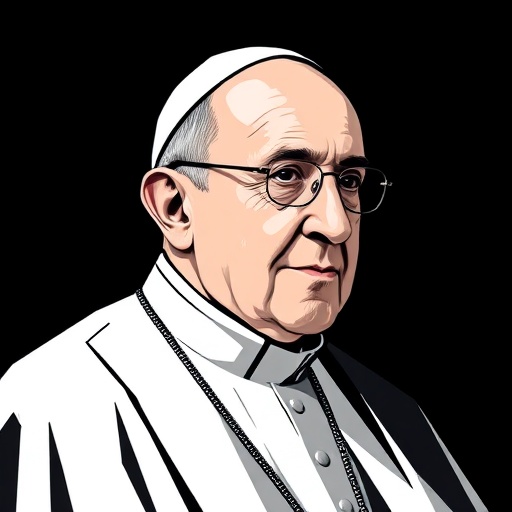
Pope Francis — "A Christian who is too attached to riches is an idolater."
A Christian who is too attached to riches is an idolater.
A Christian who is too attached to riches is an idolater.
Click any product to generate a realistic preview. Up to 3 at a time.
* Initial load can take up to 90 seconds — revising the preview in another color is nearly instant.
"Slander is worse than murder. Slander kills the reputation of a person. It is worse than murder because even if you kill, you can repent and go to heaven. But slander kills the soul of the person."
"A pastor who does not pray is a pastor who is in danger."
"The environmental crisis and social crisis are not two separate crises, but one complex crisis."
"The victims of abuse must be protected above all else."
"I would like to go to Moscow. And not only Moscow. To all of Russia. But you need two to tango."
First Latin American and Jesuit pope (2013-), who has steered the Catholic Church toward pastoral inclusion on LGBTQ pastoral care, divorced Catholics, and climate. Closely associated with Pope John XXIII (the Vatican II reformer pope) and Cardinal Walter Kasper (his theological ally on pastoral reform). For an intellectual contrast, see Cardinal Raymond Burke, American traditionalist cardinal, former head of the Vatican Apostolic Signatura — Burke is the public face of Catholic traditionalism that views Francis's pastoral approach as doctrinally dangerous — he has formally challenged Amoris Laetitia and other Francis reforms.
Found in 1 providers: grok
1 source checked
A Christian who hoards wealth above all else has effectively replaced God with money — that is idolatry. Francis restates the biblical warning that you cannot serve both God and mammon. Excessive attachment to riches distorts moral priorities, making possessions the center of life rather than faith, community, and compassion. It is a blunt call to examine whether money has become a false god in your daily choices.
Bergoglio chose the papal name Francis after St. Francis of Assisi, patron saint of radical poverty. As Archbishop of Buenos Aires he lived in a small apartment, cooked his own meals, and rode public buses. As Pope he rejected the Apostolic Palace for a simple guesthouse suite. His landmark document Evangelii Gaudium attacked trickle-down economics, and he consistently positions the poor as the Church's central moral obligation.
Francis became Pope in 2013 as global wealth inequality reached historic extremes — Oxfam reported the top 1% owned more than the rest of humanity combined by 2016. The 2008 financial crisis had crushed working families while banks received government bailouts. Occupy protests reflected mass anger at inequality. Into this landscape Francis released Evangelii Gaudium, explicitly condemning the economy that kills, making this statement a direct political and spiritual challenge.
AI-generated insights based on extensive research and information for context. Factual errors? Email [email protected].
Your cart is empty