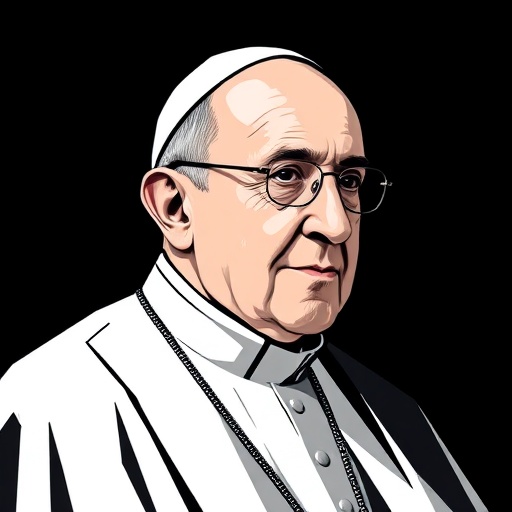
Pope Francis — "Corruption is a cancer that destroys society."
Corruption is a cancer that destroys society.
Corruption is a cancer that destroys society.
Click any product to generate a realistic preview. Up to 3 at a time.
* Initial load can take up to 90 seconds — revising the preview in another color is nearly instant.
"The family is threatened by growing efforts on the part of some to redefine the very institution of marriage, by relativism, by the culture of the ephemeral, by a lack of openness to life."
"Priests who are rigid are sick. They are sick inside."
"A good laugh is good for the soul."
"Sometimes I have to take a tranquilizer to sleep. I keep calm. If I have a problem, I write it down on a piece of paper and give it to St. Joseph. Now he sleeps on it! And I sleep too. It’s a good way…"
"An economic system that has as its center the god of money needs to be denounced, because it is a system that kills."
First Latin American and Jesuit pope (2013-), who has steered the Catholic Church toward pastoral inclusion on LGBTQ pastoral care, divorced Catholics, and climate. Closely associated with Pope John XXIII (the Vatican II reformer pope) and Cardinal Walter Kasper (his theological ally on pastoral reform). For an intellectual contrast, see Cardinal Raymond Burke, American traditionalist cardinal, former head of the Vatican Apostolic Signatura — Burke is the public face of Catholic traditionalism that views Francis's pastoral approach as doctrinally dangerous — he has formally challenged Amoris Laetitia and other Francis reforms.
Found in 1 providers: grok
1 source checked
Corruption erodes the foundations of any community by prioritizing self-interest over collective welfare. Like cancer spreading silently through a body, corrupt practices infiltrate institutions, undermine trust, hollow out public services, and ultimately collapse the social contract that holds societies together. Once embedded, corruption becomes self-reinforcing, making honest governance increasingly difficult to restore.
Born Jorge Mario Bergoglio in Argentina, Pope Francis witnessed firsthand the devastating effects of political corruption under military dictatorship and economic collapse. As the first Jesuit pope, he has consistently championed the poor and marginalized, repeatedly condemning corrupt politicians, mafia networks, and even corrupt clergy within the Vatican's own financial institutions, making this a central theme of his papacy.
Pope Francis became pope in 2013 amid global disillusionment following the 2008 financial crisis, the Arab Spring's collapse into authoritarian backlash, and mounting scandals in governments worldwide. The Vatican itself faced the VatiLeaks scandal. Rising populism, kleptocracy in developing nations, and corporate fraud created widespread cynicism about institutions, making his moral authority on corruption uniquely resonant and politically urgent.
AI-generated insights based on extensive research and information for context. Factual errors? Email [email protected].
Your cart is empty