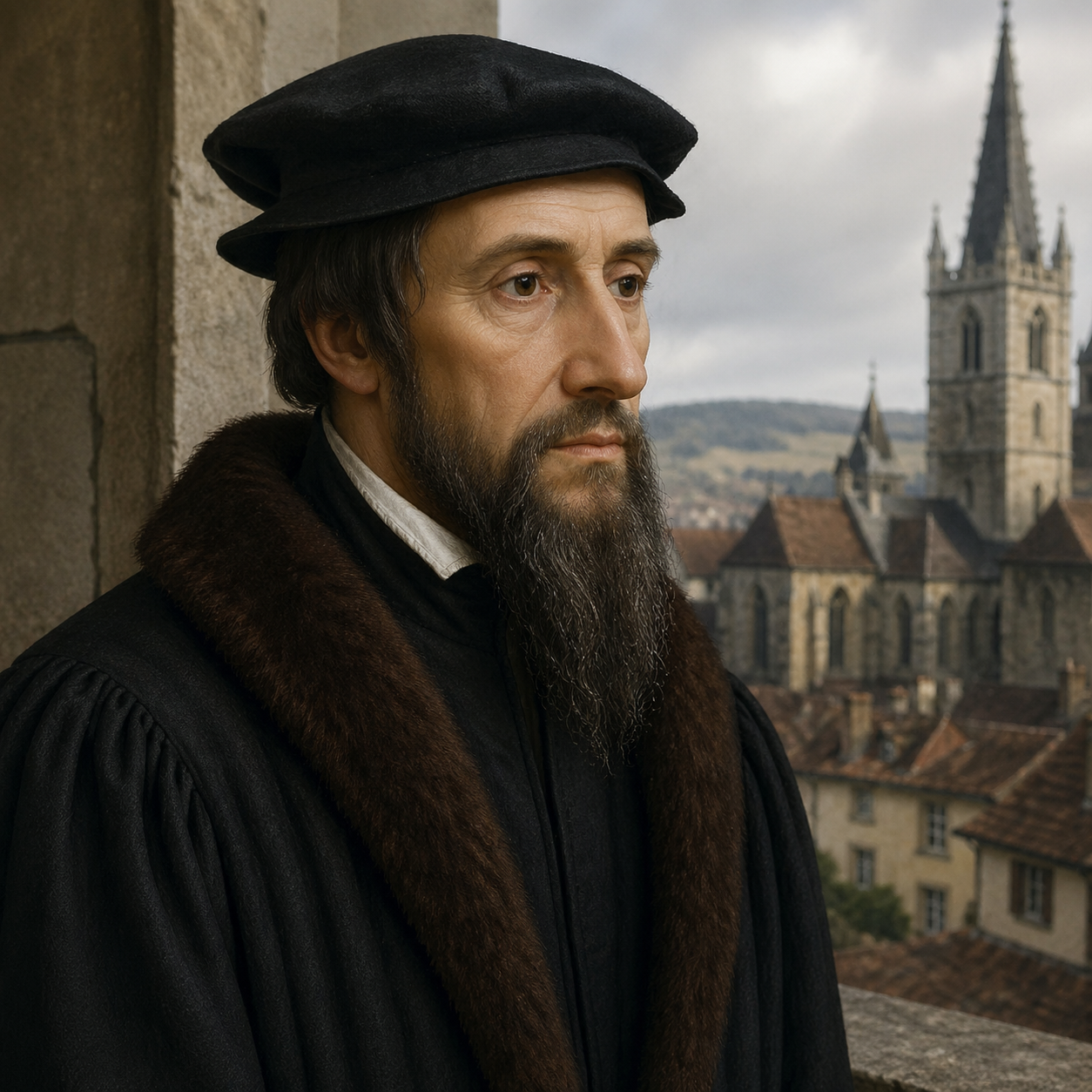
John Calvin — "A dog barks when his master is attacked. I would be a coward if I saw that God's…"
A dog barks when his master is attacked. I would be a coward if I saw that God's truth is attacked and yet would remain silent.
A dog barks when his master is attacked. I would be a coward if I saw that God's truth is attacked and yet would remain silent.
Click any product to generate a realistic preview. Up to 3 at a time.
* Initial load can take up to 90 seconds — revising the preview in another color is nearly instant.
"The seed of the Word of God takes root and grows fruitful only in those whom the Lord, by his eternal election, has predestined to be his children and heirs of the heavenly kingdom. To all others who,…"
"The reprobate are raised up to manifest the glory of God, when, by their condemnation, they show his justice."
"We call predestination God's eternal decree, by which he compacted with himself what he willed to become of each man. For all are not created in equal condition; rather, eternal life is foreordained f…"
"God's purpose is immutable, and cannot be changed."
"Free-will cannot will good and of necessity serves sin."
French theologian whose Institutes of the Christian Religion (1536) systematized Protestant Reformed doctrine, including predestination. Closely associated with Martin Luther (Reformation founder, Calvin's predecessor). For an intellectual contrast, see Jacobus Arminius, Dutch Reformed theologian (1560-1609) — Arminius's rejection of strict double-predestination founded Arminianism — the theological tradition modern Methodism, most evangelicalism, and Pentecostalism descend from. The Calvinist-Arminian debate has divided Protestantism for 400 years.
Found in 2 providers: deepseek,grok
2 sources checked
Even a dog instinctively defends its master — loyalty demands action under threat. If an animal does this by instinct, then a person who claims devotion to God but goes quiet when that faith is challenged is worse than a dog. Genuine conviction requires speaking out when it costs something. Comfortable silence in the face of an attack on what you hold most sacred is not neutrality — it's cowardice dressed up as prudence.
Calvin spent his adult life on the front lines of the Protestant Reformation, defending Reformed theology against Rome, against rival reformers, and against hostile city councils in Geneva — where he was actually expelled in 1538 before returning in 1541. He wrote the Institutes of the Christian Religion, produced commentaries on nearly every biblical book, and publicly confronted figures like Michael Servetus. For Calvin, theological silence was not caution; it was betrayal of his core calling.
Calvin lived during the 1500s Reformation, when Europe was shattering over papal authority, scripture, and salvation doctrine. The Catholic Church held both spiritual and political power; reformers faced excommunication, exile, and execution — Servetus burned at the stake in Geneva in 1553. The printing press spread disputes across borders with unprecedented speed. In that environment, speaking theological truth was genuinely dangerous, making the choice between vocal conviction and self-preserving silence a daily, life-threatening calculation for reformers.
AI-generated insights based on extensive research and information for context. Factual errors? Email [email protected].
Your cart is empty