Laozi — "Act without action. Those who act will fail. Those who seize will lose."
Act without action. Those who act will fail. Those who seize will lose.
Act without action. Those who act will fail. Those who seize will lose.
Click any product to generate a realistic preview. Up to 3 at a time.
* Initial load can take up to 90 seconds — revising the preview in another color is nearly instant.
"The sage knows without traveling, perceives without looking, completes without acting."
"Simplicity, patience, compassion. These three are your greatest treasures."
"He who knows that enough is enough will always have enough."
"One who makes promises rashly rarely keeps good faith; One who is in the habit of considering things easy meets with frequent difficulties."
"The sage is not attached to anything, and so he loses nothing."
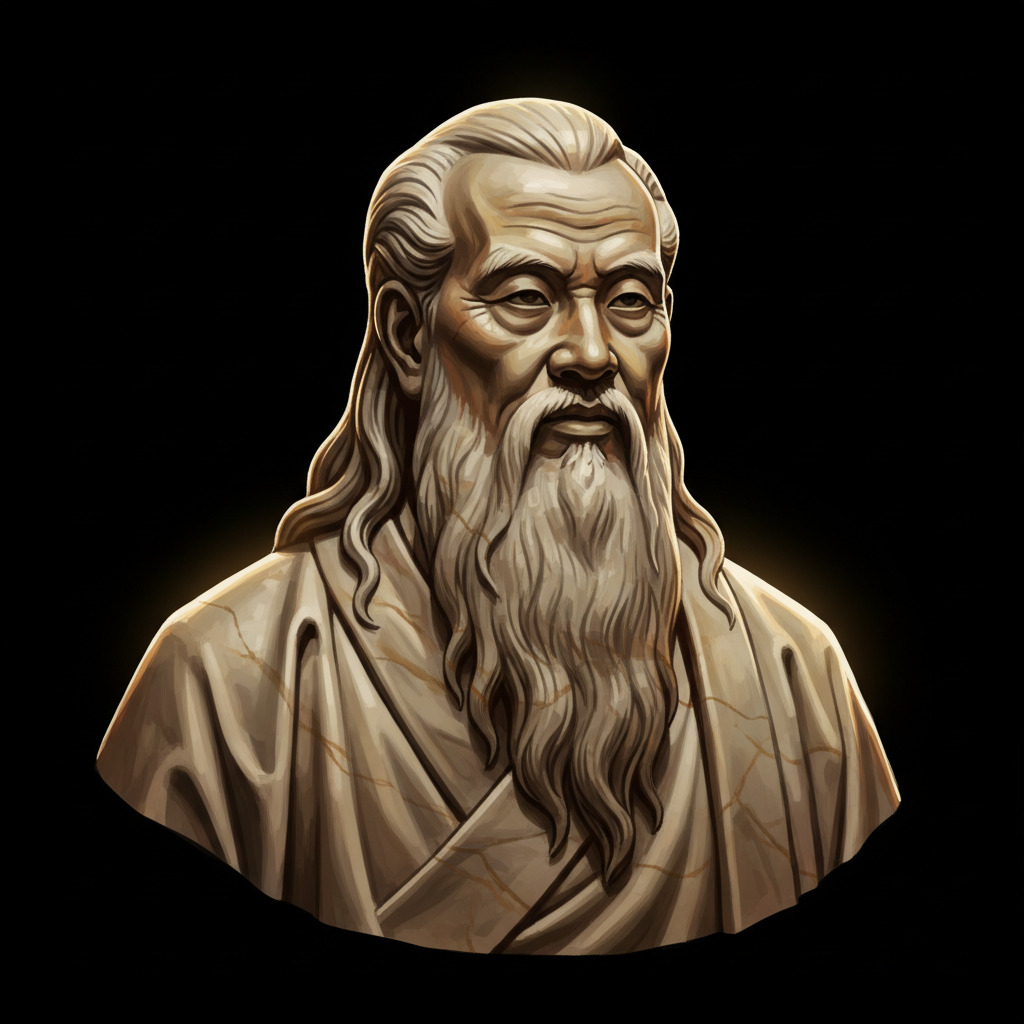
Reputed founder of Taoism and author of the Tao Te Ching, whose wu wei (effortless action) shaped East Asian philosophy. Closely associated with Zhuangzi (later Taoist who extended Laozi's framework). For an intellectual contrast, see Confucius, near-contemporary Chinese sage of social ritual and duty — Confucius systematized social order through ritual and hierarchy; Laozi argued that all such systems were the disease, not the cure — the two founding poles of Chinese moral philosophy.
Found in 1 providers: gemini
1 source checked
True effectiveness comes from not forcing outcomes. When you push hard to make something happen, you create resistance and errors; when you grasp tightly at what you want, it slips away. The advice is to work with the natural flow of situations rather than against them. Let things unfold, respond rather than impose, and you accomplish more than someone straining to control every detail.
This captures wu wei, the central principle Laozi built Taoism around. As a quiet archivist in the Zhou royal court, he reportedly grew disillusioned with political striving and ambition, eventually leaving civilization altogether. His withdrawal from official life embodied his teaching: the more rulers and officials grasped for control, the worse things became. He favored yielding, softness, and non-interference as genuine strength.
Laozi lived during the late Zhou dynasty, an era of collapsing feudal order and constant warfare between rival states. Ambitious lords seized territory, schemed for power, and launched campaigns that ruined common people. Against this backdrop of forceful action and political maneuvering, his message that grasping leads to loss was radical. It offered an alternative to the Confucian emphasis on active moral engagement and the Legalist push for rigid control.
AI-generated insights based on extensive research and information for context. Factual errors? Email [email protected].
Your cart is empty