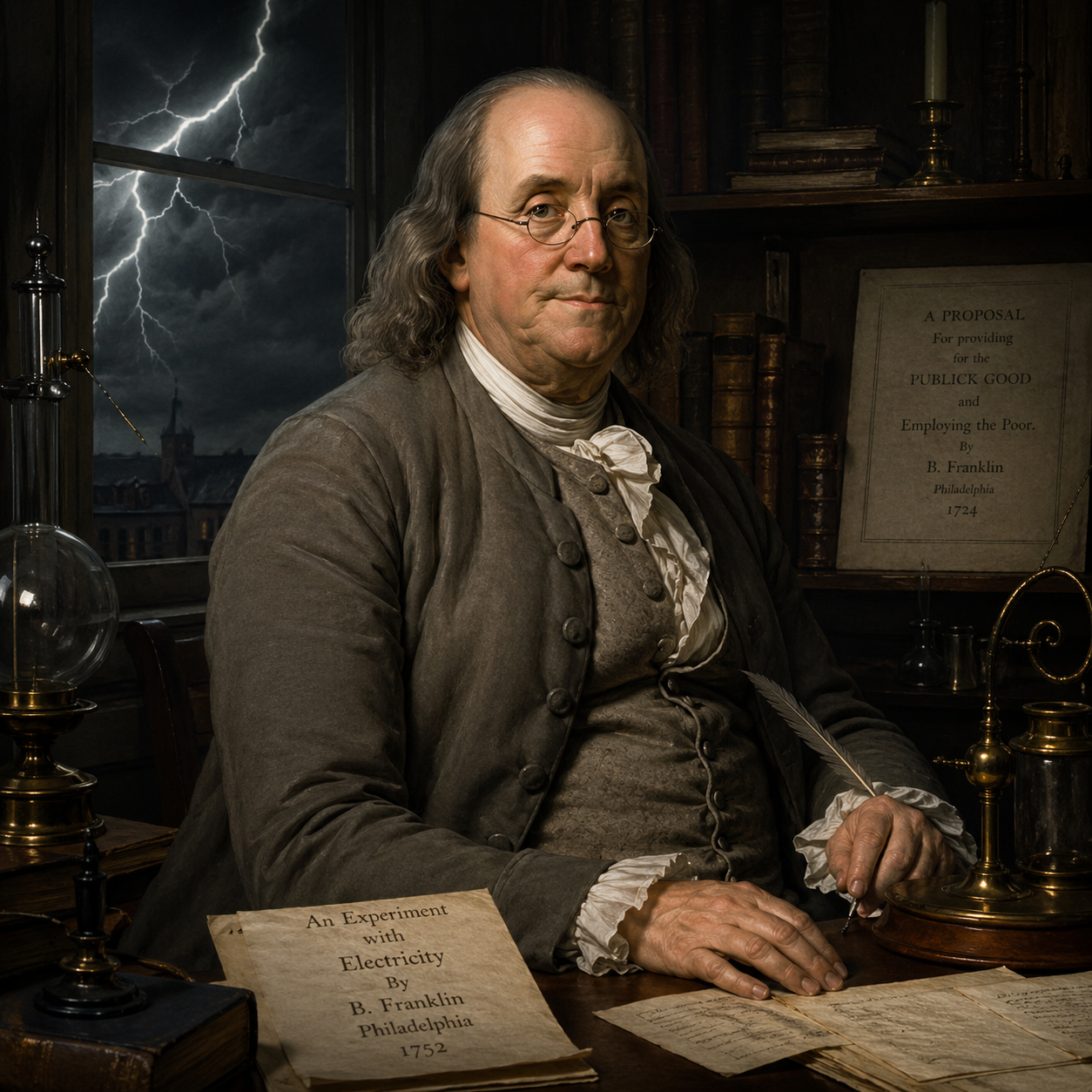
Benjamin Franklin — "After Supper walk a Mile, after Dinner sleep a while."
After Supper walk a Mile, after Dinner sleep a while.
After Supper walk a Mile, after Dinner sleep a while.
Click any product to generate a realistic preview. Up to 3 at a time.
* Initial load can take up to 90 seconds — revising the preview in another color is nearly instant.
"To cross the sea takes naught but a pair of legs and the will to swim."
"Never ruin an apology with an excuse."
"Eat to please yourself, but dress to please others."
"The greatest invention of the world is the invention of good bread."
"He that by the Plough would thrive, Himself must either hold or drive."
Polymath Founding Father, diplomat, and Poor Richard's Almanack author who helped draft the Declaration of Independence and the Constitution. Closely associated with John Adams (fellow Founder, Massachusetts statesman) and Thomas Jefferson (fellow Declaration drafter). For an intellectual contrast, see Thomas Hutchinson, last royal governor of colonial Massachusetts — Franklin leaked Hutchinson's loyalist correspondence to Boston in 1772 to inflame revolutionary sentiment — Hutchinson represented the colonial-aristocrat crown-loyalty that Franklin's revolution was organized to dismantle.
Found in 1 providers: grok
1 source checked
Walk after your evening meal and rest after your midday meal. It matches activity to meal timing: the heavier midday dinner warrants a restorative nap to aid digestion, while a lighter supper benefits from a brisk walk before sleep. The rhyming form makes it easy to recall. The core idea is simple—calibrate movement and rest around when and how much you eat, and your body will function better.
Franklin published practical maxims like this in Poor Richard's Almanack, which reached tens of thousands of colonists annually. He believed in systematic self-improvement grounded in observation, not theory. His own life reflected this: he lived to 84, exceptional for his era, and credited disciplined daily habits. As a printer, inventor, and statesman, he prized efficient routines, and this couplet fits his empirical, no-nonsense philosophy of applying reason to ordinary living.
In 18th-century colonial America, 'dinner' meant the heavy midday meal and 'supper' a lighter evening one—the reverse of modern usage. Formal medicine was primitive; bloodletting and purges were standard treatments, and digestive ailments were rampant. Walking was one of the few reliably beneficial health interventions available. Franklin's era also marked the Enlightenment, a moment when educated people began applying observation and reason to daily habits, elevating folk health wisdom into something closer to practical science.
AI-generated insights based on extensive research and information for context. Factual errors? Email [email protected].
Your cart is empty