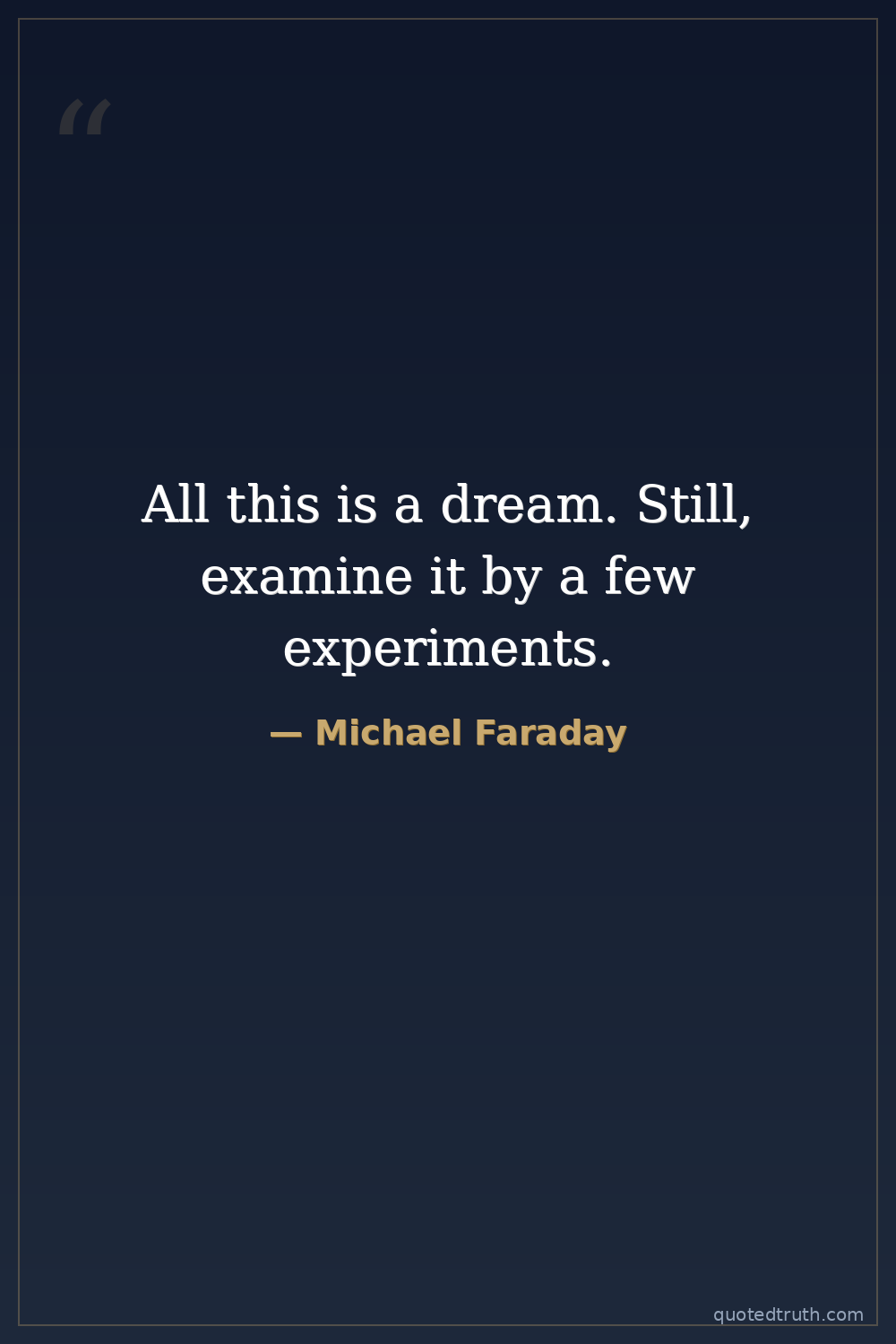
Michael Faraday — "All this is a dream. Still, examine it by a few experiments."
All this is a dream. Still, examine it by a few experiments.
All this is a dream. Still, examine it by a few experiments.
Click any product to generate a realistic preview. Up to 3 at a time.
* Initial load can take up to 90 seconds — revising the preview in another color is nearly instant.
"Magnetic curves are lines of force; they are not only lines of force but lines of action."
"I am a simple man, and I have found great joy in the study of nature."
"The human mind is a wonderful thing, and it is capable of doing wonders."
"I am not afraid of failure, for it is through failure that we learn."
"The greatest error is to believe that one knows everything."
Found in 1 providers: deepseek
1 source checked
Speculation and imagination are not enough. Even the most compelling idea should be treated as tentative until tested against reality. Before accepting a theory, strip it down and design concrete trials to see whether it actually holds up. Don't dismiss bold guesses, but don't trust them either. Run the experiment, watch what happens, and let the result decide whether the vision was insight or illusion.
Faraday built his career on this exact principle. A self-taught bookbinder's apprentice with no formal mathematics, he relied on meticulous experimentation rather than theoretical elegance. His discovery of electromagnetic induction in 1831 came from patiently testing coils, magnets, and currents in thousands of trials. He distrusted unverified hypotheses, including his own intuitions about fields and lines of force, and insisted that laboratory evidence, not speculation, must anchor scientific belief.
Faraday worked in early-to-mid 1800s Britain, when natural philosophy was shifting from gentlemanly speculation toward rigorous experimental science. The Royal Institution, where he lectured, championed public demonstration and reproducible results. Romantic-era thinkers were tempted by grand unifying visions of nature, while industrial advances in electricity, chemistry, and steam demanded practical verification. Faraday's insistence on testing ideas helped cement the modern scientific method at a moment when electromagnetism was transforming communication and power.
AI-generated insights based on extensive research and information for context. Factual errors? Email [email protected].
Your cart is empty