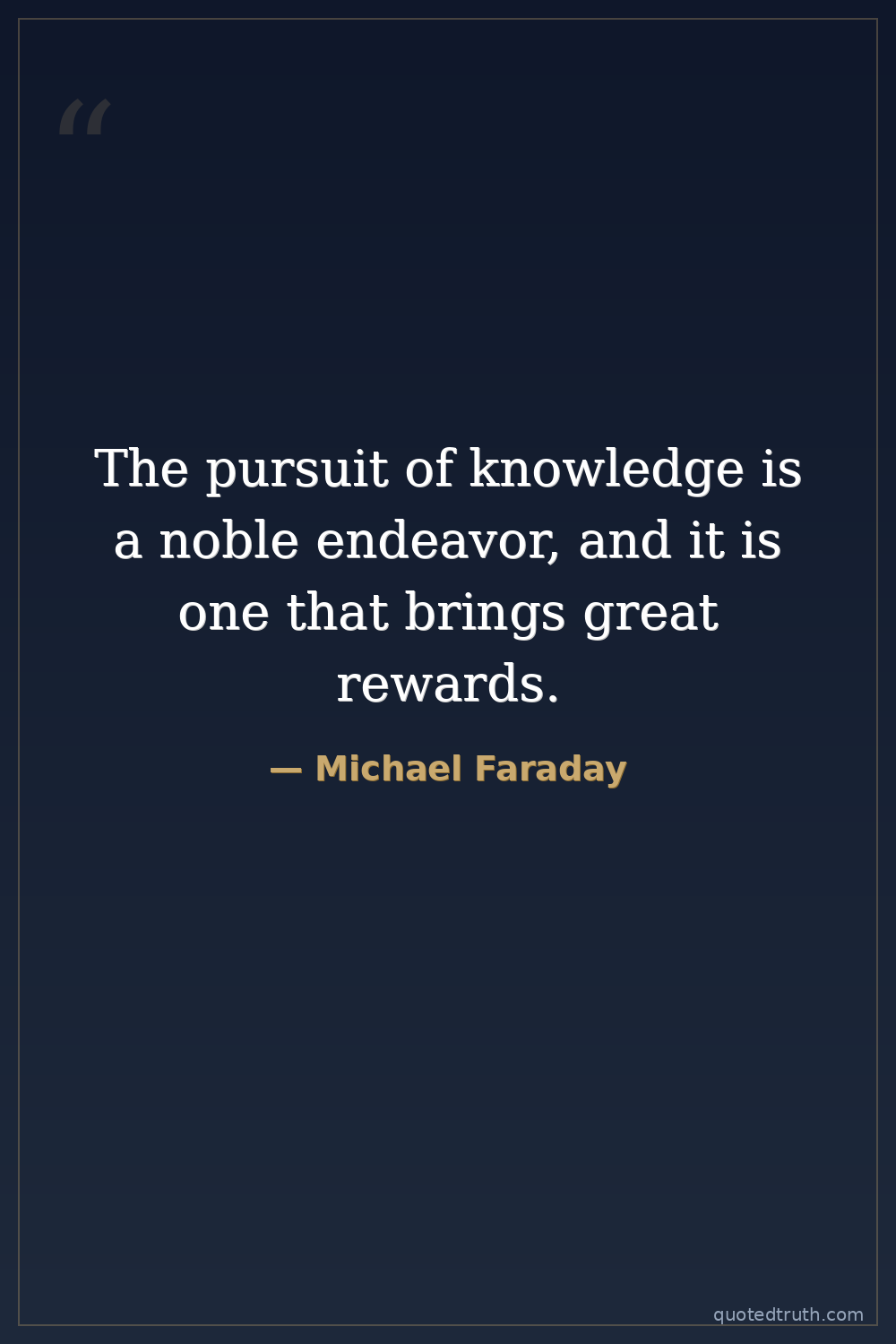
Michael Faraday — "The pursuit of knowledge is a noble endeavor, and it is one that brings great re…"
The pursuit of knowledge is a noble endeavor, and it is one that brings great rewards.
The pursuit of knowledge is a noble endeavor, and it is one that brings great rewards.
Click any product to generate a realistic preview. Up to 3 at a time.
* Initial load can take up to 90 seconds — revising the preview in another color is nearly instant.
"I have always tried to make my lectures as clear and simple as possible, so that they may be understood by all."
"The greatest error is to believe that one knows everything."
"But still try, for who knows what is possible?"
"I am busy just now again on the old subject of light and experiment, and hope to have some new views to bring out."
"There's nothing quite as frightening as someone who knows they are right."
Attributed, expressing his philosophical view on scientific inquiry.
Date: Mid 19th Century (approx.)
EducationalFound in 1 providers: grok
1 source checked
Seeking understanding and learning new things is a worthy, honorable activity that pays back the effort you put in. The rewards aren't just money or status, but deeper satisfaction, practical discoveries, and a richer view of the world. Curiosity, in other words, is worth taking seriously as a life's work because chasing it reliably leaves you better off than you started.
Faraday lived this idea. Born poor, apprenticed to a bookbinder, he taught himself science by reading the volumes he stitched, then talked his way into Humphry Davy's lab. With almost no formal math, he discovered electromagnetic induction, the basis of electric motors and generators. He declined a knighthood and the Royal Society presidency, preferring the bench. For him, knowledge itself was the reward.
Faraday worked through the early-to-mid 1800s, when the Industrial Revolution was remaking Britain and science was shifting from gentleman's hobby to professional discipline. The Royal Institution's public lectures, which he headlined, drew huge crowds eager to understand electricity, chemistry, and steam. Self-improvement literature flourished, and working-class men were, for the first time, accessing scientific education through mechanics' institutes, making Faraday's rags-to-laboratory arc a cultural touchstone.
AI-generated insights based on extensive research and information for context. Factual errors? Email [email protected].
Your cart is empty