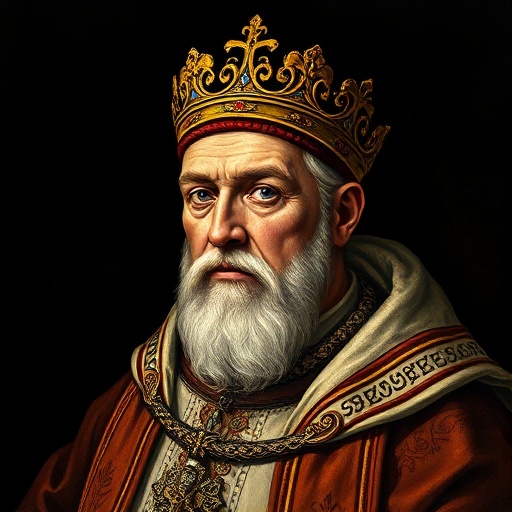
Pope Urban II — "All who die in the true faith will receive the crown of life."
All who die in the true faith will receive the crown of life.
All who die in the true faith will receive the crown of life.
Click any product to generate a realistic preview. Up to 3 at a time.
* Initial load can take up to 90 seconds — revising the preview in another color is nearly instant.
"Whatever Christians still remain in hiding there are sought out with unheard of tortures."
"Let those who have been accustomed to fight for a little gain against Christians, now fight for an eternal reward against the infidels."
"When they wish to torture people by a base death, they perforate their navels, and dragging forth the extremity of the intestines, bind it to a stake; then with flogging they lead the victim around un…"
"All who are burdened with debt and wish to escape it, let them join this holy expedition."
"Let those who have been hired for a few pieces of silver now receive an eternal reward."
Pope (1088-1099) whose Council of Clermont speech (November 1095) launched the First Crusade — the founding event of nine centuries of Christian-Muslim military conflict. Closely associated with Pope Gregory VII (his predecessor on papal-imperial reform). For an intellectual contrast, see Saladin, Kurdish-Muslim Sultan of Egypt and Syria (1138-1193) — Saladin recaptured Jerusalem in 1187, undoing the First Crusade Urban II launched 92 years earlier. Saladin's chivalrous treatment of Christian prisoners became the canonical Muslim counter-image to Crusader brutality. The cleanest before/after pairing of the Crusades' moral arc.
Found in 1 providers: grok
1 source checked
This quote promises eternal life as a reward for dying while holding sincere Christian belief. "Crown of life" draws from scripture (James 1:12, Revelation 2:10), symbolizing the heavenly prize awaiting the faithful. It frames death not as loss but as the ultimate spiritual victory—provided the person genuinely held the faith. It collapses fear of death by reframing it as a guaranteed passage to divine reward for the truly devout.
Urban II made this promise operational at the Council of Clermont in 1095, offering full spiritual indulgence to crusaders who died fighting for the faith. A former Cluniac monk and reformist pope, he deeply believed Christianity demanded sacrifice. This quote captures his theology of holy war: death in service to God was not failure but triumph. He used this promise to recruit armies, legitimize violence, and bind fractured Western Christendom behind a single sacred mission.
In 11th-century Europe, the afterlife was immediate psychological reality—fear of hell and purgatory shaped every decision laypeople made. Jerusalem had fallen under Seljuk Turkish control, and the Byzantine Empire was crumbling. Urban II's 1095 crusade call offered full remission of sins to those who fought and died. This transformed battlefield death into spiritual promotion. The Church wielded extraordinary authority over salvation, making such promises genuinely motivating—soldiers could trade mortal risk for guaranteed heavenly reward.
AI-generated insights based on extensive research and information for context. Factual errors? Email [email protected].
Your cart is empty