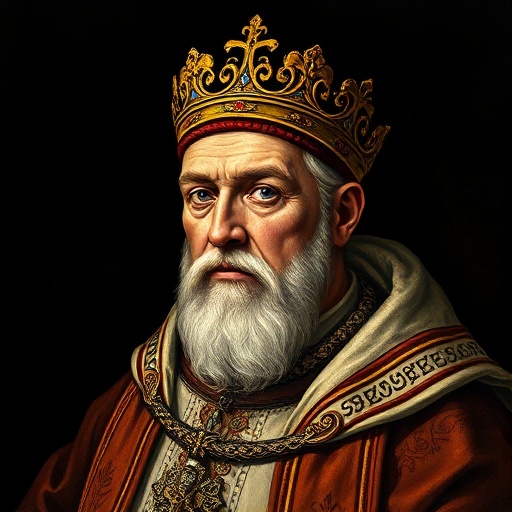
Pope Urban II — "For the land which you inhabit, shut in on all sides by the seas and surrounded …"
For the land which you inhabit, shut in on all sides by the seas and surrounded by the mountain peaks, is too narrow for your large population.
For the land which you inhabit, shut in on all sides by the seas and surrounded by the mountain peaks, is too narrow for your large population.
Click any product to generate a realistic preview. Up to 3 at a time.
* Initial load can take up to 90 seconds — revising the preview in another color is nearly instant.
"Let no one who has entered upon this pilgrimage turn back."
"Let our lives be stronger than death to fight against the enemies of the Christian people."
"From the confines of Jerusalem and the city of Constantinople a horrible tale has gone forth and very frequently has been brought to our ears, namely, that a race from the kingdom of the Persians, an …"
"If you must have blood, bathe in the blood of the infidels."
"Let those who have been robbers, now become soldiers of Christ."
Pope (1088-1099) whose Council of Clermont speech (November 1095) launched the First Crusade — the founding event of nine centuries of Christian-Muslim military conflict. Closely associated with Pope Gregory VII (his predecessor on papal-imperial reform). For an intellectual contrast, see Saladin, Kurdish-Muslim Sultan of Egypt and Syria (1138-1193) — Saladin recaptured Jerusalem in 1187, undoing the First Crusade Urban II launched 92 years earlier. Saladin's chivalrous treatment of Christian prisoners became the canonical Muslim counter-image to Crusader brutality. The cleanest before/after pairing of the Crusades' moral arc.
Found in 1 providers: grok
1 source checked
Urban argues that Europe is geographically confined and demographically strained — too many people competing for too little land. He frames outward expansion as a practical necessity, not merely a religious duty. The overcrowded homeland can no longer sustain its population, making the march toward Jerusalem a solution to earthly scarcity as much as a spiritual calling. Material need becomes a recruiting argument alongside divine purpose.
Urban II, born Odo of Châtillon, was a Cluniac monk turned diplomat and reformer. As pope since 1088, he understood both ecclesiastical authority and secular motivation. His Clermont speech blended spiritual obligation with pragmatic incentive — a hallmark of his political genius. This line reveals his shrewd grasp of what moved feudal audiences: not just faith, but hunger, land scarcity, and the restlessness of landless younger sons.
In 1095 Europe, population had grown significantly since the Carolingian era, intensifying competition for arable land under feudalism's rigid inheritance system. Younger noble sons inherited nothing; serfs faced subsistence conditions. Simultaneously, Byzantine Emperor Alexios I had pleaded for help against Seljuk Turks who had seized Anatolia and threatened Jerusalem. Urban's demographic argument resonated viscerally — the Crusade offered land, adventure, and salvation to a genuinely land-hungry society.
AI-generated insights based on extensive research and information for context. Factual errors? Email [email protected].
Your cart is empty