Max Planck — "An experiment is a question which science poses to Nature, and a measurement is …"
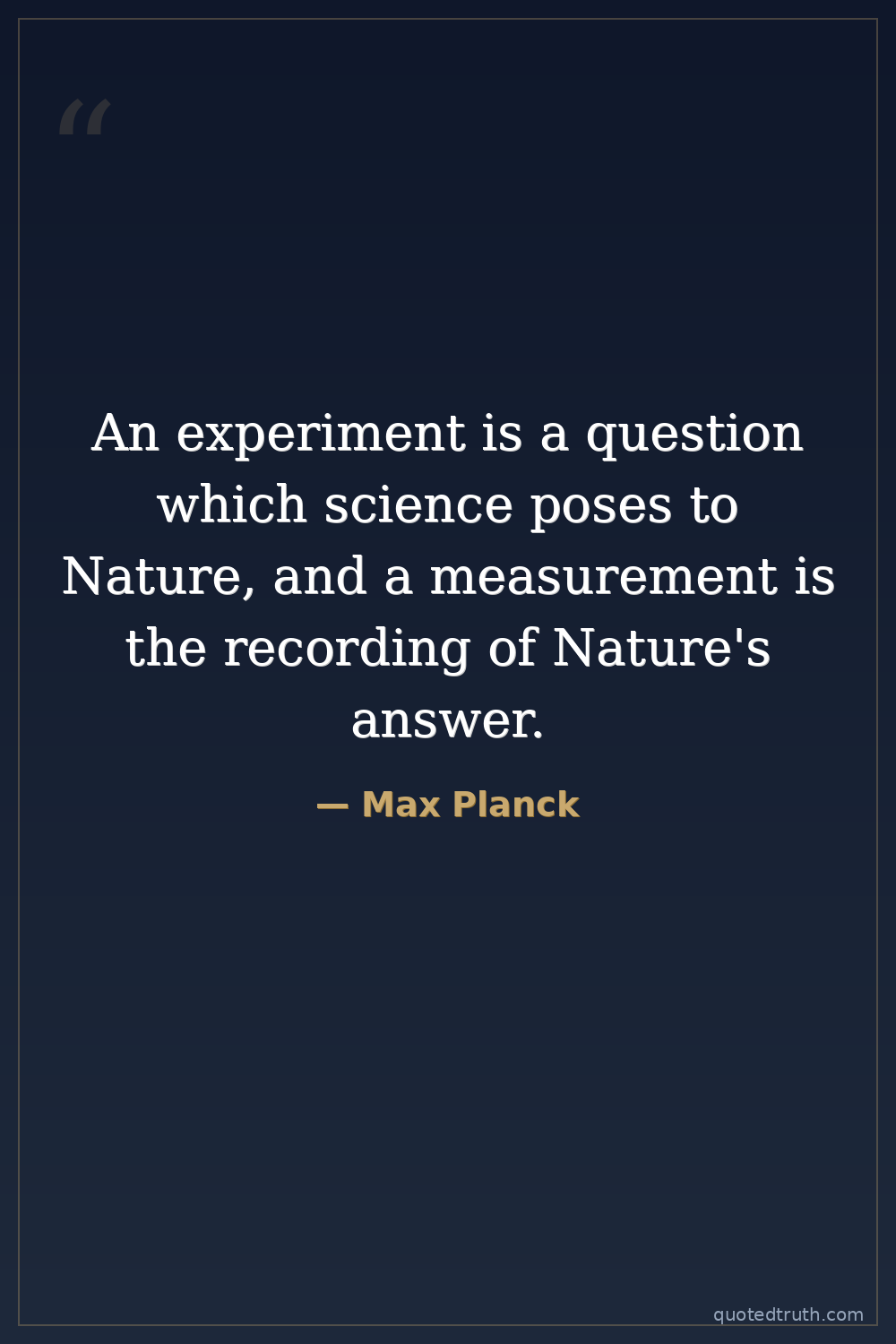
An experiment is a question which science poses to Nature, and a measurement is the recording of Nature's answer.
An experiment is a question which science poses to Nature, and a measurement is the recording of Nature's answer.
Click any product to generate a realistic preview. Up to 3 at a time.
* Initial load can take up to 90 seconds — revising the preview in another color is nearly instant.
"The old pioneers of science, such as Galileo, Kepler, Newton, were deeply religious men."
"The quantum theory has done a great deal for physics, but it has not made it any easier to understand."
"The constant changes in the scientific worldview show how important it is to remain open to new ideas."
"The creative scientist is one who can see things in a new way."
"The pursuit of knowledge is an endless journey."
Found in 1 providers: grok
1 source checked
Science works by asking nature direct questions through carefully designed experiments, and measurements are simply how we write down nature's replies. Rather than guessing or speculating, researchers set up specific conditions to force a clear yes-or-no response from the physical world. The quote frames scientific investigation as an active dialogue: we ask, nature answers, and instruments capture what it says. Truth comes from listening precisely to what reality reveals under controlled conditions.
Planck built his career on precise measurement, studying blackbody radiation data so carefully that he uncovered the quantum of action in 1900. He respected experimental results even when they shattered classical physics, including his own initial assumptions. A rigorous theorist grounded in empirical evidence, he believed mathematical models must answer to observation. This quote captures his lifelong conviction that nature, not human preference, decides which theories survive, a principle that forced him to accept quantum discontinuity.
Planck worked during the late 1800s through early 1900s, when physics was transforming from classical certainty into quantum and relativistic revolution. Laboratories across Germany refined instruments capable of probing atoms, radiation, and subatomic behavior. Experimental precision was exposing cracks in Newtonian mechanics, and the scientific method itself was being defended against philosophical speculation. Industrial Germany invested heavily in physics research, and figures like Einstein, Bohr, and Planck reshaped reality through data-driven inquiry rather than armchair reasoning.
AI-generated insights based on extensive research and information for context. Factual errors? Email [email protected].
Your cart is empty