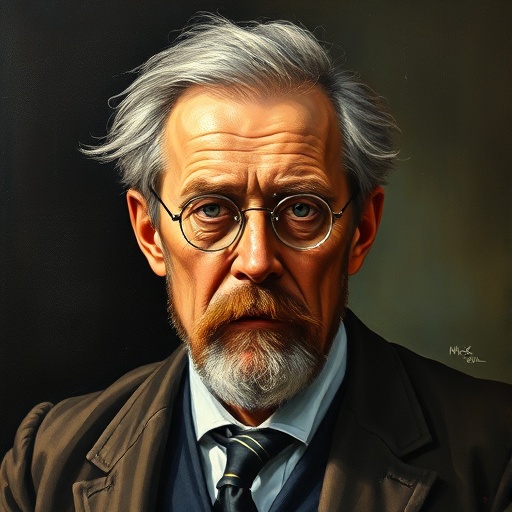
Max Planck — "I regard consciousness as fundamental. I regard matter as derivative from consci…"
I regard consciousness as fundamental. I regard matter as derivative from consciousness.
I regard consciousness as fundamental. I regard matter as derivative from consciousness.
Click any product to generate a realistic preview. Up to 3 at a time.
* Initial load can take up to 90 seconds — revising the preview in another color is nearly instant.
"Science cannot solve the ultimate mystery of nature. And that is because, in the last analysis, we ourselves are a part of nature and therefore a part of the mystery that we are trying to solve."
"I was never a revolutionary. I just wanted to do something useful."
"The greatest joy of a scientist is to be able to communicate his ideas to others."
"An important scientific innovation rarely makes its way by gradually winning over and converting its opponents: it rarely happens that Saul becomes Paul. What does happen is that its opponents gradual…"
"There can never be any real opposition between religion and science; for the one is the complement of the other. Every serious and reflective person realizes, I think, that the religious element in hi…"
Found in 2 providers: deepseek,grok
2 sources checked
Planck is saying that awareness is the bedrock of reality, and physical stuff is secondary, emerging from or depending on mind. Instead of assuming the universe is made of particles and consciousness is a late accident produced by brains, he flips the order: mind comes first, and what we call matter is a pattern or expression arising within consciousness. It's a metaphysical claim placing experience, not atoms, at the foundation of existence.
Planck founded quantum theory in 1900 by proposing energy comes in discrete quanta, shattering classical physics. After decades probing matter's deepest layers, he concluded no purely material explanation held together without an intelligent mind behind it. A devout Lutheran who lectured on religion and science, he saw a conscious intelligence organizing nature's laws. This quote distills his mature view: the physicist who dissected matter ultimately judged consciousness, not matter, primary.
Planck worked from the 1890s through the 1940s, as physics overturned Newtonian certainty. Relativity, quantum mechanics, and the observer's role in measurement destabilized the old materialist picture. Positivism reigned in academia, yet quantum weirdness made leading physicists including Heisenberg, Schrödinger, and Pauli openly entertain mind's role in reality. Two world wars and the Nazi regime, which killed Planck's son, deepened his turn toward spiritual meaning, making such idealist statements resonant among his generation of scientist-philosophers.
AI-generated insights based on extensive research and information for context. Factual errors? Email [email protected].
Your cart is empty