Werner Heisenberg — "An expert is someone who knows some of the worst mistakes that can be made in hi…"
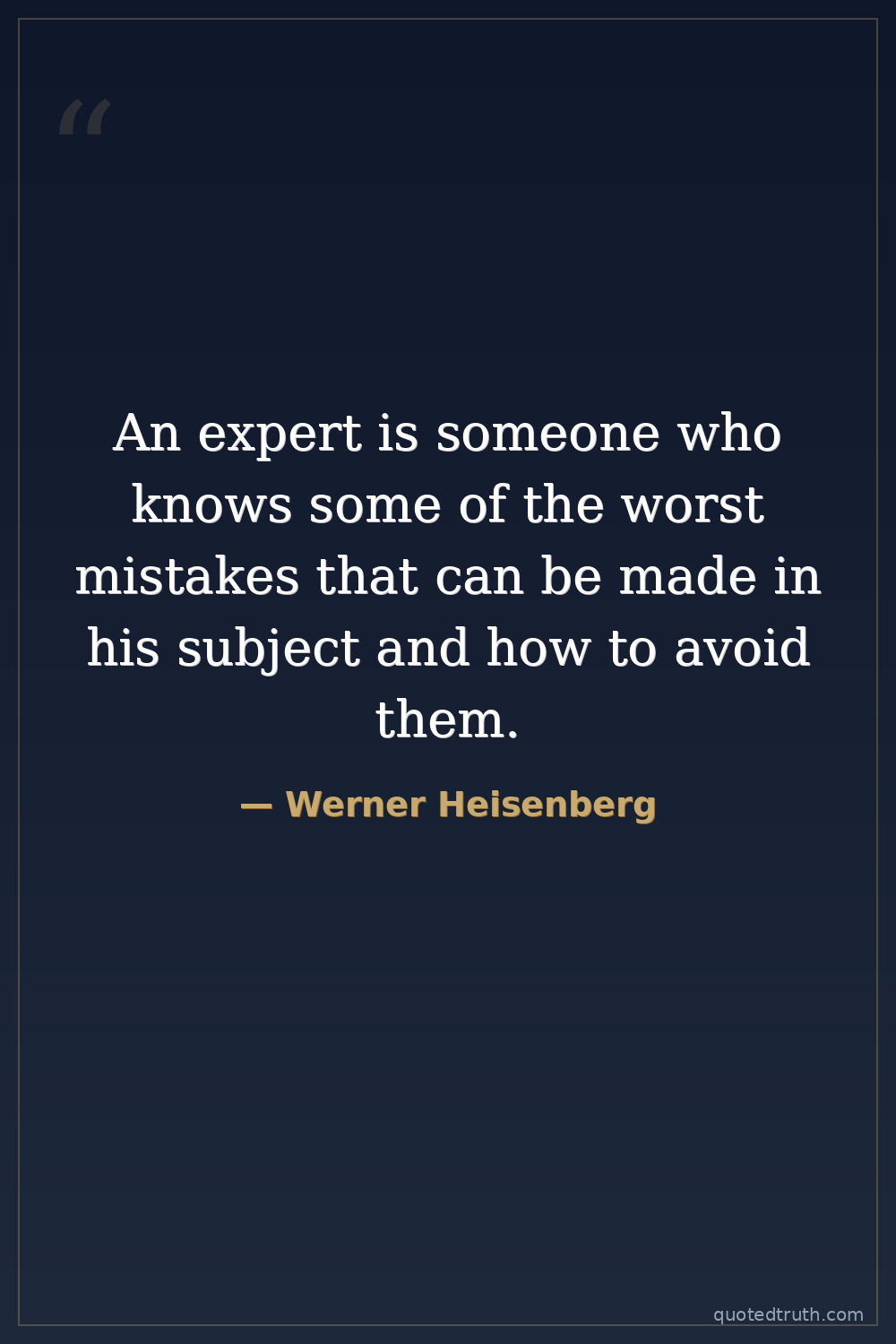
An expert is someone who knows some of the worst mistakes that can be made in his subject and how to avoid them.
An expert is someone who knows some of the worst mistakes that can be made in his subject and how to avoid them.
Click any product to generate a realistic preview. Up to 3 at a time.
* Initial load can take up to 90 seconds — revising the preview in another color is nearly instant.
"The history of physics is not only a sequence of experimental discoveries and observations, but also a history of concepts."
"I was forced to find a new way of expressing the fundamental laws of nature, one which would not rely on the outdated concepts of classical physics."
"I would say that I was absolutely convinced of the possibility of our making a uranium engine. but I never thought that we would make a bomb. and at the bottom of my heart. I was really glad that it w…"
"Science is rooted in conversations."
"The problems of language here are really serious. We wish to speak in some way about the structure of the atoms. But we cannot speak about atoms in ordinary language."
Found in 2 providers: grok,deepseek
2 sources checked
Real expertise is not about knowing everything or being flawless. Instead, it comes from having made or witnessed the major errors in a field and learning how to steer around them. A true expert has internalized the common pitfalls, dead ends, and traps that trip up newcomers, and uses that hard-won knowledge to navigate problems without repeating those costly mistakes themselves.
Heisenberg built quantum mechanics through trial, error, and repeatedly revising failed assumptions about atomic structure. His uncertainty principle itself reframed what science could reliably know, acknowledging inherent limits. As a young physicist mentored by Bohr and Born, he learned by watching giants correct each other's blunders. His controversial wartime leadership of Germany's nuclear program also shows how expertise involves recognizing where catastrophic miscalculations lie.
Heisenberg worked through the 1920s quantum revolution, when classical physics was collapsing and an entire generation of scientists had to abandon intuitive Newtonian assumptions. His era spanned two world wars, the rise and fall of Nazism, and the atomic age's dawn. Scientific progress demanded humility, since yesterday's certainties became today's errors. Postwar reconstruction of German science further underscored how acknowledging past mistakes was central to rebuilding credible expertise.
AI-generated insights based on extensive research and information for context. Factual errors? Email [email protected].
Your cart is empty