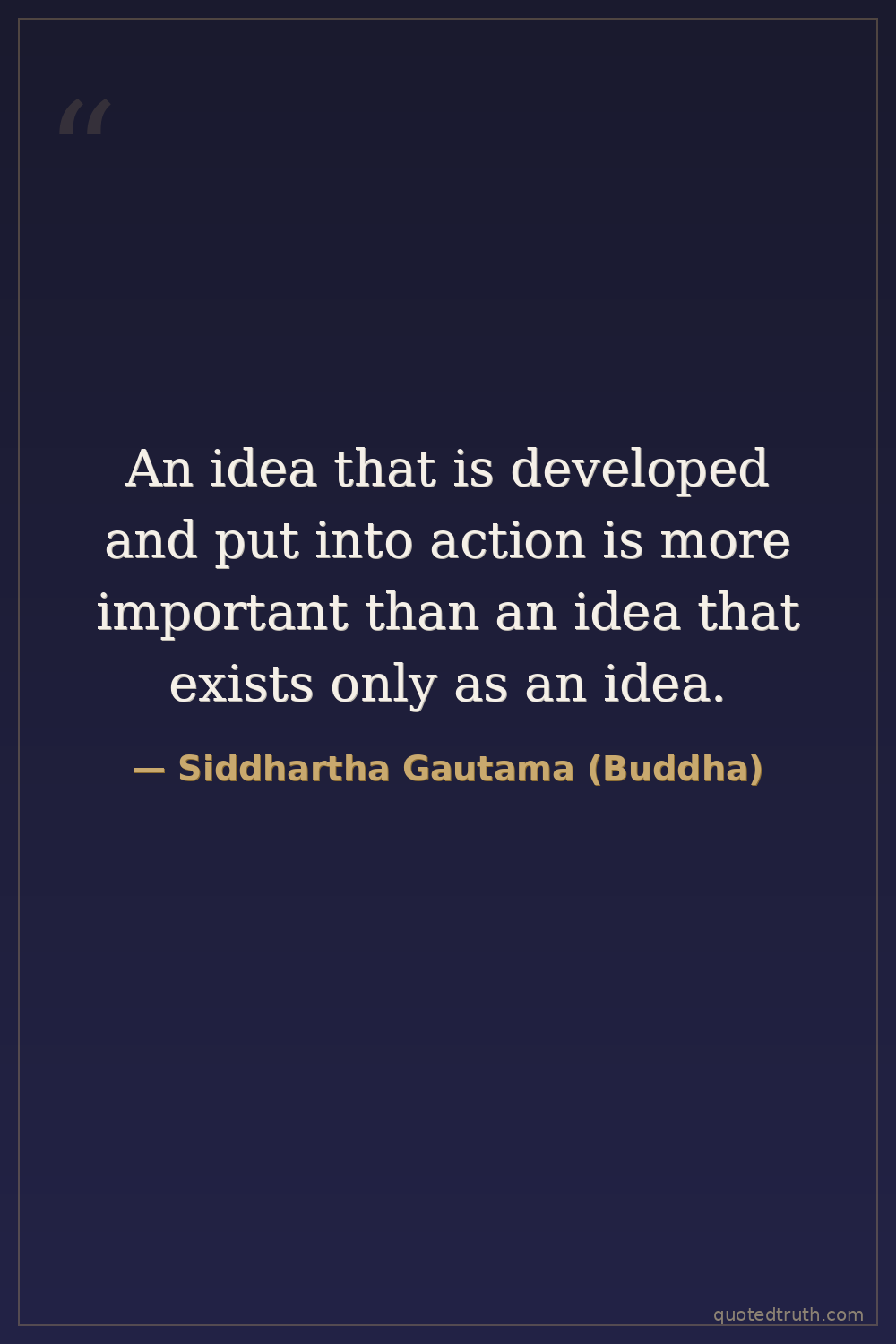
Siddhartha Gautama (Buddha) — "An idea that is developed and put into action is more important than an idea tha…"
An idea that is developed and put into action is more important than an idea that exists only as an idea.
An idea that is developed and put into action is more important than an idea that exists only as an idea.
Click any product to generate a realistic preview. Up to 3 at a time.
* Initial load can take up to 90 seconds — revising the preview in another color is nearly instant.
"An insincere and evil friend is more to be feared than a wild beast; a wild beast may wound your body, but an evil friend will wound your mind."
"I will not look at another's bowl intent on finding fault: a training to be observed."
"Irrigators channel waters, fletchers straighten arrows, carpenters bend wood, the wise master themselves."
"The greatest gift is to give people your enlightenment, to share it. It has to be the greatest."
"Senseless talk brings suffering, for it is thrown right back to you."
Found in 1 providers: gemini
1 source checked
An idea has no real value until someone acts on it. Thinking about a plan, holding a belief, or imagining a solution changes nothing on its own. The moment you translate thought into concrete effort, it gains weight, tests itself against reality, and can actually help someone. Execution, not conception, is what separates a genuine contribution from a daydream. Results come only from ideas you develop and carry through.
The Buddha built his entire teaching around practice, not theory. He reportedly refused to engage in pure metaphysical speculation, calling such debates useless unless they reduced suffering. His Eightfold Path is explicitly action-oriented, covering right effort, right livelihood, and right action. After his awakening under the Bodhi tree, he spent 45 years walking, teaching, and founding the sangha rather than writing treatises. Realized understanding, embodied in conduct, was the whole point of his project.
In 5th-century BCE northern India, Brahmin orthodoxy dominated spiritual life through ritual, Sanskrit scripture, and caste-bound sacrifice. A wave of shramana movements, including Jains, Ajivikas, and early Buddhists, pushed back by emphasizing lived discipline over priestly ceremony. The Buddha taught in Magadhi, the local vernacular, so commoners could practice directly. Against a culture that prized memorized verses and inherited status, insisting that a developed, enacted idea outweighs an unused one was a quietly radical reordering of religious authority.
AI-generated insights based on extensive research and information for context. Factual errors? Email [email protected].
Your cart is empty