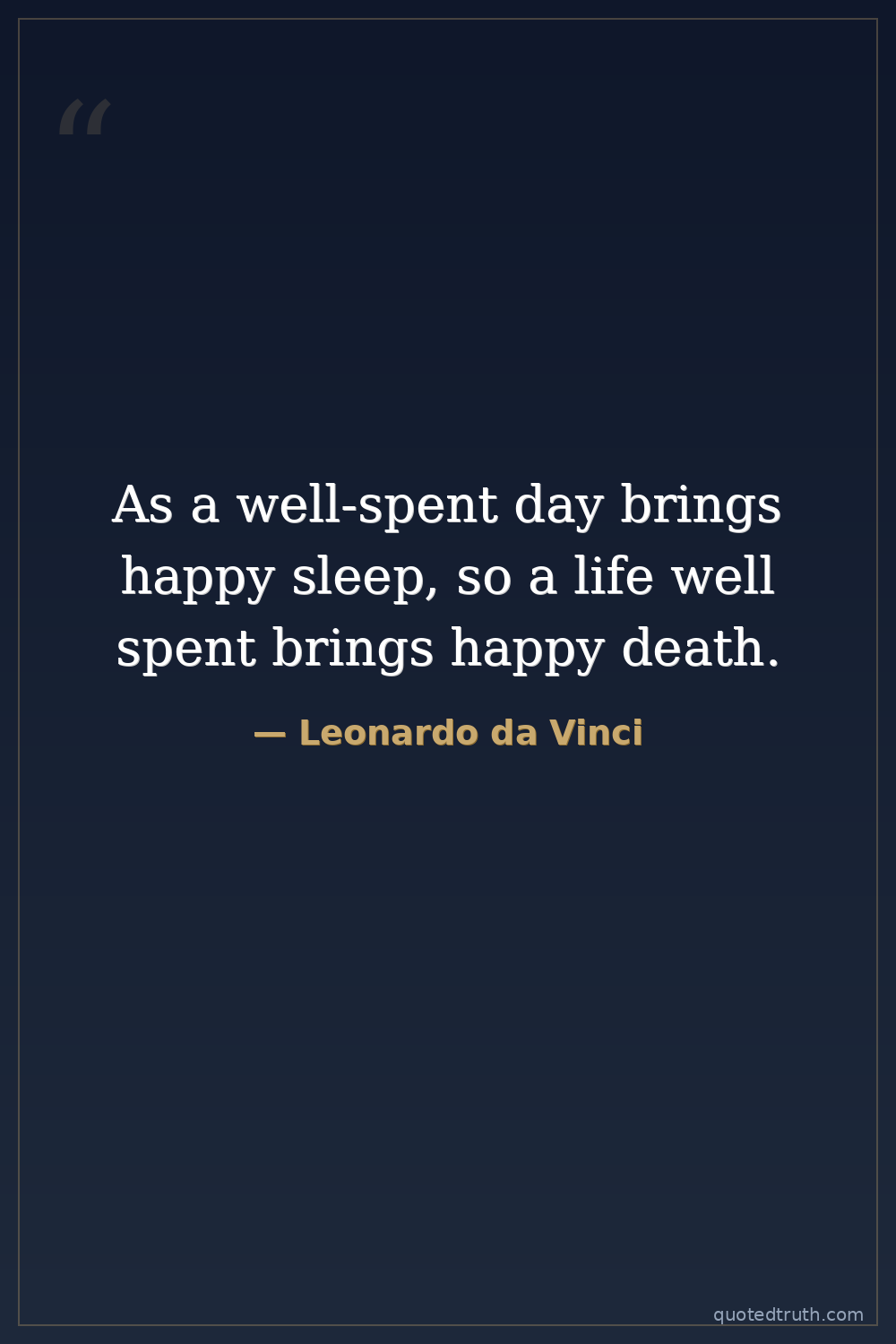
Leonardo da Vinci — "As a well-spent day brings happy sleep, so a life well spent brings happy death."
As a well-spent day brings happy sleep, so a life well spent brings happy death.
As a well-spent day brings happy sleep, so a life well spent brings happy death.
Click any product to generate a realistic preview. Up to 3 at a time.
* Initial load can take up to 90 seconds — revising the preview in another color is nearly instant.
"Human subtlety will never devise an invention more beautiful, more simple or more direct than does nature, because in her inventions nothing is lacking and nothing is superfluous."
"Water is the driving force of all nature."
"An average human looks without seeing, listens without hearing, touches without feeling, eats without tasting, moves without physical awareness, inhales without awareness of odour or fragrance, and ta…"
"The painter who draws merely by practice and by eye, without any reason, is like a mirror which copies everything placed in front of it without understanding."
"Nature is full of infinite causes that have never occurred in experience."
Found in 1 providers: grok
1 source checked
Just as a productive day lets you sleep without regret, a purposeful life lets you face death without fear. The analogy equates the quality of how time is spent with the peace felt at its close. Living with intention, effort, and meaning transforms both endings — nightly and final — from loss into fulfillment. Death, like sleep, becomes a natural reward rather than a reckoning, provided the hours preceding it were genuinely, honestly used.
Leonardo filled thousands of notebook pages with anatomical drawings, mechanical inventions, and scientific observations alongside masterpieces like the Mona Lisa and The Last Supper. He worked obsessively across disciplines, driven by insatiable curiosity. Though he left projects unfinished — the Sforza horse, The Adoration of the Magi — his relentless output embodied this philosophy. He died at 67 in France, reportedly cradled by King Francis I, a peaceful end matching the grandeur of his life's effort.
Da Vinci lived during the Italian Renaissance (1452–1519), when humanist philosophy challenged the medieval Church's focus on suffering and eternal salvation as life's sole purpose. Scholars and artists began celebrating earthly achievement and individual potential. Yet death remained omnipresent — plague outbreaks, warfare, and short life expectancy made mortality unavoidable. This quote bridges secular and spiritual: it reframes death not as divine judgment but as the natural conclusion of a life measured by human accomplishment and honest effort.
AI-generated insights based on extensive research and information for context. Factual errors? Email [email protected].
Your cart is empty