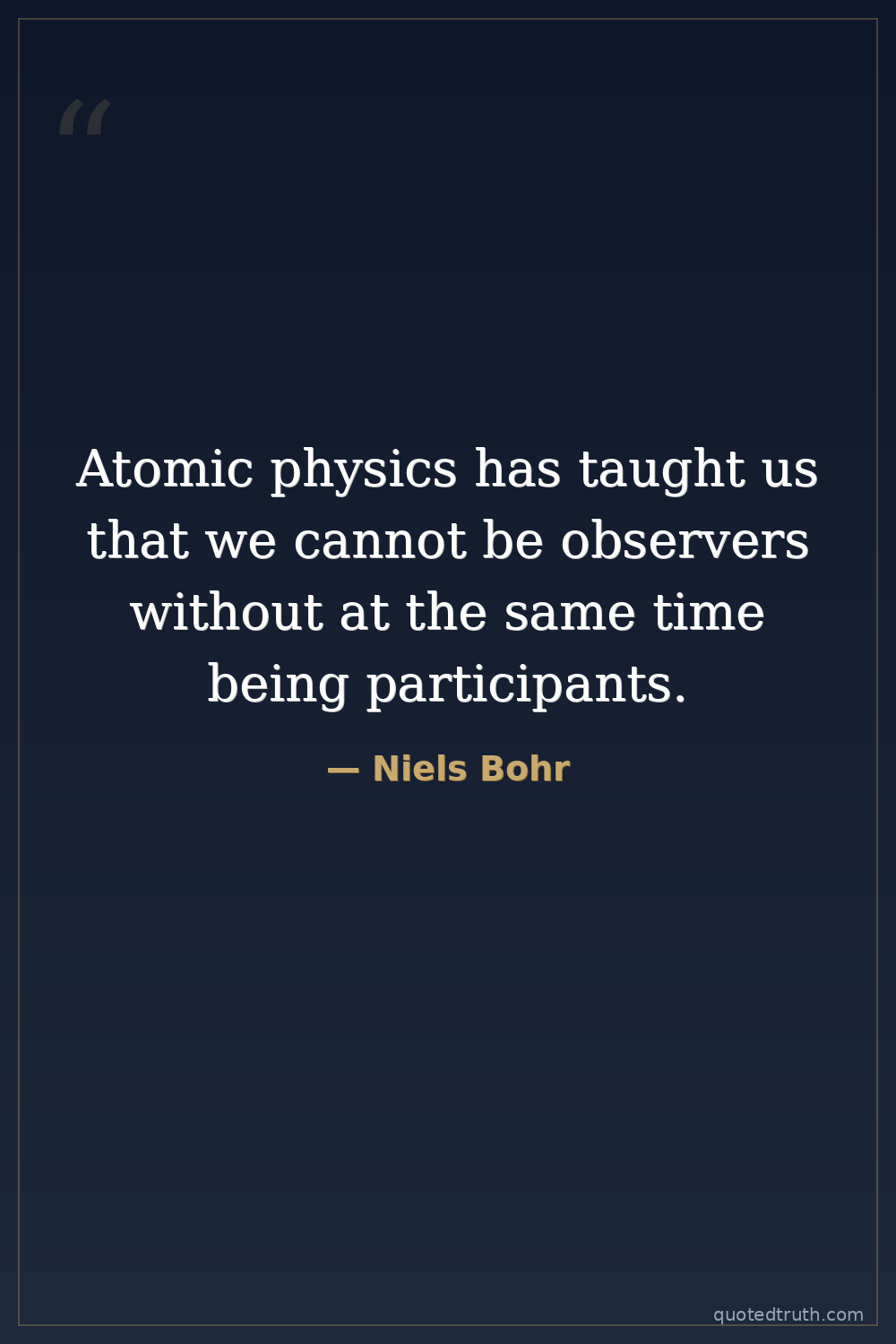
Niels Bohr — "Atomic physics has taught us that we cannot be observers without at the same tim…"
Atomic physics has taught us that we cannot be observers without at the same time being participants.
Atomic physics has taught us that we cannot be observers without at the same time being participants.
Click any product to generate a realistic preview. Up to 3 at a time.
* Initial load can take up to 90 seconds — revising the preview in another color is nearly instant.
"The atom is not a mechanical system, but a system of relationships."
"The electron is an elementary particle, but it is not a 'thing' in the usual sense of the word."
"Every great and deep difficulty bears in itself its own solution. It forces us to change our thinking in order to find it."
"The meaning of life is that it stops."
"The atom is a tiny planetary system. The electrons revolve around the nucleus just as the planets revolve around the sun."
Essays 1958-1962 on Atomic Physics and Human Knowledge
Date: 1955 (essay written)
EducationalFound in 1 providers: grok
1 source checked
When you look closely at something, your act of looking changes it. You cannot stand apart from reality and study it from a safe distance, because the tools and choices you use to measure always leave a mark. Observation is never passive; the observer is always tangled up in the thing being observed, shaping the outcome simply by paying attention and deciding what to look for.
Bohr built the planetary atomic model and co-founded quantum mechanics, where measuring an electron's position disturbs its momentum. His complementarity principle, developed at his Copenhagen institute, insisted that the experimental setup is part of the phenomenon. He extended this lesson beyond physics into philosophy, psychology, and ethics, arguing that humans never study nature from outside it but always from within as engaged participants.
Bohr worked through the 1920s quantum revolution and the 1940s atomic age, when physics collided with world events. The Copenhagen interpretation, Heisenberg's uncertainty principle, and the Manhattan Project all forced scientists to confront that neutral observation was a myth. Bohr himself fled Nazi-occupied Denmark, advised Allied bomb work, and afterward lobbied for open science, embodying an era when researchers could no longer pretend their discoveries stood apart from politics or human consequence.
AI-generated insights based on extensive research and information for context. Factual errors? Email [email protected].
Your cart is empty