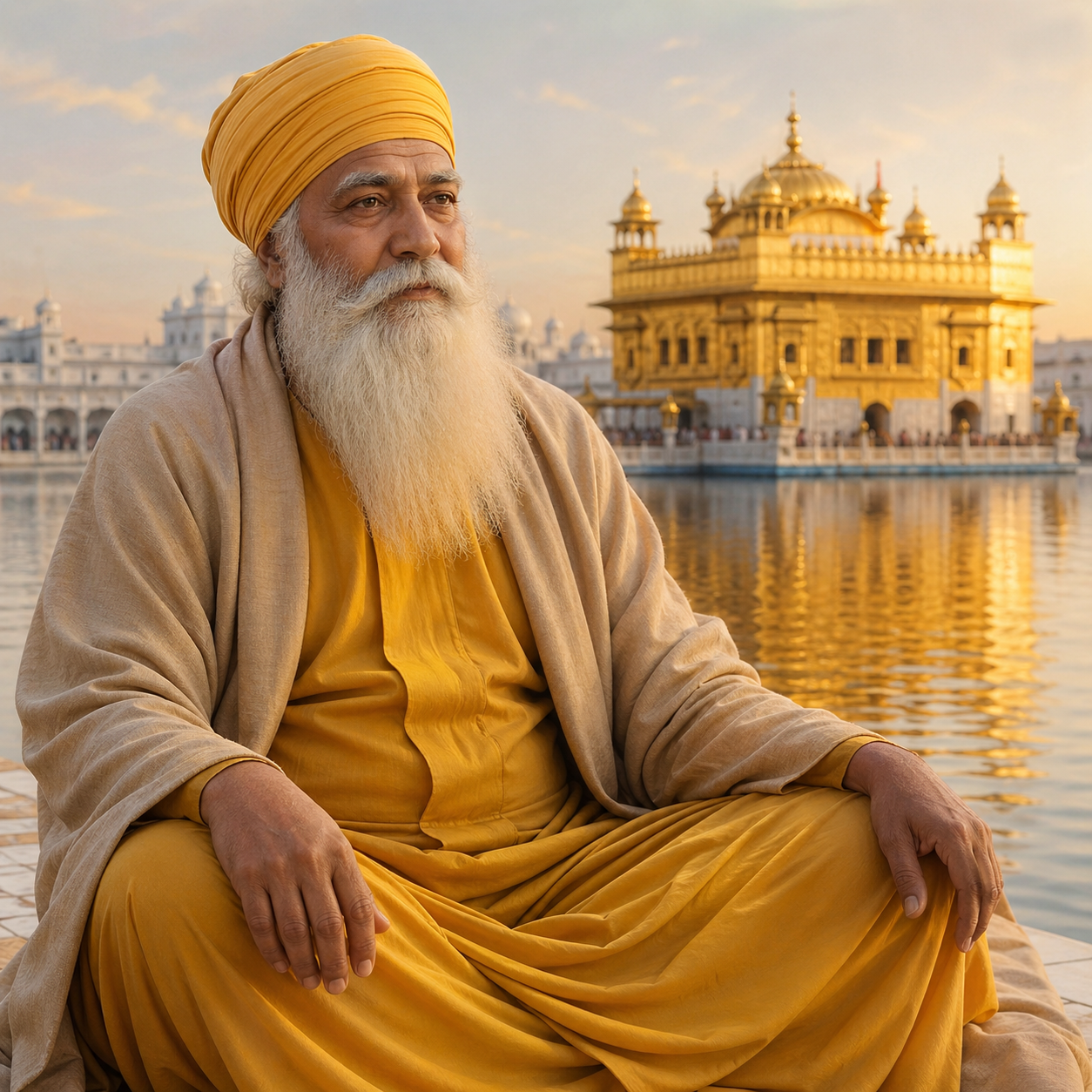
Guru Nanak — "Before becoming a Muslim, a Hindu, a Christian, a Jew, let us become a Human."
Before becoming a Muslim, a Hindu, a Christian, a Jew, let us become a Human.
Before becoming a Muslim, a Hindu, a Christian, a Jew, let us become a Human.
Click any product to generate a realistic preview. Up to 3 at a time.
* Initial load can take up to 90 seconds — revising the preview in another color is nearly instant.
"Hindus are getting Spiritually ruined by worshiping their idols all life and the Muslims by bowing their heads towards Mecca (believing that God exists only in Mecca); but both do not understand/reali…"
"Why call her bad from whom are born kings?"
"The ignorant person is blind, even though he has eyes."
"The Dhoop (burnt incense), lamps and the Naivaed (an offering of eatables presented to deity or idol. All of them become false) by smell. (Then, O Rabb!) If Your Poojaa can be done only with these thi…"
"The Lord is the ocean, and we are the fish in it."
Founder of Sikhism and the first of the Ten Sikh Gurus, whose teachings of one universal God and rejection of caste shaped Punjab. Closely associated with Kabir (mystical poet whose verses appear in the Sikh Guru Granth Sahib). For an intellectual contrast, see Brahmanical orthodoxy, the Hindu caste-and-ritual establishment of his era — Sikhism was founded as a deliberate alternative to both Hindu ritual hierarchy and Islamic exclusivism — Nanak's universalism was a structural rejection of caste and priestly mediation.
Attributed, common in interfaith dialogues, though exact textual source difficult to pinpoint in GGS
Date: c. 15th-16th century CE
WisdomFound in 1 providers: grok
1 source checked
Strip away the labels of religion and nationality and what remains is our shared humanity, which should come first. Before identifying as a member of any faith tradition, we should recognize ourselves and others as human beings worthy of dignity and compassion. Religious identity is secondary to the fundamental ethical obligations we owe each other as people. Our common humanity is the foundation; creeds are built on top of it.
Guru Nanak founded Sikhism in the late 15th century specifically to transcend the bitter Hindu-Muslim divide of Punjab. His famous declaration after enlightenment was 'There is no Hindu, there is no Muslim.' He traveled widely, engaging clerics of both faiths, rejecting caste, ritualism, and sectarian labels. He taught one universal God and the equal dignity of all people, embodied in the langar community kitchen where everyone, regardless of faith or caste, ate together.
Nanak lived 1469–1539 in Punjab under the Delhi Sultanate and then the early Mughal Empire, a period of sharp Hindu-Muslim friction, forced conversions, caste rigidity, and Babur's violent 1526 invasion, which Nanak witnessed and protested. Religious identity dictated taxation, law, and social standing. His call to prioritize shared humanity over sectarian labels was a direct response to the communal violence, spiritual hypocrisy, and rigid hierarchies defining early-modern South Asia.
AI-generated insights based on extensive research and information for context. Factual errors? Email [email protected].
Your cart is empty