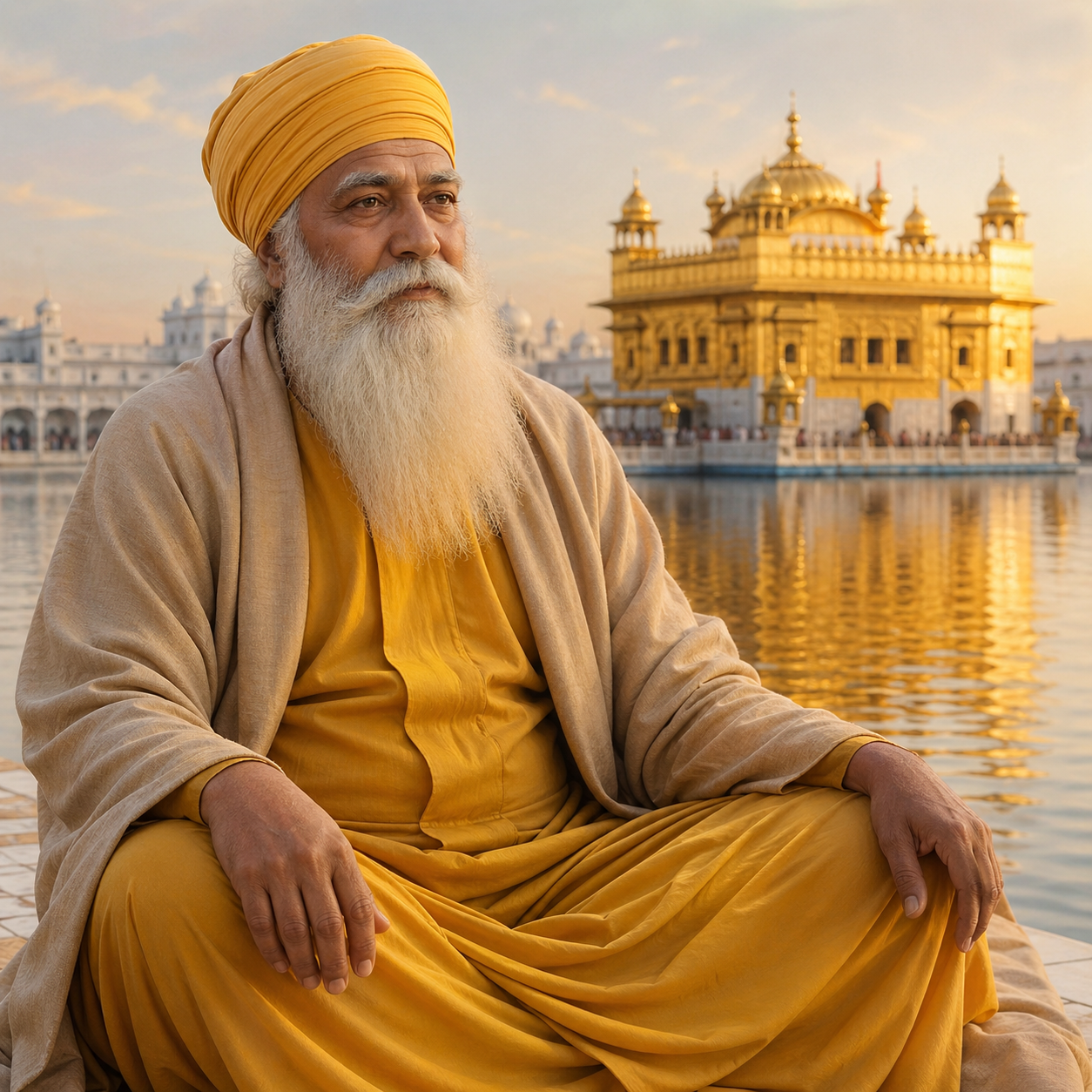
Guru Nanak — "Before becoming a Muslim, a Hindu, a Sikh or a Christian, let's become a Human f…"
Before becoming a Muslim, a Hindu, a Sikh or a Christian, let's become a Human first.
Before becoming a Muslim, a Hindu, a Sikh or a Christian, let's become a Human first.
Click any product to generate a realistic preview. Up to 3 at a time.
* Initial load can take up to 90 seconds — revising the preview in another color is nearly instant.
"Why call her bad from whom are born kings?"
"There is no Hindu and no Musalman."
"Hindus are getting Spiritually ruined by worshiping their idols all life and the Muslims by bowing their heads towards Mecca (believing that God exists only in Mecca); but both do not understand/reali…"
"The world is a house of clay, O Nanak, and the soul is a guest."
"Injustice has no place in God's order because He is absolute just."
Founder of Sikhism and the first of the Ten Sikh Gurus, whose teachings of one universal God and rejection of caste shaped Punjab. Closely associated with Kabir (mystical poet whose verses appear in the Sikh Guru Granth Sahib). For an intellectual contrast, see Brahmanical orthodoxy, the Hindu caste-and-ritual establishment of his era — Sikhism was founded as a deliberate alternative to both Hindu ritual hierarchy and Islamic exclusivism — Nanak's universalism was a structural rejection of caste and priestly mediation.
Found in 1 providers: gemini
1 source checked
This quote argues that religious labels — Muslim, Hindu, Sikh, Christian — are secondary to our shared humanity. Before adopting any faith identity, we should first cultivate what actually makes us human: compassion, integrity, and decency toward others. Religious divisions often become excuses for tribalism and violence. Nanak insists the moral foundation must be our common humanity, and genuine spirituality can only build from there.
Guru Nanak (1469–1539) founded Sikhism explicitly to bridge the Hindu-Muslim divide fracturing his society. He traveled across Asia and the Middle East engaging scholars of every faith. His closest companion was Mardana, a Muslim musician. He rejected caste and priestly gatekeeping, teaching Ik Onkar — one God accessible to all. His entire life demonstrated that shared humanity must precede any religious identity.
Nanak lived during explosive religious conflict in the Indian subcontinent. The Mughal conquest under Babur brought warfare and mass displacement. Hindu-Muslim tensions ran deep, with caste rigidly stratifying Hindu society while Mughal rulers imposed Islamic authority. Religious identity determined legal status, social access, and physical safety. Interfaith violence and forced conversions were realities. Calling people to humanity first was a radical, politically dangerous counter-cultural act.
AI-generated insights based on extensive research and information for context. Factual errors? Email [email protected].
Your cart is empty