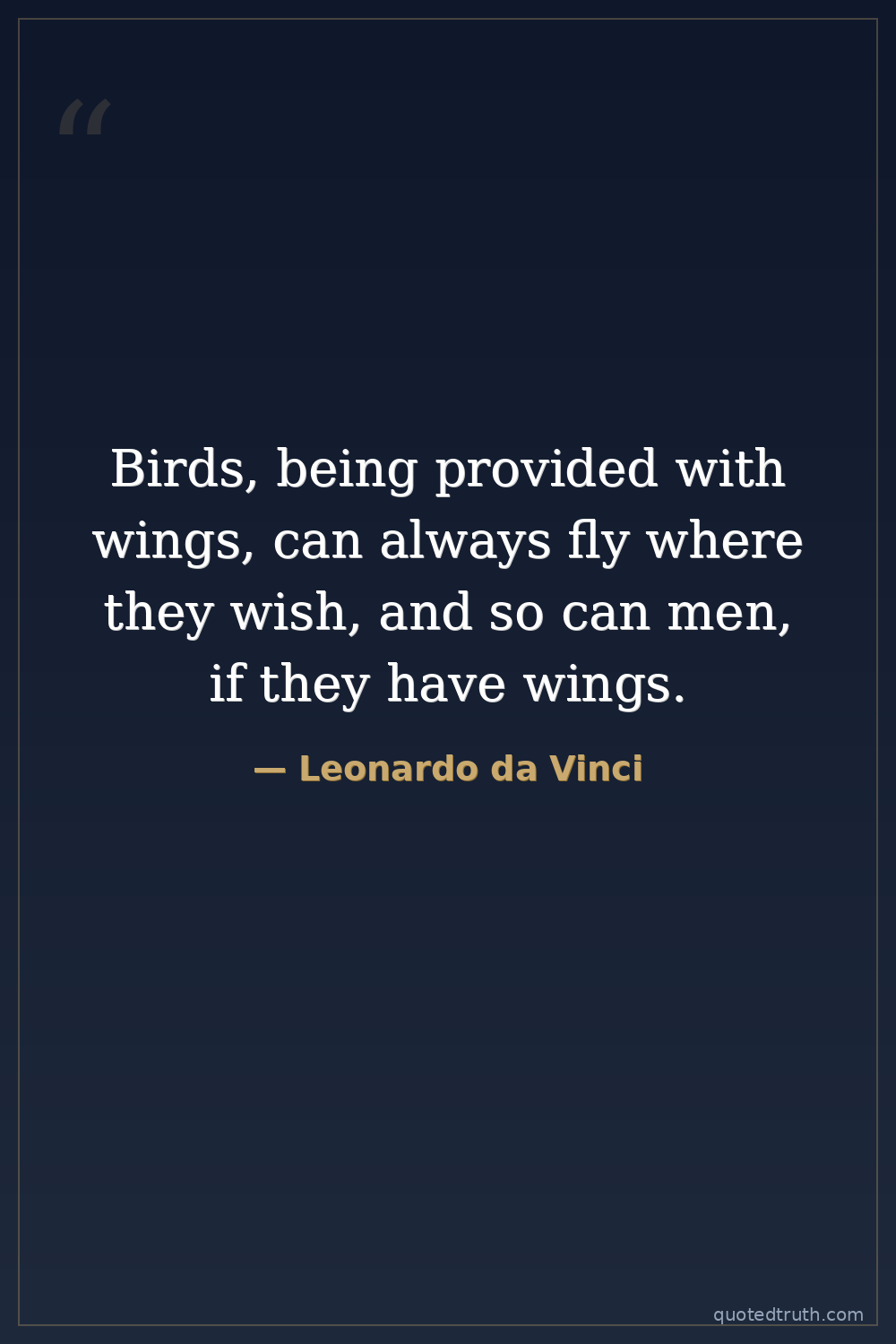
Leonardo da Vinci — "Birds, being provided with wings, can always fly where they wish, and so can men…"
Birds, being provided with wings, can always fly where they wish, and so can men, if they have wings.
Birds, being provided with wings, can always fly where they wish, and so can men, if they have wings.
Click any product to generate a realistic preview. Up to 3 at a time.
* Initial load can take up to 90 seconds — revising the preview in another color is nearly instant.
"An average human looks without seeing, listens without hearing, touches without feeling, eats without tasting, moves without physical awareness, inhales without awareness of odour or fragrance, and ta…"
"The small is a good example of the great."
"Art is never finished, only abandoned."
"The water that you touch in a river is the last of that which has passed, and the first of that which comes; so with present time."
"Man has a body, but no soul."
Found in 1 providers: grok
1 source checked
This quote asserts that human flight is not inherently impossible — it is simply a matter of having the right tools. Just as birds fly because they possess wings, humans could fly if similarly equipped. Capability follows from design, not species. The limitation is not human nature itself but the absence of mechanical means to replicate what nature already demonstrates is entirely achievable through proper engineering.
Da Vinci spent decades studying birds in flight, filling notebooks with anatomical sketches of wings, feathers, and muscle mechanics. His ornithopter designs — flying machines modeled directly on bird anatomy — were concrete attempts to engineer artificial wings for humans. His Treatise on the Flight of Birds (c. 1505) shows he viewed flight not as fantasy but as a solvable engineering problem, and this quote distills that conviction: nature's solutions are blueprints, not boundaries.
In the late 15th and early 16th centuries, the Renaissance reoriented European thought toward human potential and empirical observation of nature. Flight was widely considered the exclusive domain of angels and birds — a divine privilege beyond human reach. Da Vinci's materialist framing, treating flight as a mechanical problem rather than a sacred boundary, was radical. It positioned human ingenuity and craft as capable of equaling what God had granted other creatures, challenging centuries of theological limitation.
AI-generated insights based on extensive research and information for context. Factual errors? Email [email protected].
Your cart is empty