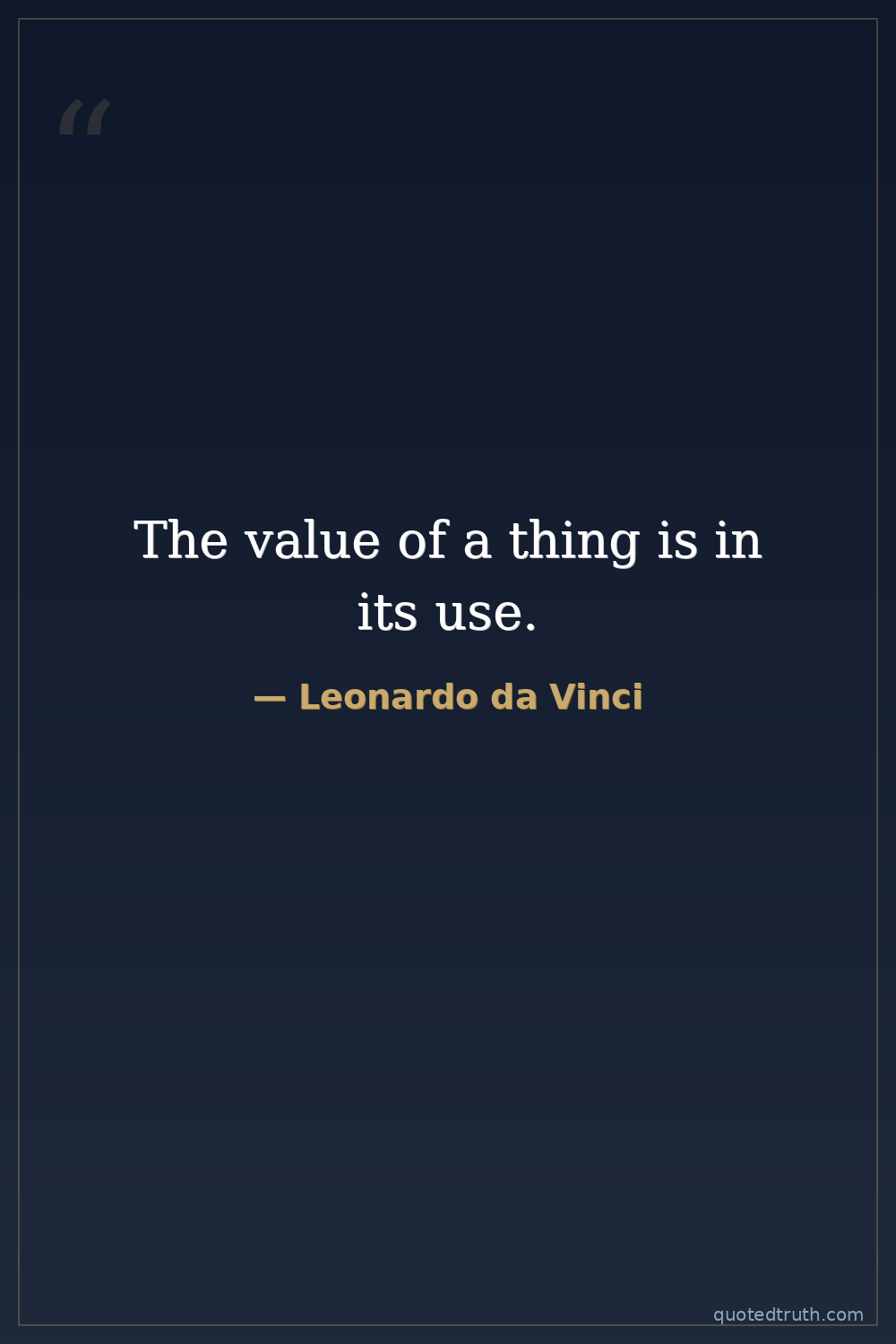
Leonardo da Vinci — "The value of a thing is in its use."
The value of a thing is in its use.
The value of a thing is in its use.
Click any product to generate a realistic preview. Up to 3 at a time.
* Initial load can take up to 90 seconds — revising the preview in another color is nearly instant.
"The wise man will want to be rich only in order to be able to help himself and his friends."
"The mind of the painter is a mirror of the world."
"To develop a complete mind: Study the science of art; Study the art of science. Learn how to see. Realize that everything connects to everything else."
"Oh, how many times have I been deceived by my own opinions!"
"Thou, O God, dost sell us all good things at the price of labour."
Found in 1 providers: grok
1 source checked
Worth isn't inherent or abstract — it's determined by practical application. Something beautiful but unused is worthless; something plain but functional is valuable. It's a utilitarian philosophy: ideas, tools, knowledge, even art derive meaning only through deployment in the real world. Value isn't assigned by possession or appearance, but by what a thing actually does or enables.
Leonardo lived this belief. His notebooks — filled with designs for flying machines, hydraulic systems, war engines, and anatomical studies — were obsessively practical. He dissected corpses not for shock but to understand how muscles function. His paintings solved problems of perspective and light. Even his art was instrumental: The Last Supper engineered to manipulate viewer sight lines. He despised idle theory, calling himself a man without letters who learned from experience.
Leonardo worked during the Italian Renaissance, late 15th to early 16th century, when Europe was transitioning from scholasticism — where truth came from ancient texts — to empirical observation. The printing press had just democratized knowledge. Merchants, guilds, and city-states competed through practical innovation: better weapons, ships, infrastructure. Humanist thinkers began measuring worth by earthly achievement rather than divine revelation. Leonardo's pragmatic view of value as use was both radical and timely.
AI-generated insights based on extensive research and information for context. Factual errors? Email [email protected].
Your cart is empty