Benjamin Franklin — "By failing to prepare, you are preparing to fail."
By failing to prepare, you are preparing to fail.
By failing to prepare, you are preparing to fail.
Click any product to generate a realistic preview. Up to 3 at a time.
* Initial load can take up to 90 seconds — revising the preview in another color is nearly instant.
"Honest cards, short reckonings."
"The discontented man finds no easy chair."
"Who dainties love, shall beggars prove."
"It is a grand mistake to think of being great without ever being good."
"If you would have your business done, go; if not, send."
Polymath Founding Father, diplomat, and Poor Richard's Almanack author who helped draft the Declaration of Independence and the Constitution. Closely associated with John Adams (fellow Founder, Massachusetts statesman) and Thomas Jefferson (fellow Declaration drafter). For an intellectual contrast, see Thomas Hutchinson, last royal governor of colonial Massachusetts — Franklin leaked Hutchinson's loyalist correspondence to Boston in 1772 to inflame revolutionary sentiment — Hutchinson represented the colonial-aristocrat crown-loyalty that Franklin's revolution was organized to dismantle.
Found in 3 providers: deepseek,grok,gemini
3 sources checked
Neglecting preparation is not a neutral act — it is an active choice that guarantees failure. The quote reframes passive inaction as something deliberate: skipping planning functionally selects the worst outcome. In modern terms, it applies everywhere from job interviews to product launches — winging it does not leave you at zero, it puts you at a disadvantage before you even begin.
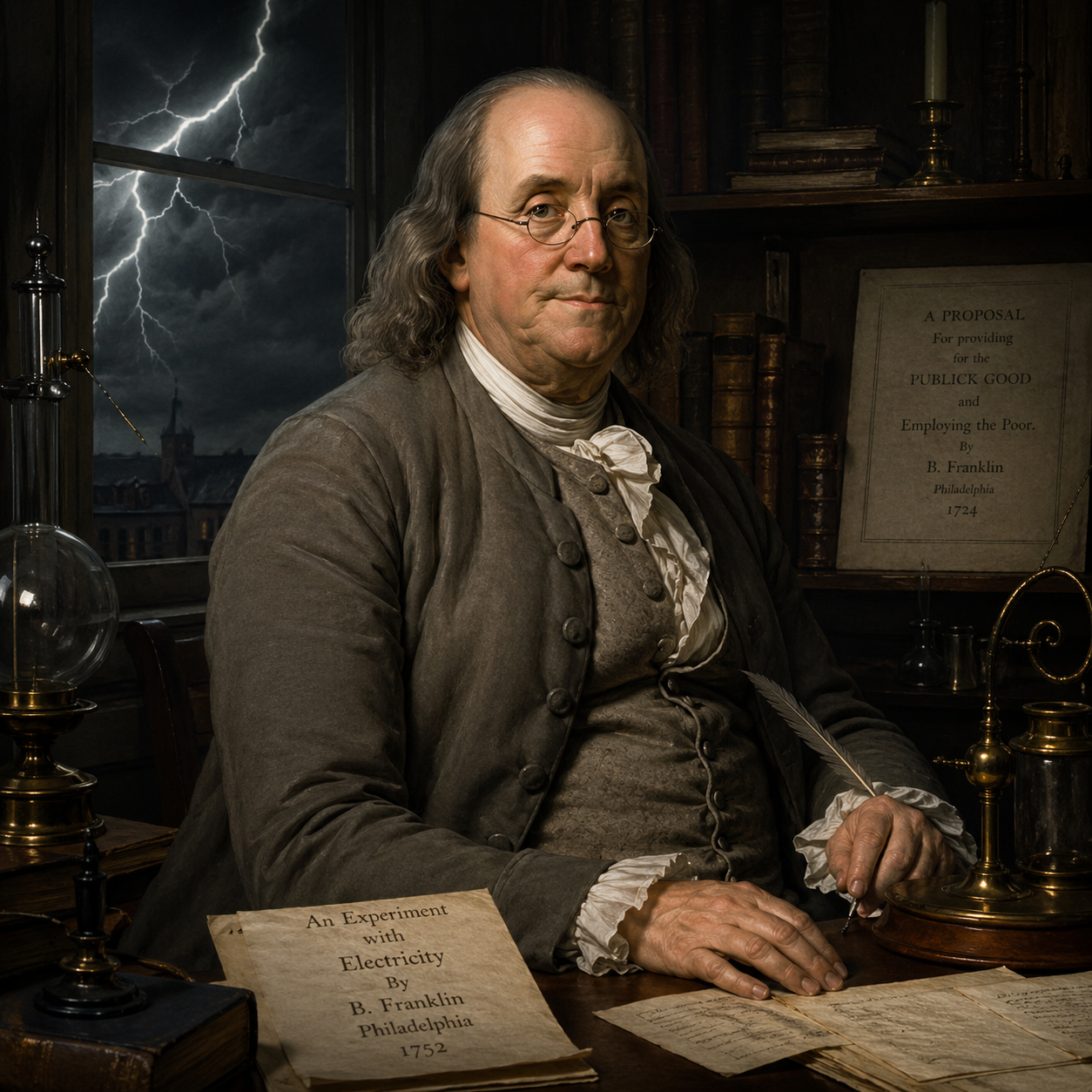
Franklin embodied systematic preparation throughout his life. His kite-and-key electricity experiments required precise planning to avoid death. His decade-long diplomatic mission to France — which secured the alliance that won the Revolution — depended on years of cultivating relationships. He structured each day with a written schedule, taught himself five languages, and built Poor Richard's Almanack from 25 years of disciplined observation.
Franklin's era — colonial America through the early Republic (1706–1790) — made preparation a survival skill. Settlers faced brutal winters, crop failures, and political instability. The Revolutionary War punished the unprepared; ill-equipped armies famously suffered at Valley Forge. The Enlightenment, which shaped Franklin's worldview, championed reason and planning over fate or superstition, making disciplined foresight a moral virtue, not merely a practical one.
AI-generated insights based on extensive research and information for context. Factual errors? Email [email protected].
Your cart is empty