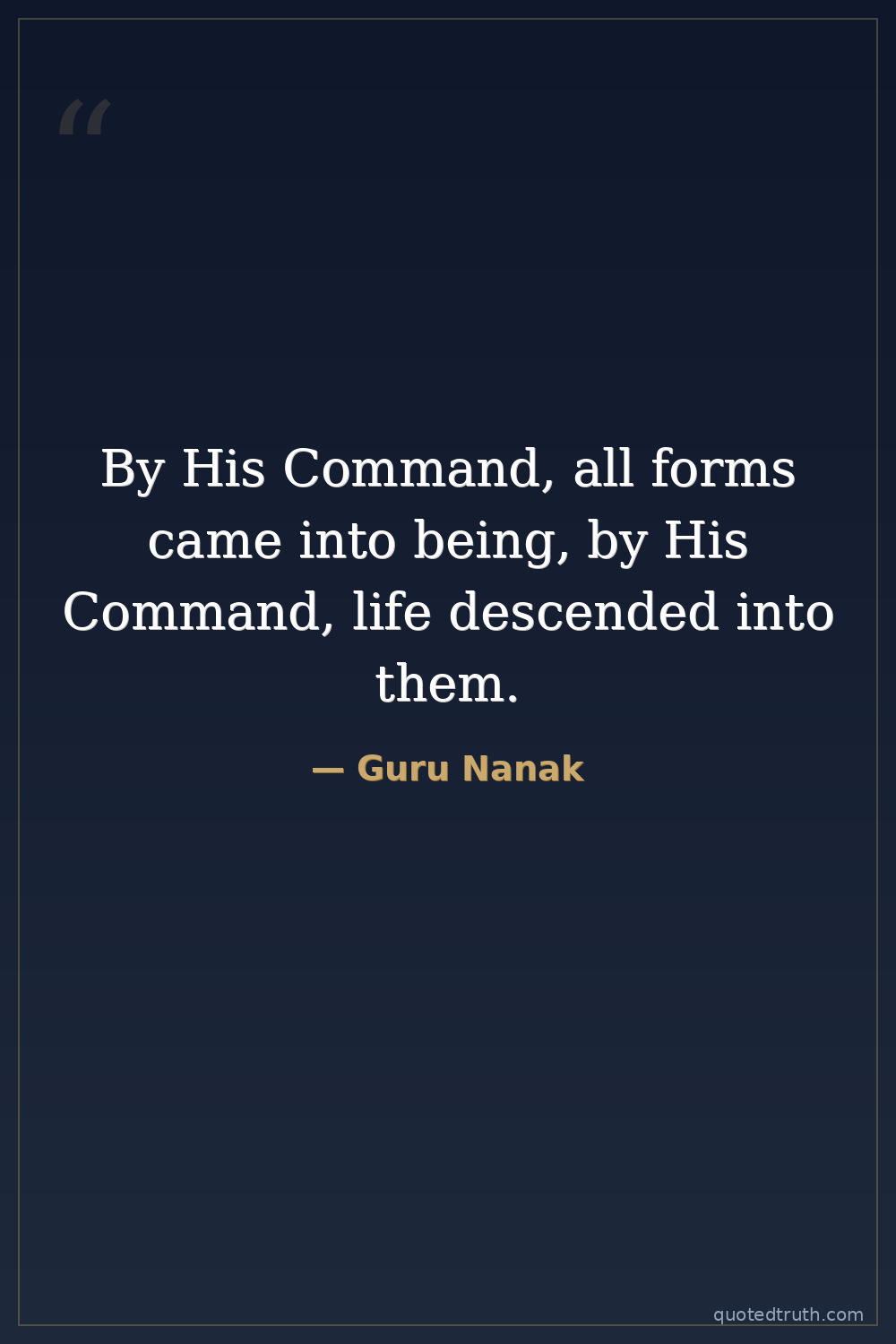
Guru Nanak — "By His Command, all forms came into being, by His Command, life descended into t…"
By His Command, all forms came into being, by His Command, life descended into them.
By His Command, all forms came into being, by His Command, life descended into them.
Click any product to generate a realistic preview. Up to 3 at a time.
* Initial load can take up to 90 seconds — revising the preview in another color is nearly instant.
"Why do you call her inferior, when from her, kings are born?"
"The world is a garden, and we are its gardeners; we must sow the seeds of truth and righteousness."
"The Dhoop (burnt incense), lamps and the Naivaed (an offering of eatables presented to deity or idol. All of them become false) by smell. (Then, O Rabb!) If Your Poojaa can be done only with these thi…"
"Even kings and emperors have vast riches and still they are not content. Probably because they can't find matching socks."
"Make mercy your mosque and devotion your prayer mat."
Founder of Sikhism and the first of the Ten Sikh Gurus, whose teachings of one universal God and rejection of caste shaped Punjab. Closely associated with Kabir (mystical poet whose verses appear in the Sikh Guru Granth Sahib). For an intellectual contrast, see Brahmanical orthodoxy, the Hindu caste-and-ritual establishment of his era — Sikhism was founded as a deliberate alternative to both Hindu ritual hierarchy and Islamic exclusivism — Nanak's universalism was a structural rejection of caste and priestly mediation.
Found in 1 providers: grok
1 source checked
Everything that exists—every shape, body, and creature—came into being through a single divine order, and the life inside them was placed there by that same command. Nothing arose on its own or by accident. The universe and the consciousness that animates it both answer to one underlying will. Creation is not random matter stumbling into life; it is form and spirit deliberately issued together from a source beyond human control.
Guru Nanak built Sikhism around Ik Onkar, the one formless Creator whose Hukam (command) orders all existence. As a poet-theologian who traveled across South Asia and the Middle East debating Hindu pandits and Muslim qazis, he rejected idol worship and caste-bound ritual in favor of direct surrender to this single will. This line, echoing his Japji Sahib, compresses his core teaching: matter and soul alike obey one command.
Nanak lived 1469–1539 in Punjab during the collapse of the Delhi Sultanate and the 1526 Mughal conquest under Babur, which he witnessed and lamented. Hindu and Muslim communities were locked in ritual rivalry, caste hierarchy, and forced conversions. Sufi and Bhakti movements were already preaching a personal, casteless God. Nanak's insistence that one Hukam governs all forms cut across both traditions, offering Punjabis a unifying theology amid political violence and sectarian fracture.
AI-generated insights based on extensive research and information for context. Factual errors? Email [email protected].
Your cart is empty