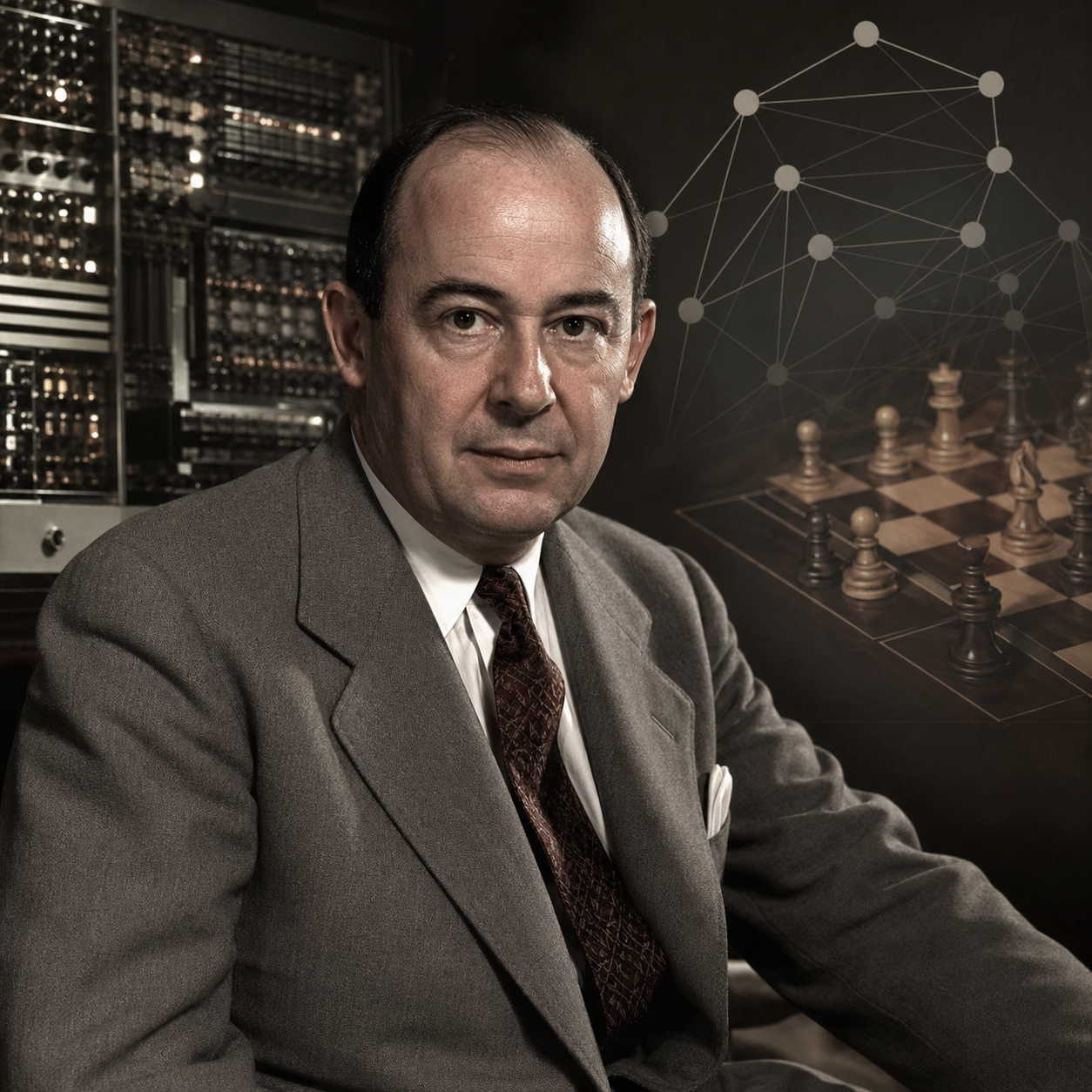
John von Neumann — "Computers are like humans - they do everything except think."
Computers are like humans - they do everything except think.
Computers are like humans - they do everything except think.
Click any product to generate a realistic preview. Up to 3 at a time.
* Initial load can take up to 90 seconds — revising the preview in another color is nearly instant.
"Technological possibilities are irresistible to man. If man can go to the moon, he will. If he can control the climate, he will."
"The only way to be sure of yourself is to be a little bit unsure."
"The world is so complicated that it cannot be described in any other way than by itself."
"The atomic bomb is a great invention. It is also a great danger."
"The world is not as simple as we would like it to be."
A concise statement on the capabilities and limitations of early computing machines.
Date: Mid-20th century (1947)
ShockingFound in 1 providers: gemini
1 source checked
Machines can execute calculations, process information, and follow instructions at extraordinary speed — but they don't generate original ideas, understand context, or reason from genuine comprehension. Execution and thought are fundamentally different. A computer performs exactly what it is programmed to do, no more. Genuine thinking requires consciousness, creativity, and judgment — qualities that computation mimics in appearance but lacks in substance, drawing a sharp line between mechanical processing and authentic intelligence.
Von Neumann designed the stored-program architecture underlying virtually every modern computer — he literally built what he critiqued. His work in game theory modeled rational human decision-making, deepening his grasp of the gap between strategic cognition and mechanical execution. Having created these systems at Princeton's Institute for Advanced Study and Los Alamos, he saw firsthand how ENIAC and its successors processed without comprehending, computed without conceiving.
Von Neumann worked during computing's birth — ENIAC launched in 1945 and stored-program machines emerged through the late 1940s. Alan Turing's 1950 paper 'Computing Machinery and Intelligence' ignited public debate about machine cognition. Cold War demands drove rapid computational advances, yet philosophers and scientists grappled with whether machines truly thought. His remark entered a world captivated by these machines yet deeply uncertain about the boundary between human intelligence and mechanical simulation.
AI-generated insights based on extensive research and information for context. Factual errors? Email [email protected].
Your cart is empty