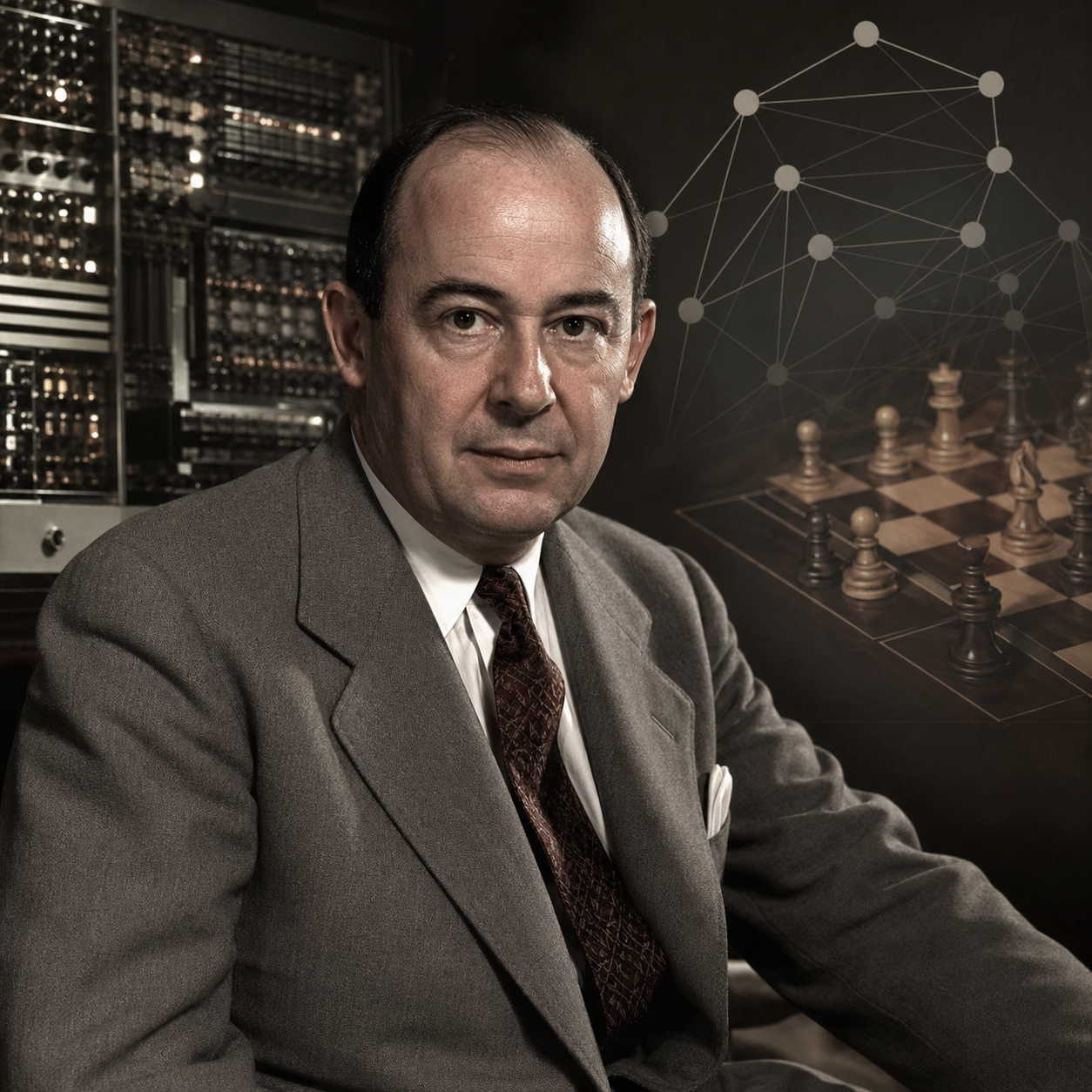
John von Neumann — "It is just as important to know what not to do as it is to know what to do."
It is just as important to know what not to do as it is to know what to do.
It is just as important to know what not to do as it is to know what to do.
Click any product to generate a realistic preview. Up to 3 at a time.
* Initial load can take up to 90 seconds — revising the preview in another color is nearly instant.
"If people do not believe that mathematics is simple, it is only because they do not realize how complicated life is."
"I'm told that the only difference between a mathematician and a physicist is that a mathematician thinks about mathematics and a physicist thinks about physics. And a physicist is always trying to get…"
"It is not a question of whether we will be able to build a computer that can think. It is a question of whether we will be able to build a computer that can think as fast as we do."
"Mathematics is a game played according to certain simple rules with meaningless marks on paper."
"It is just as foolish to complain that people are selfish and treacherous as it is to complain that the magnetic field does not increase unless the electric field has a curl. Both are laws of nature."
Found in 1 providers: grok
1 source checked
Knowing which paths to avoid, which options to eliminate, and which actions to skip is equally as valuable as knowing the right path forward. In any complex problem—whether engineering, strategy, or daily decisions—ruling out what doesn't work narrows the solution space and saves time. Negative knowledge is not the absence of knowledge; it is a form of wisdom that prevents wasted effort and costly mistakes.
Von Neumann's minimax theorem in game theory is built on this principle—optimal play means knowing which moves to avoid, not just which to make. His computer architecture deliberately excluded analog components and embraced the stored-program concept by ruling out alternatives. On the Manhattan Project, he determined which implosion geometries would fail, eliminating dead ends that saved years of research. His legendary efficiency stemmed from rapid elimination of wrong approaches.
Von Neumann worked during a period of explosive possibility and catastrophic risk—the Manhattan Project, early computing, and Cold War nuclear strategy. In each domain, wrong choices carried enormous costs: the wrong bomb design, the wrong computer architecture, the wrong geopolitical move. Game theory itself emerged partly to formalize when NOT to act in competitive situations. The era demanded rigorous negative reasoning as much as positive innovation.
AI-generated insights based on extensive research and information for context. Factual errors? Email [email protected].
Your cart is empty