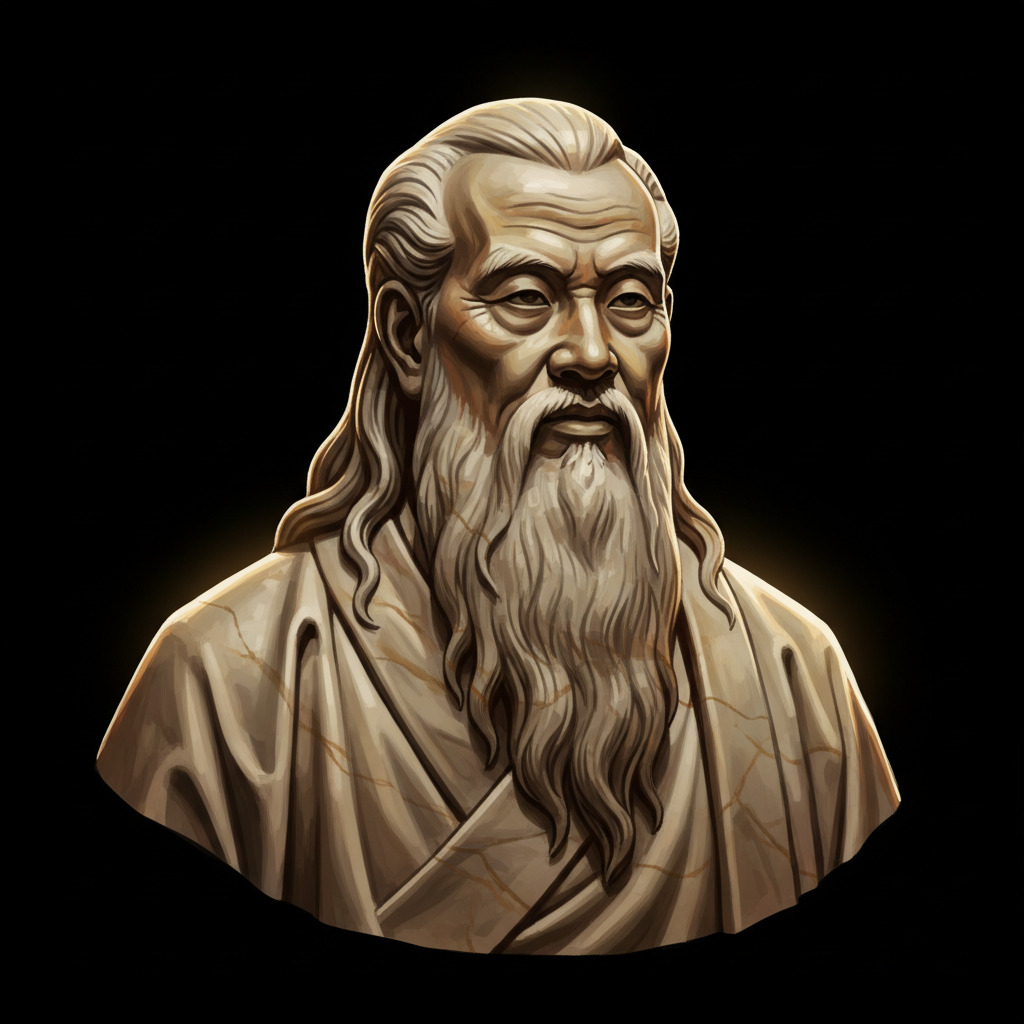
Laozi — "Deal with it before it happens. Set things in order before there is confusion."
Deal with it before it happens. Set things in order before there is confusion.
Deal with it before it happens. Set things in order before there is confusion.
Click any product to generate a realistic preview. Up to 3 at a time.
* Initial load can take up to 90 seconds — revising the preview in another color is nearly instant.
"He who boasts of his own achievements will not endure."
"Act without doing; work without effort."
"Simplicity, patience, compassion. These three are your greatest treasures."
"If a nation is to be great, it must be like a great river, it must flow freely in every direction."
"To yield is to be preserved whole. To be bent is to be straightened. To be empty is to be filled. To be worn out is to be renewed. To have little is to gain. To have plenty is to be perplexed."
Reputed founder of Taoism and author of the Tao Te Ching, whose wu wei (effortless action) shaped East Asian philosophy. Closely associated with Zhuangzi (later Taoist who extended Laozi's framework). For an intellectual contrast, see Confucius, near-contemporary Chinese sage of social ritual and duty — Confucius systematized social order through ritual and hierarchy; Laozi argued that all such systems were the disease, not the cure — the two founding poles of Chinese moral philosophy.
Found in 1 providers: gemini
1 source checked
Act on problems while they are still small and manageable, before they grow into crises. Organize systems and relationships before disorder takes hold, because intervening early requires far less effort than fixing something already broken. Prevention beats reaction. Tending to the seed of trouble is easier than uprooting the full-grown weed, and arranging structure in calm moments spares you the chaos of scrambling once confusion has already spread.
Laozi, the legendary archivist of the Zhou court and founder of Taoism, centered his teaching on wu wei—effortless action aligned with the natural flow of things. Working quietly among royal records, he observed how dynasties collapsed from neglected small matters. His Tao Te Ching repeatedly urges rulers and sages to address issues at their root, when intervention is subtle and cheap, reflecting his belief that mastery lies in sensing beginnings, not wrestling outcomes.
Laozi lived during the late Zhou dynasty (6th century BCE), as centralized authority crumbled into the Spring and Autumn period's endless feudal wars. States collapsed from mismanaged alliances, neglected grievances, and crises ignored until unstoppable. Amid this disorder, philosophers like Confucius and Laozi searched for how to restore harmony. Laozi's counsel to act early spoke directly to rulers watching their kingdoms unravel from problems that, caught sooner, could have been quietly resolved.
AI-generated insights based on extensive research and information for context. Factual errors? Email [email protected].
Your cart is empty