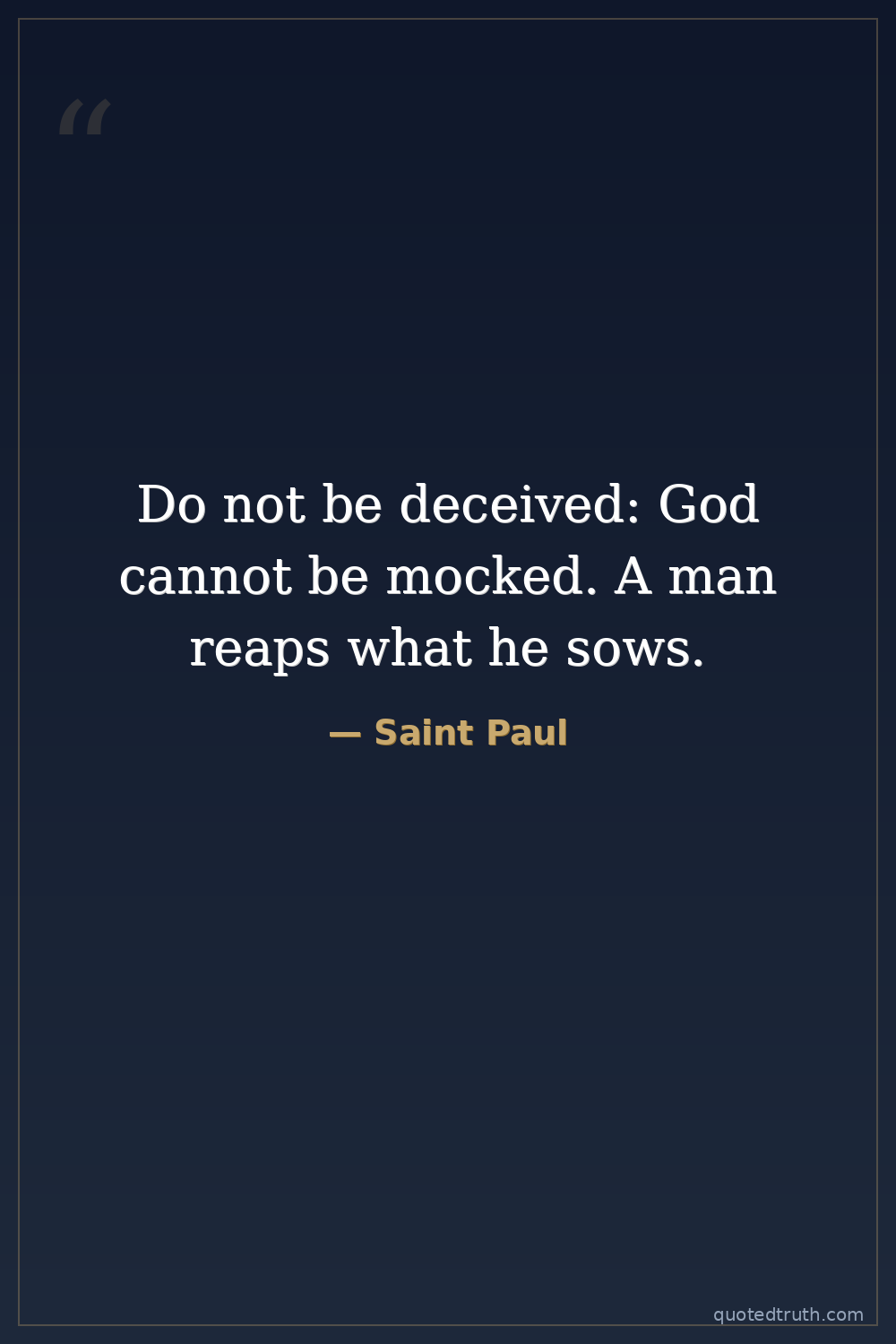
Saint Paul — "Do not be deceived: God cannot be mocked. A man reaps what he sows."
Do not be deceived: God cannot be mocked. A man reaps what he sows.
Do not be deceived: God cannot be mocked. A man reaps what he sows.
Click any product to generate a realistic preview. Up to 3 at a time.
* Initial load can take up to 90 seconds — revising the preview in another color is nearly instant.
"For in him we live and move and have our being."
"Submit to one another out of reverence for Christ."
"For I bear in my body the marks of the Lord Jesus."
"And unto the Jews I became as a Jew, that I might gain the Jews; to them that are under the law, as under the law, that I might gain them that are under the law; To them that are without law, as witho…"
"If then you have been raised with Christ, seek the things that are above, where Christ is, seated at the right hand of God."
Found in 1 providers: deepseek
1 source checked
Actions have consequences you cannot escape. Whatever you put into life—good or bad, honest or deceptive—eventually comes back to you in kind. You may fool other people, but the moral fabric of the universe keeps accurate accounts. Self-deception is the real danger here: pretending that selfish, cruel, or dishonest choices will not produce matching results. Character compounds over time, and the harvest always matches the seed.
Paul wrote this in his letter to the Galatians, a community he had personally founded and now feared was drifting into hypocrisy and factionalism. As a former Pharisee trained under Gamaliel, he knew Jewish agricultural imagery intimately. His own dramatic reversal on the Damascus road taught him that a life spent persecuting believers reaped consequences, and he staked his apostleship on the principle that grace never cancels moral accountability.
First-century Galatia was an agrarian Roman province where sowing and reaping were literal daily realities, not metaphors. Greco-Roman religion treated gods as transactional—bribe them with sacrifices, flatter them with rituals, and escape punishment. Paul was writing around 50 CE to confront that mindset inside the young church, where some taught that circumcision or ritual compliance let people bypass ethical transformation. His farming image cut through legal loopholes with unavoidable natural law.
AI-generated insights based on extensive research and information for context. Factual errors? Email [email protected].
Your cart is empty