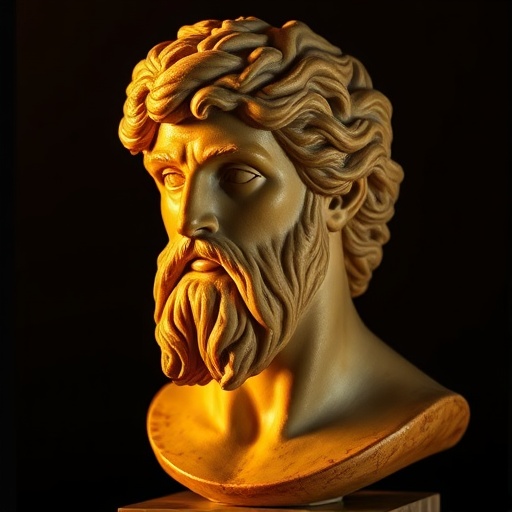
Pythagoras — "Don't put a god's image on a ring."
Don't put a god's image on a ring.
Don't put a god's image on a ring.
Click any product to generate a realistic preview. Up to 3 at a time.
* Initial load can take up to 90 seconds — revising the preview in another color is nearly instant.
"Don't keep clawed birds."
"Number is the within of all things."
"Choose always the way that seems the best, however rough it may be; custom will soon render it easy and agreeable."
"The square of the hypotenuse of a right-angled triangle is equal to the sum of the squares of the other two sides."
"Choose rather to be strong of soul than strong of body."
Greek philosopher and mathematician whose school in Croton combined geometry (the Pythagorean theorem), number-mysticism, and a religious-vegetarian way of life. Closely associated with Thales of Miletus (earlier pre-Socratic and the first philosopher). For an intellectual contrast, see Heraclitus, pre-Socratic Greek philosopher of flux — Heraclitus called Pythagoras 'the chief of swindlers' — among the founding insults of the philosophical-rivalry tradition. Their 'all is flux' vs 'all is number' poles still organize the philosophy of mathematics today (Platonist vs anti-realist).
A Pythagorean 'Symbol', likely a prohibition against idolatry or misuse of divine symbols.
Date: c. 570-495 BCE (interpreted later)
WisdomFound in 1 providers: gemini
1 source checked
Don't trivialize the sacred by turning it into an everyday accessory. This rule warns against reducing the divine to mere decoration — something worn casually, traded, or shown off. The sacred deserves genuine reverence, not casual familiarity. When you engrave a god's face on a ring, you transform worship into fashion and the profound into the portable. Keep holy things holy; don't commodify what deserves deep respect.
Pythagoras founded a religious brotherhood governed by strict lifestyle rules called akousmata — cryptic sayings his followers obeyed literally. He believed numbers held divine properties and that the cosmos was ordered by sacred mathematical ratios. This taboo fits his worldview perfectly: the divine should be approached through disciplined study and ritual purity, not casual display. He treated everyday life as spiritual practice where even small acts either honored or degraded the sacred.
In 6th-century BCE Greece, signet rings engraved with gods like Zeus, Hermes, and Athena were ubiquitous — used to seal documents, worn as status symbols, and circulated through commerce. Divine images appeared on coins, pottery, and household objects constantly. Pythagoras's rule challenged this normalization, insisting gods were not decorative motifs or status tokens. In a polytheistic culture saturated with divine imagery, demanding deliberate restraint was a radical counter-cultural stance.
AI-generated insights based on extensive research and information for context. Factual errors? Email [email protected].
Your cart is empty