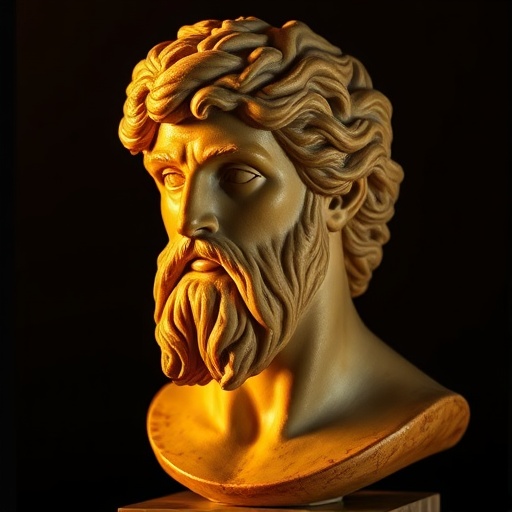
Pythagoras — "In no way neglect the health of your body; But give it drink and food in due mea…"
In no way neglect the health of your body; But give it drink and food in due measure, and also the exercise of which it has need.
In no way neglect the health of your body; But give it drink and food in due measure, and also the exercise of which it has need.
Click any product to generate a realistic preview. Up to 3 at a time.
* Initial load can take up to 90 seconds — revising the preview in another color is nearly instant.
"Do not cut your nails on holy days."
"Don't sit on a bushel."
"Do not break bread."
"Let no one persuade you by word or deed to do or say whatever is not best for you."
"All things are numbers."
Greek philosopher and mathematician whose school in Croton combined geometry (the Pythagorean theorem), number-mysticism, and a religious-vegetarian way of life. Closely associated with Thales of Miletus (earlier pre-Socratic and the first philosopher). For an intellectual contrast, see Heraclitus, pre-Socratic Greek philosopher of flux — Heraclitus called Pythagoras 'the chief of swindlers' — among the founding insults of the philosophical-rivalry tradition. Their 'all is flux' vs 'all is number' poles still organize the philosophy of mathematics today (Platonist vs anti-realist).
Practical advice on health and moderation from the 'Golden Verses'.
Date: c. 570-495 BCE
WisdomFound in 1 providers: gemini
1 source checked
Don't ignore your physical health. Consume food and water in balanced amounts—not too much, not too little—and make sure your body gets regular physical activity. True wellness requires discipline: neither overindulgence nor deprivation. The body needs consistent, measured care to function properly. This is a practical prescription for sustainable health through moderation in diet and deliberate exercise rather than excess or neglect.
Pythagoras founded a strict philosophical community in Croton with rigorous dietary codes—members followed vegetarianism, avoided certain foods, and practiced physical discipline. He believed the body and soul were interconnected, and that bodily purity supported intellectual and spiritual clarity. His brotherhood's lifestyle regimens reflected this conviction. For Pythagoras, mathematics and philosophy weren't purely abstract; cultivating a disciplined, healthy body was inseparable from pursuing wisdom.
In 6th-century BC Greece, formal medicine was primitive—Hippocrates wouldn't codify humoral theory for another century. Yet Greeks valued physical excellence deeply: the Olympic Games celebrated athletic bodies, and city-states trained citizens militarily. Disease was often attributed to divine displeasure or imbalance. Pythagoras's advice to measure food, drink, and exercise represented a rational, philosophical approach to health at a time when such systematic thinking was genuinely revolutionary.
AI-generated insights based on extensive research and information for context. Factual errors? Email [email protected].
Your cart is empty