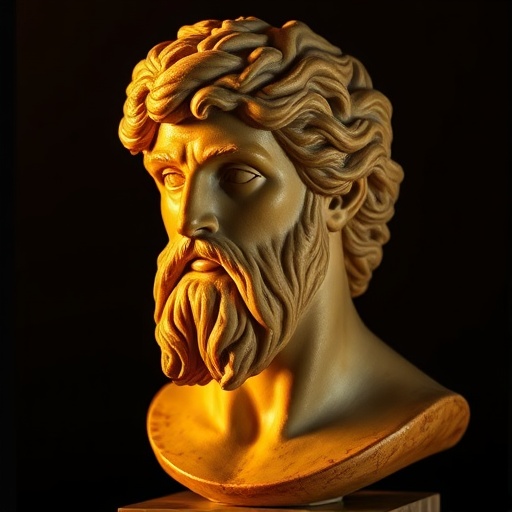
Pythagoras — "Don't sit on a bushel."
Don't sit on a bushel.
Don't sit on a bushel.
Click any product to generate a realistic preview. Up to 3 at a time.
* Initial load can take up to 90 seconds — revising the preview in another color is nearly instant.
"The highest good is the purification of the soul."
"Power is the near neighbour of necessity."
"Do not look in a mirror by lamplight."
"Number is the ruler of forms and ideas, and the cause of gods and daemons."
"Leave not a trace of the pot in the ashes."
Greek philosopher and mathematician whose school in Croton combined geometry (the Pythagorean theorem), number-mysticism, and a religious-vegetarian way of life. Closely associated with Thales of Miletus (earlier pre-Socratic and the first philosopher). For an intellectual contrast, see Heraclitus, pre-Socratic Greek philosopher of flux — Heraclitus called Pythagoras 'the chief of swindlers' — among the founding insults of the philosophical-rivalry tradition. Their 'all is flux' vs 'all is number' poles still organize the philosophy of mathematics today (Platonist vs anti-realist).
A Pythagorean 'Symbol', interpreted by Diogenes Laertius as 'keep both today and the future in mind since a bushel is a daily ration'.
Date: c. 570-495 BCE (interpreted 3rd century CE)
WisdomFound in 1 providers: gemini
1 source checked
Don't hide your abilities, hoard your gifts, or let your potential sit idle. A bushel measures grain — a daily provision meant to circulate, not be blocked. Sitting on it means suppressing what should flow outward. Act on your talents, share what you know, and don't let comfort or timidity bury what you're capable of doing or contributing.
Pythagoras founded a brotherhood in Croton built around shared intellectual life and transmitted wisdom. He taught that mathematical truths — harmony, number, proportion — were universal and obligated to be discovered and passed on. His akousmata, cryptic symbolic rules for disciples, consistently pushed against hoarding and passivity. This saying directly mirrors his conviction that a mind capable of insight has a duty to use and share it, not guard it.
In 6th-century BCE Magna Graecia, a bushel (choinix) was a standard daily grain ration — survival itself measured and allocated. Knowledge was similarly rationed, held by priestly and aristocratic classes who guarded it as power. Pythagorean communities in Croton challenged this by forming schools where initiated members shared learning collectively. Against a world where wisdom was deliberately withheld from ordinary people, this saying carried a pointed, countercultural charge.
AI-generated insights based on extensive research and information for context. Factual errors? Email [email protected].
Your cart is empty